


A sperm whale can hold its breath for over an hour and drop nearly 2,250 metres below the surface — deeper than the height of seven Eiffel Towers stacked end to end — on a single lungful of air. It hunts in absolute blackness, chasing squid across a zone of the ocean where sunlight has been absent for hundreds of metres, and it does so with a head that accounts for roughly a third of its body length, containing a waxy substance called spermaceti. A temperature-controlled buoyancy role has been proposed, but should not be described as an established explanation of each dive.
The physics of that dive is one of the most extreme feats in vertebrate biology.
The waxy engine in the head
Spermaceti is the substance whalers hunted for centuries, believing at first that the milky liquid pooled inside the head of the animal was its semen — hence the name. It isn’t. It’s a chamber of specialised fatty tissue and oil, occupying the top half of the skull, that can shift between liquid and semi-solid states depending on temperature and pressure.
A 1978 study by Malcolm Clarke proposed that temperature-dependent changes in spermaceti density could contribute to buoyancy control. It explicitly presented this as a hypothesis. The physical properties of oil samples are not direct observations of a living whale cooling and reheating its head on every dive.
The head’s role in sound production and echolocation is central to hunting. Calling it a demonstrated heat-controlled ballast tank overstates the evidence.
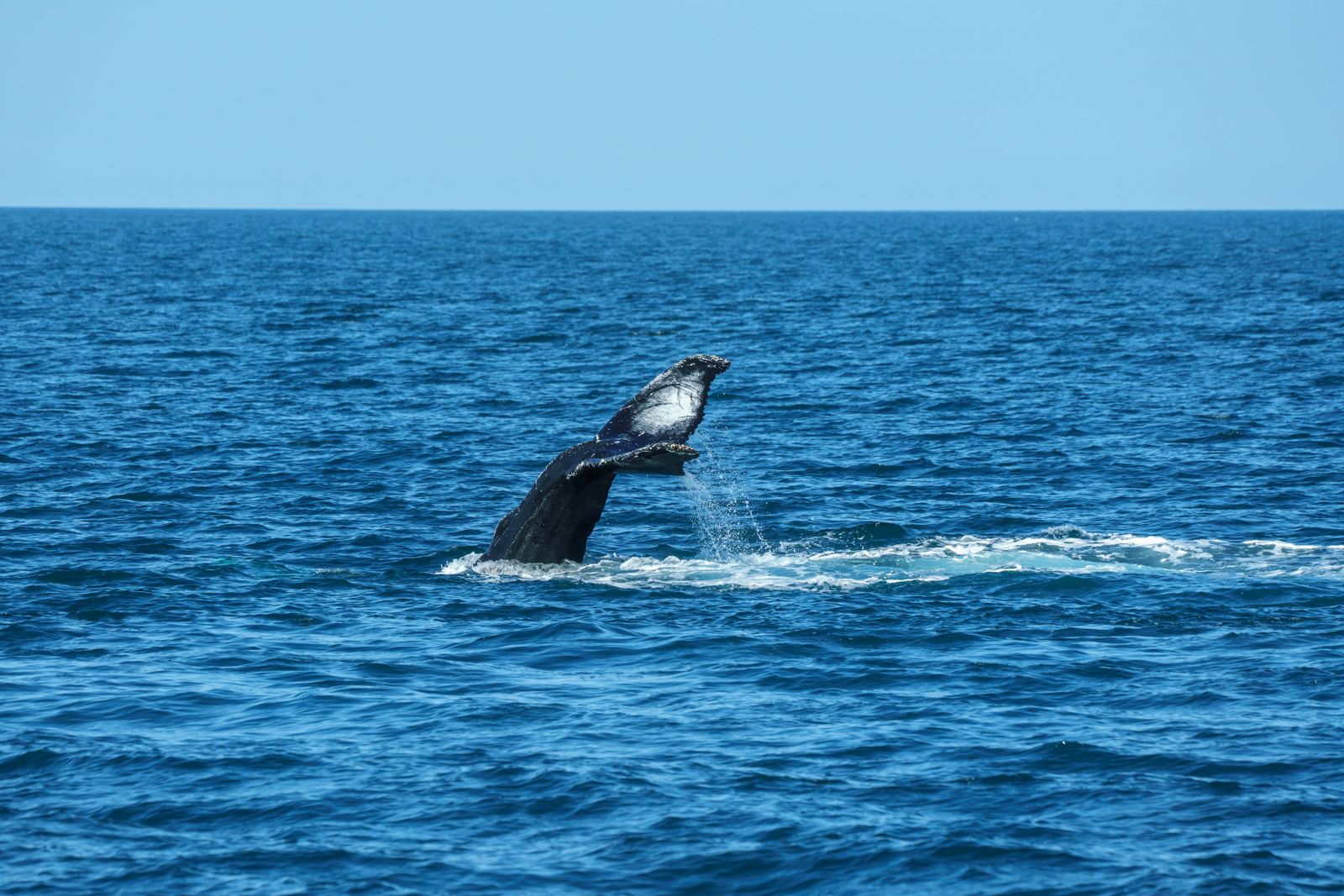
How deep is 2,250 metres, really
To picture the depth: the wreck of the Titanic sits at about 3,800 metres. Sperm whales make deep foraging dives, but maximum depths should not be described as routine. Research on western North Atlantic dive behaviour documents a range of depths and behaviours rather than a fixed near-2,250-metre routine. That’s beyond the crush depth of most military submarines. The pressure there is roughly 225 times atmospheric pressure at the surface, far beyond conditions an unprotected human can safely endure.
Diving mammals have specialised respiratory and circulatory adaptations. Their ability to tolerate pressure should not be explained by saying a human ribcage would instantly collapse or that nitrogen cannot enter a whale’s bloodstream.
Oxygen storage in the muscles, not the lungs
A sperm whale doesn’t hold its breath the way a human does. Its oxygen supply is not limited to air in the lungs; blood and muscle stores are important. Most of the oxygen it carries down is bound to myoglobin in its muscles — the same protein that gives red meat its colour, but present at concentrations so extreme that sperm whale muscle tissue is almost black. The myoglobin in these animals allows the molecules to be packed at densities that would be toxic in any land mammal.
The heart rate slows to a handful of beats per minute. Blood flow is shunted away from the extremities and toward the brain and vital organs. The spleen releases stored red blood cells, boosting oxygen-carrying capacity — the same reflex that lets elite human apnoeists exceed static breath-holds of ten minutes, only turned up to a scale no human physiology could survive.
Hunting in total darkness
Below 200 metres, sunlight effectively ends. Below 1,000 metres, the ocean is black. And yet sperm whales find their prey — mostly deep-sea squid, including the giant squid Architeuthis and the even larger colossal squid — by producing the loudest sound ever recorded from a biological source.
The spermaceti organ isn’t only a ballast. It’s a biological sonar transmitter. Air is forced through a structure called the museau de singe (“monkey’s muzzle”) at the front of the head, generating a click that reverberates through the oil-filled chamber and is focused into a directed beam. The clicks reach around 230 decibels underwater — loud enough, as Smithsonian Magazine has documented, that some researchers have hypothesised the whale may briefly stun its prey with sound.
Each click is a ping. The whale listens for the echo, builds a three-dimensional acoustic image of the surrounding water, and homes in on squid it has never seen and never will. In the deep, sight is useless. Sound is everything.

The click that became a language
Those clicks aren’t only for hunting. Near the surface — during the brief windows when sperm whales rest between dives — the same clicking apparatus is used for something that looks a great deal like conversation. Sperm whales produce short, patterned bursts of clicks called codas. Different whale families use different coda dialects. The clicks travel between animals often pressed head-to-head, which is roughly the whale equivalent of leaning in close to talk about a book.
An international team of linguists and marine biologists has reported that sperm whale codas contain what look like phonetic vowels — sound elements that can be lengthened, shortened, or shifted in tone in ways that parallel human languages like Mandarin, Latin, and Slovenian. Researchers identified 156 unique click patterns in one Caribbean community alone.
Researchers have noted that sperm whale calls initially seem like an entirely alien intelligence, but closer analysis reveals surprising similarities to human communication patterns.
Project CETI founder David Gruber has observed that sperm whales may have been transmitting information across generations for millions of years, and that modern tools are finally allowing humans to detect the complexity that has always existed in whale communication.
Ten minutes at the surface, fifty below
Between dives, the whale surfaces for roughly ten minutes. It breathes. It socialises. It rests, drifting tail-down in the brief, vertical way sperm whales sleep, before the pod stirs and moves again.
Then the animal angles downward for another dive. Changes in body buoyancy, oxygen use and physiology must be distinguished from the proposed spermaceti-temperature mechanism. Somewhere in the black water below, a squid is moving, and a beam of focused sound is already reaching for it.
The head as a weapon
The same anatomy that lets a sperm whale dive and hunt also, apparently, lets it fight. In 2026, a University of St Andrews team published the first known footage of sperm whales headbutting one another — a behaviour long speculated about in the literature and immortalised in Herman Melville’s Moby-Dick, where the white whale rams and sinks a ship. Reported in the journal Marine Mammal Science, the footage suggests the reinforced spermaceti-filled skull functions, among other things, as a battering ram.
Melville was writing in 1851, working from whaler accounts of ships genuinely sunk by ramming sperm whales — the Essex, in 1820, being the most famous. Footage of whales headbutting one another does not independently verify every historical account of whales ramming ships.
Predators of the deep, prey at the surface
For all their size — adult males can reach 18 metres and weigh up to 50 tonnes — sperm whales aren’t invulnerable. Their smaller cousin, the pygmy sperm whale, has been filmed being hunted by orca pods off Madeira, a predatory interaction National Geographic documented as never before seen in that region. The pygmy species shares much of the same deep-diving anatomy but at a fraction of the scale.
Full-grown sperm whales have essentially one natural predator: coordinated groups of orcas, which occasionally attack calves or weakened adults. Everything else in the deep — the giant squid included — is prey.
The scale of a life
A sperm whale lives for roughly 60 to 70 years. Across that span, it will make hundreds of thousands of dives. It will produce clicks by the millions. It will travel enough kilometres to circle the planet many times over. It will spend the overwhelming majority of its life in darkness, in cold, at pressures that would kill anything that walks on land, hunting animals most humans will never see.
And every 50 minutes or so, it will come back up. It will float at the surface with its family, exchange a few clicks, and then tip its enormous head downward, begin another dive into the black.
Correction, 3 October 2026: The earlier article presented cooling and reheating spermaceti as a proven ballast mechanism and maximum depths as routine. The buoyancy explanation is now identified as a hypothesis and the depth claim has been qualified.
