At weather stations scattered across the interior of Chile’s Atacama Desert, the rain gauges have sat empty for so long that some meteorological records show years, even decades, of continuous zeros. The instruments work. The technicians visit. The pages are turned. The number does not change.
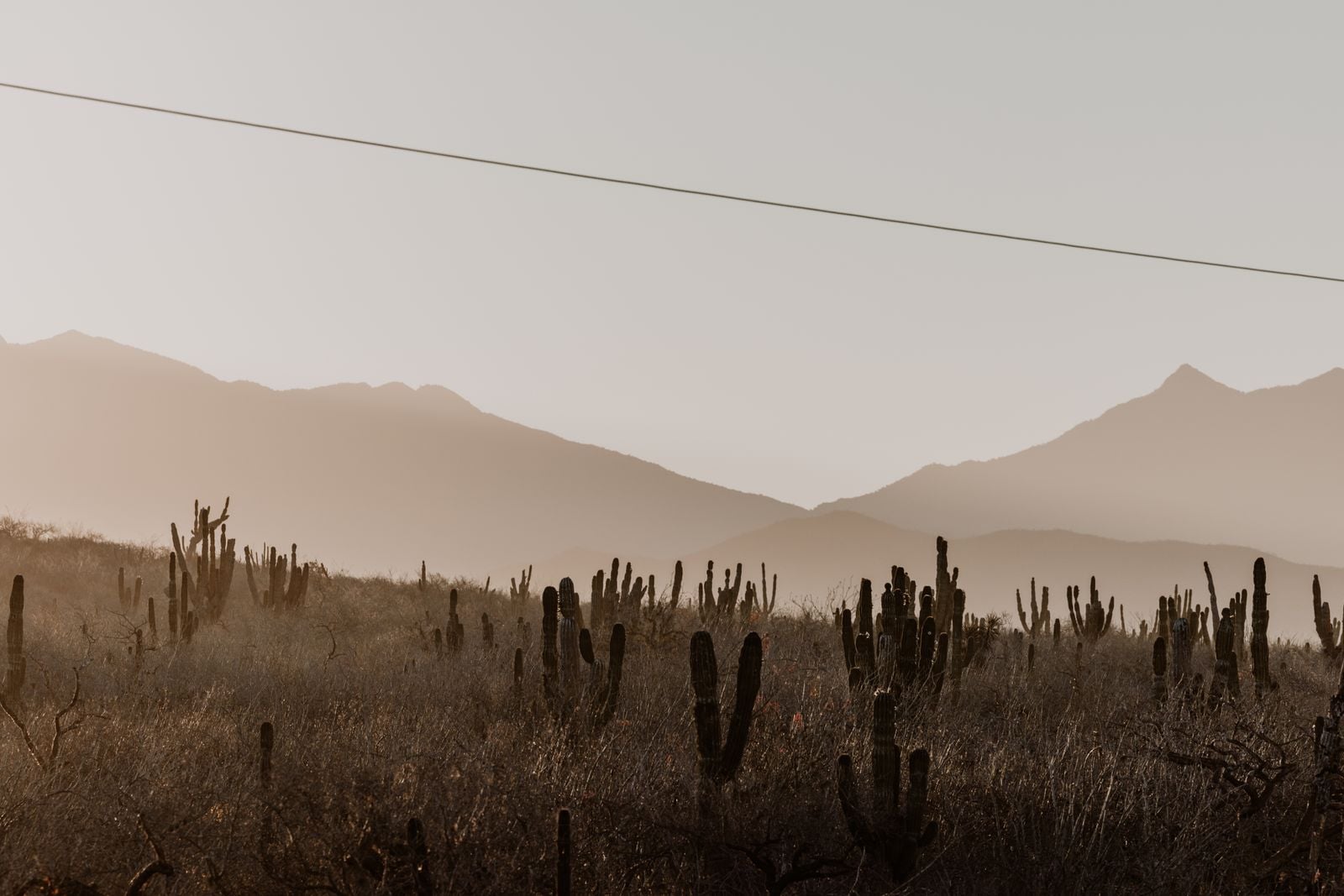
And yet the desert is not lifeless. Cacti stand in ranks along ridges that have never been watered from above. Lichens the colour of oxidised copper crust the north-facing rocks. Something is keeping them alive, and it is not rain.
It is fog. A specific, named fog. The locals call it camanchaca — a thick marine mist that rolls off the cold Humboldt Current, climbs the coastal escarpment at dawn, and drapes itself across the lower slopes before the sun burns it off by mid-morning. The lichens drink it. The cacti drink it. Entire ecosystems in the driest place on Earth have evolved to pull water directly out of the air.
The driest place, measured
The Atacama stretches down the northern spine of Chile, wedged between the Pacific and the Andes. According to reporting from Forbes on the region, average annual rainfall across the desert works out to less than half an inch. In some interior basins, precipitation is measured in millimetres per decade rather than per year.
The dryness is not accidental. Three geographic conspiracies stack on top of one another. The Andes to the east block moisture arriving from the Amazon. The cold Humboldt Current offshore chills the air above the Pacific, suppressing evaporation and cloud formation. And a persistent subtropical high-pressure system sits over the region, driving sinking air that dries out whatever moisture manages to sneak through.
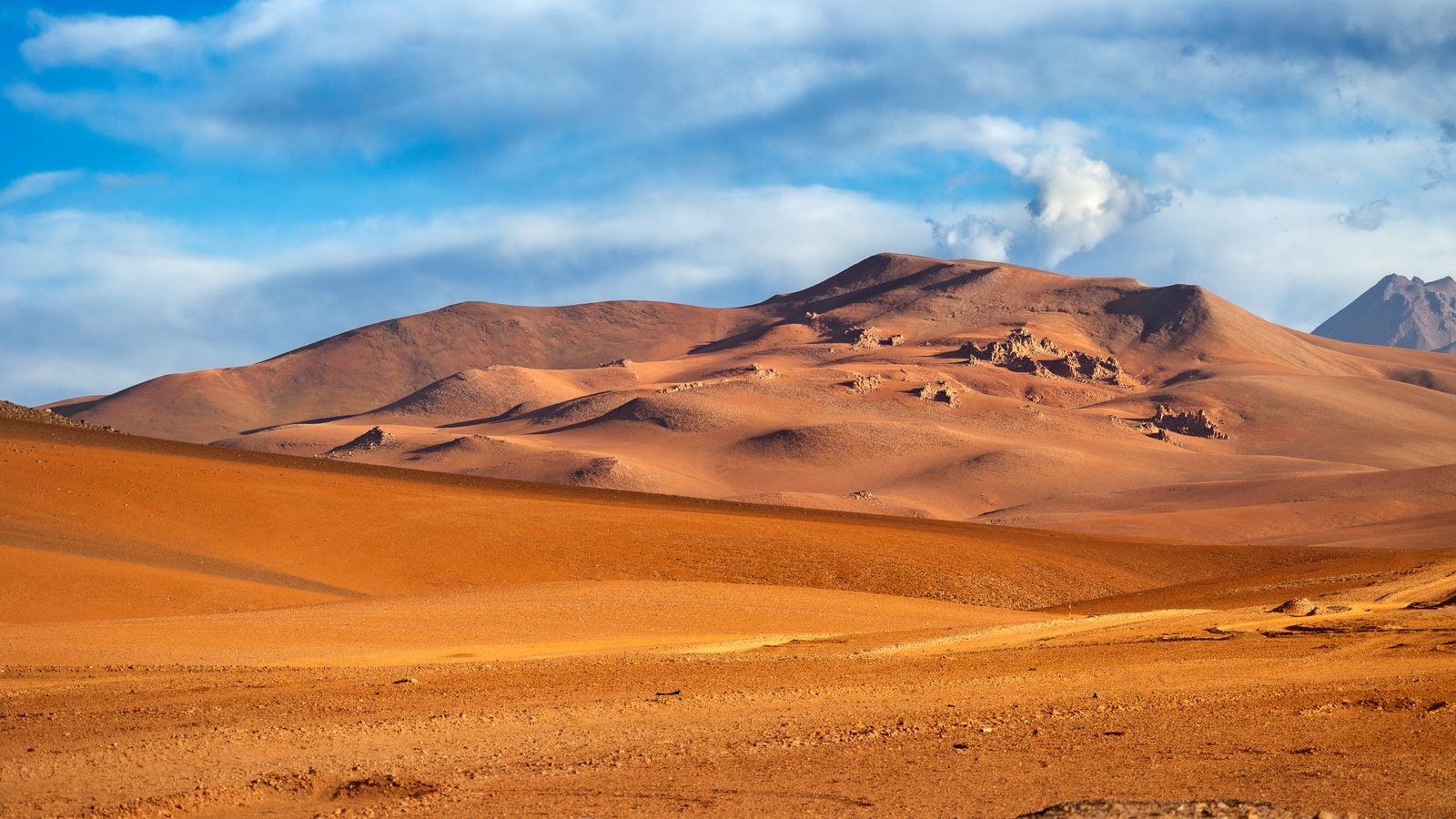
The result is a place scientists reach for when they need a stand-in for Mars. Soils are salty and oxidising. The region experiences extreme UV radiation at ground level. The planetary science literature uses the Puna de Atacama as one of the closest terrestrial analogues to the Martian surface available for field work.
What camanchaca actually is
Just before sunrise on the coastal side of the desert, something starts to happen in the fog belt. The chilled marine air, saturated with moisture it cannot hold, meets the warmer air rising off the escarpment. A thick, low stratocumulus layer forms — dense enough to hide a person standing ten feet away.
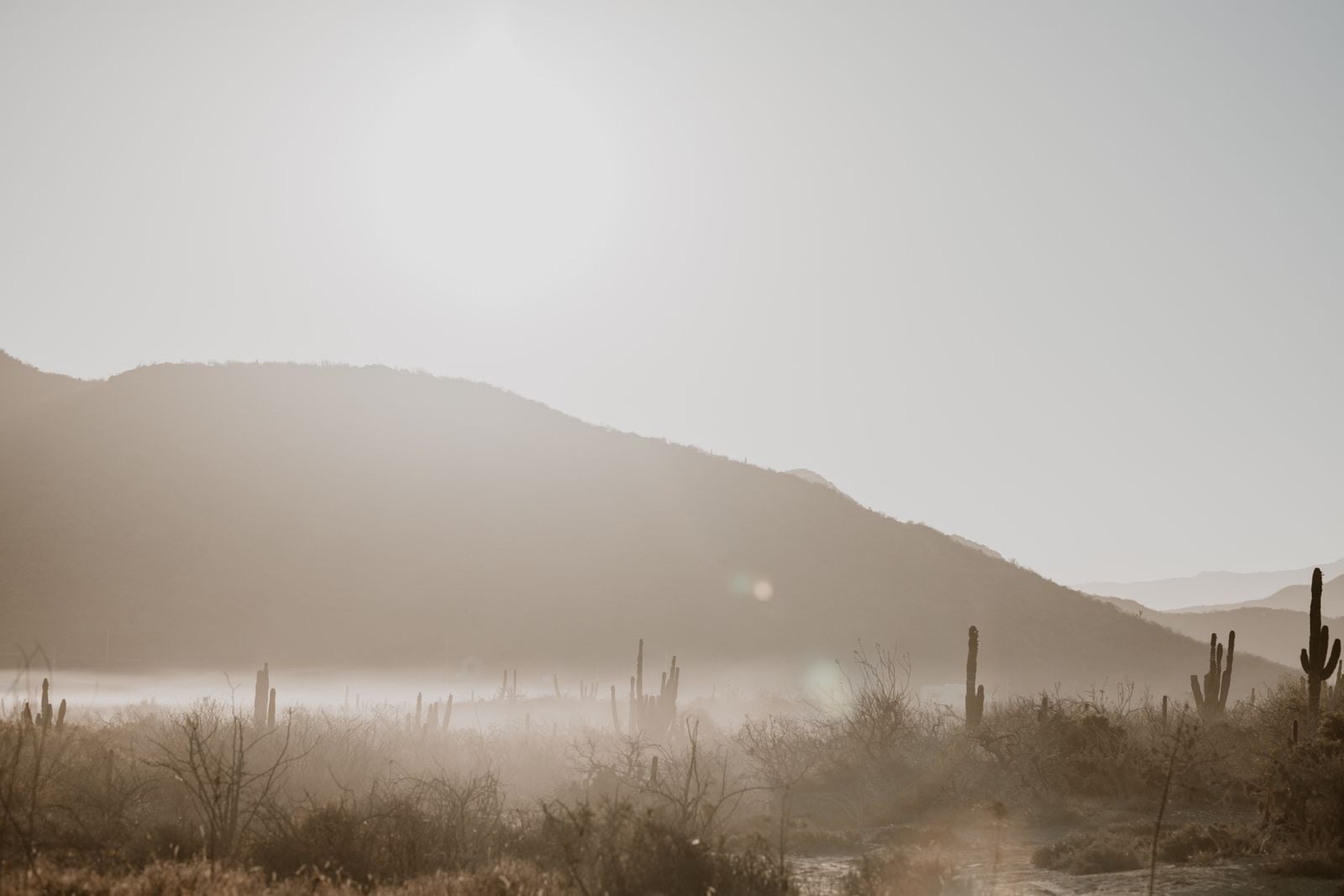
The camanchaca fog can be so dense it obscures visibility to just a few feet. Accounts from the region describe the camanchaca blowing in from the Pacific every morning at dawn, tantalising the northern desert with moisture it never manages to release as rain.
Instead, the water hangs suspended. Individual droplets are microscopic — too small to fall, too small even to feel. They drift horizontally on the wind, past the rocks, past the cacti, past the lichen mats, and unless something intercepts them, they simply evaporate again by 10 a.m.
What the desert has evolved, and what humans have recently imitated, is the art of interception.
How a lichen drinks a cloud
Lichens are the quiet virtuosos of the fog belt. They are composite organisms — a fungus married to an alga, sometimes with a cyanobacterium as a third partner — and they have no roots, no vascular system, and no meaningful way to store water long-term. What they do have is surface area. Enormous amounts of it, folded into thalli that behave like sponges pressed against the wind.
When camanchaca rolls in, the lichen thallus absorbs moisture directly through its outer layer within minutes. Photosynthesis, dormant through the dry hours, switches back on. The alga inside starts fixing carbon. This might last two or three hours before the fog burns off and the lichen dehydrates again into brittle dormancy, waiting for tomorrow.
The colonies that carpet the coastal cordillera in species like Roccella and Ramalina are among the densest lichen communities anywhere on the planet, and many species there exist nowhere else. These lichen colonies persist in zones with no recorded rainfall, running their entire life cycles on fog alone.
The cacti that catch water with spines
The cacti of the fog belt take a different approach. Their spines are not just defensive. They are condensers.
Each spine presents a cool, narrow surface to the passing fog. Droplets accumulate on the spine, coalesce into larger drops, and slide down toward the base of the plant, where they drip onto soil directly above the shallow root network. A mature cactus can harvest a measurable volume of water per fog event this way. The cactus never touches rain in its entire life. It drinks what its own architecture combs out of the sky.
Some populations have gone further and evolved to face specific directions. Colonies on the coastal ridges tilt toward the prevailing fog wind, presenting the maximum spine surface to the incoming camanchaca. From a distance, entire hillsides of cacti appear to be leaning into the Pacific.
Humans learned late, and copied
The lichens and the cacti figured this out over millions of years. Humans arrived later with large-mesh fog collectors — vertical nets, typically made of polypropylene, strung between poles on ridges where the camanchaca reliably passes.
The mesh does exactly what a cactus spine does, at a larger scale. Fog droplets hit the fibres, coalesce, slide down into a gutter at the base, and run through a pipe into a storage tank. A well-sited collector can produce substantial volumes of clean water per foggy day. Villages along the northern Chilean coast that have no groundwater and no rain have run on fog harvest for years.
Communities in the northern Chilean coastal region became case studies in fog harvesting. The technology has since been exported to Morocco, Peru, Nepal, and the highlands of Ethiopia — anywhere a cold current meets a warm coast and a reliable marine layer forms.
Why the sky above stays clear
The fog is a coastal phenomenon. Push inland, past the coastal cordillera and onto the high plateau, and the atmosphere changes character entirely. The camanchaca does not make it over the ridge. What remains above is the clearest, driest, most stable air on the planet — which is why the Atacama has become the global capital of ground-based astronomy.
The Atacama Large Millimeter Array, ALMA, sits on the Chajnantor plateau. According to the same Forbes account of the region, the array of radio telescopes achieves remarkable sensitivity for observing cold dust rings around forming stars. The dryness that starves the lichens of rain is the same dryness that lets astronomers see deep into space.
The sky over the Atacama is dark enough that light pollution has become a genuine conservation concern. Lighting designer Paulina Villalobos, who grew up in the region, has spent years working on regulations to protect the darkness itself — a resource as scarce and as valuable, in its way, as the water in the fog.
A flower that only appears when it rains
Once every few years, moisture delivers enough water to the southern Atacama to trigger something called the desierto florido — the flowering desert. Seeds that have been sitting dormant in the soil for a decade or more germinate within days. Hillsides that were bare rock turn purple, pink, and yellow with flowers.
One of them is the pata de guanaco, a small fuchsia bloom. The plant has attracted attention for its extreme drought tolerance. The strategies these organisms use to survive without rain sit alongside some of the strangest biology on the planet. Tardigrades survive by dehydrating themselves into a glassy dormancy and waiting years for water to return — a strategy the Atacama lichens have converted from an emergency measure into a daily rhythm.
What the empty gauges actually mean
A weather station that has never recorded rain is a strange piece of scientific evidence. It is a negative result, extended across the working lifetime of every meteorologist who ever visited the site. Some stations in the Yungay region of the central Atacama, studied by NASA astrobiologists in the early 2000s, produced soil samples so dry and so oxidised that they contained fewer viable microbes than samples returned from the Antarctic Dry Valleys.
And yet, a hundred kilometres away on the coast, the fog belt is one of the more biologically productive fog ecosystems on Earth. The gap between the two — a place where nothing lives and a place where entire endemic communities thrive on airborne water — is separated by a single ridge line and an accident of wind direction.
Fog, at ground level
The visitors who arrive in San Pedro de Atacama in growing numbers — the tourist economy of the town has expanded rapidly, as visiting students have observed — mostly experience the desert as a place of dry heat and Martian vistas. The camanchaca happens elsewhere, on the coastal cordillera, before dawn, and it is gone by breakfast.
To see it, you have to be standing on a ridge above the Pacific at 5 a.m., in a cold wet grey that soaks your clothes and hides the sea. Fog beads on eyelashes. Lichens, dry and brittle the night before, are already darkening as they absorb water. The cacti, if you look closely, have single droplets suspended at the tips of their spines, catching the first grey light.
By ten o’clock the sun will have burned it all off. The lichens will be brittle again. The spines will be dry. The rain gauges, further inland, will register their unbroken zero for one more day. And the desert will wait, as it has waited for decades of measurement, for the fog to come back tomorrow.