


Yang Zhifa was digging through the dry March soil near Xi’an when his shovel hit something hard that wasn’t a rock. It was a clay head. Yang and his neighbours had been hired to sink a well during a drought year. The well never got finished. What they had opened was part of a buried military world, thousands of soldiers, horses, and chariots arranged in battle formation, sealed underground for more than two millennia.
The discovery was made in March 1974. The emperor whose tomb complex Yang’s shovel had just punctured had died in 210 BCE.
A well in the wrong place
The drought in Lintong County that spring was severe enough that villagers needed a new water source. Yang and the other farmers picked a spot at the foot of Mount Li, in a field where villagers had for generations turned up odd shards of fired clay while ploughing. Local lore treated the fragments as strange and unlucky. People reburied them. Some smashed them. Nobody connected them to anything larger.
Several metres down, the shovels stopped working through earth and started scraping against something fired and hollow. The men pulled up fragments first, including body parts and a head with human features. Some of what came out of the ground was discarded before anyone understood its importance. Yang eventually took fragments to the county cultural office, where the archaeologist Zhao Kangmin recognised that the pieces belonged to something far larger than a village curiosity.
Zhao helped gather and reconstruct the fragments. The well was abandoned. The field around it would soon stop being an ordinary farming plot.
The emperor who wanted an army for the afterlife
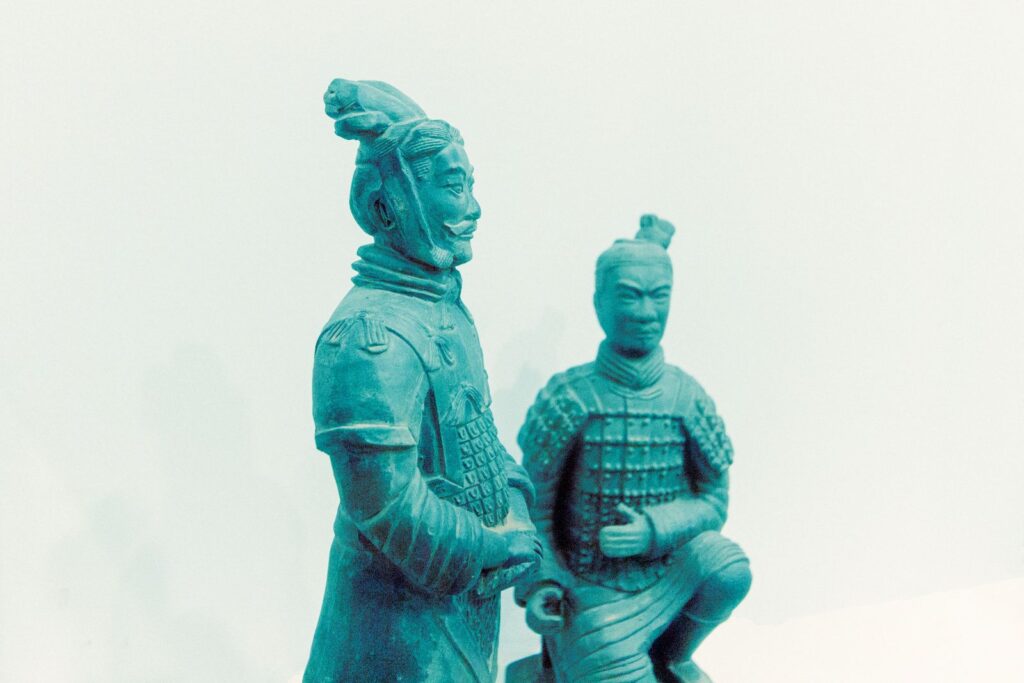
The tomb complex belonged to Qin Shi Huang, the ruler who unified the warring Chinese states in 221 BCE and gave the country its enduring name. He standardised the writing system, the currency, the axle width of carts, and the legal code. He also began building his own burial complex at the age of 13, the year he took the throne of Qin. Construction continued for decades and, according to the historian Sima Qian writing about a century after the emperor’s death, employed hundreds of thousands of conscripted labourers.
Sima Qian described the tomb itself in vivid detail: rivers of mercury flowing mechanically across a miniature map of the empire, crossbows rigged to fire at intruders, and a ceiling studded with heavenly bodies. He did not mention the terracotta army. For two millennia, nobody knew it was there. The figures Yang’s shovel helped reveal were arrayed in pits east of the actual burial mound, facing outward, guarding the approach.
Soil testing in the surrounding tumulus has since found mercury concentrations far above background levels, suggesting Sima Qian may have been right about at least one detail. The burial mound itself has never been excavated.
What 8,000 soldiers actually look like
The pit Yang opened, now called Pit 1, is about 230 metres long and 62 metres wide, roughly the floor area of two football pitches laid end to end. It is the largest of three main pits discovered between 1974 and 1976. Pit 1 holds the infantry. Pit 2 holds cavalry, archers, and chariots. Pit 3 is smaller and appears to be a command post.
The wider complex is estimated to contain more than 8,000 soldiers, along with horses and chariots. Roughly 2,000 figures have been excavated and restored so far. The rest remain underground, many of them broken into pieces by the collapse of the wooden roof beams that originally covered the corridors.
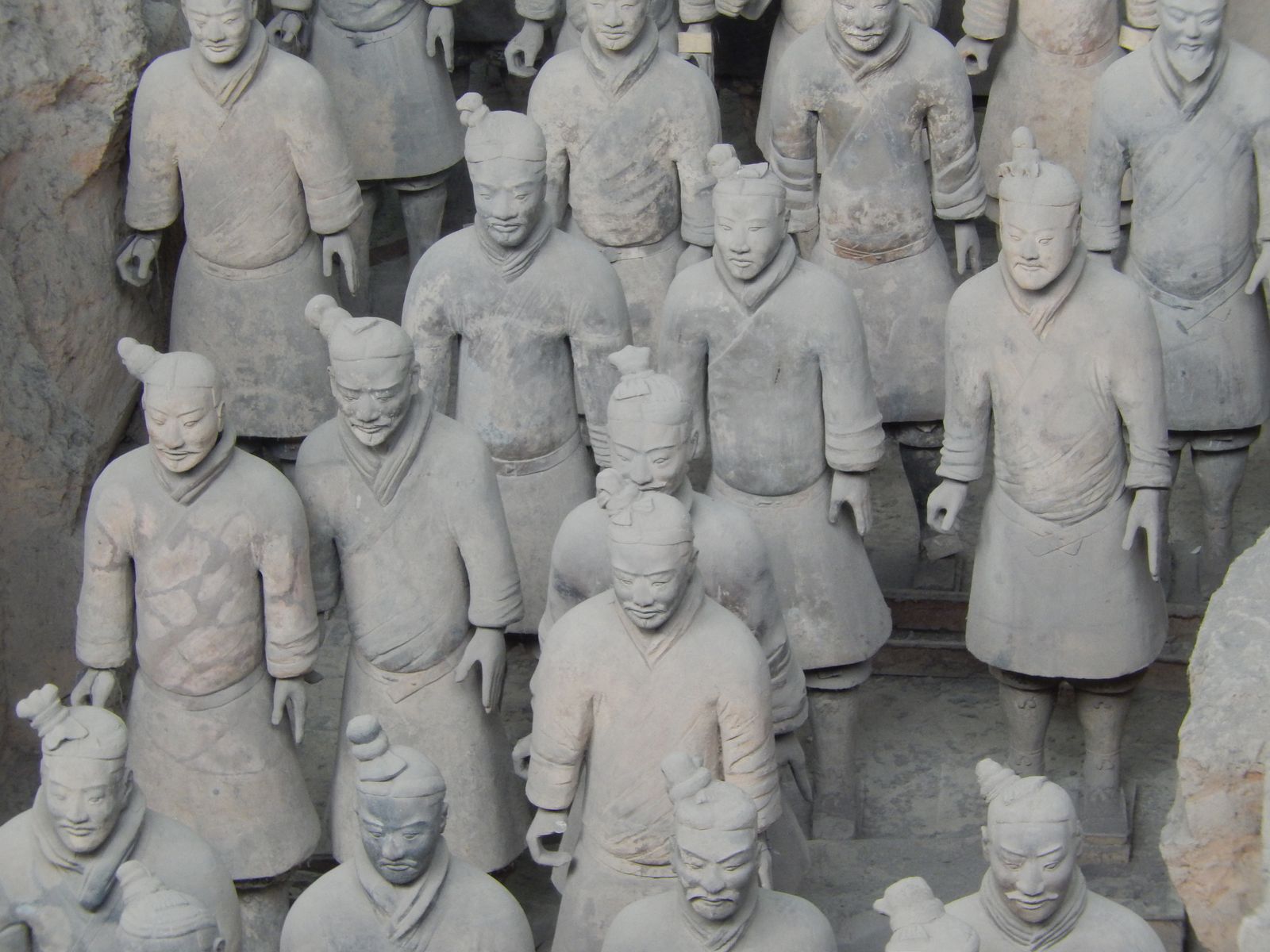
The soldiers stand between about 1.75 and 2.0 metres tall, which is taller than the average adult Chinese man of the Qin dynasty and probably reflects an idealised heroic scale. Each figure was built from local clay, fired, and then painted in lacquer and mineral pigments, including vivid greens, reds, purples, and a synthetic barium copper silicate pigment often called Han purple.
The colour rarely survives contact with air. When figures are exposed during excavation, the lacquer can curl and flake as moisture evaporates. Most of what tourists see today is grey because the paint has lifted off and crumbled to dust. Conservators at the site now work with far more careful humidity controls to slow the damage.
No two faces are the same
The detail that has carried the discovery into global imagination is the faces. The soldiers excavated so far have distinct facial structures, with different cheekbones, ears, beards, hairstyles, and caps that signal different ranks. The bodies were made from repeated parts, but the final surfaces were worked by hand.
Whether the heads were modelled on actual men in the Qin army, on idealised regional types, or simply on the imaginations of the sculptors is still debated. Analysis of features such as ear shapes has suggested a remarkable degree of variation. The army may have been designed to feel like a population, not a pattern book.
The bronze weapons they carried were real. Crossbow triggers, sword blades, spear tips, and arrowheads recovered from the pits show careful manufacture and, in some cases, remarkable preservation. Earlier accounts often claimed the weapons had been protected by an ancient chromium anti-rust coating, but a 2019 Scientific Reports study found that the chromium anti-rust theory should be abandoned. The researchers concluded that chromium traces were likely contamination from nearby lacquer after burial, while the weapons’ good preservation probably owed more to soil chemistry and bronze composition.
The accident that made the discovery
It is worth sitting for a moment with the role chance played here. The 1974 well was not the first time villagers had hit material from the mausoleum zone. Reports and memories from the area suggest that people had found fragments before. None of it added up to a discovery, because none of it reached someone who could connect the shards into a pit.
The science of fortunate accidents has a name. Building on the concept of serendipity, researchers distinguish it from blind luck by the presence of agency, meaning somebody notices the surprise and then does something with it. Yang taking the fragments to the county office was the agency step. Earlier villagers were not unlucky. They simply did not link what they found to anything larger.
That is the strange lesson of the well. A clay head in a field can remain a superstition for generations, or it can become an archaeological turning point. The difference is not only what comes out of the ground. It is whether someone recognises the moment before it disappears back into ordinary life.
What happened to Yang
The field became a museum complex. The Emperor Qinshihuang’s Mausoleum Site Museum opened to the public in 1979 and the mausoleum complex was inscribed on the UNESCO World Heritage list in 1987. It is now one of the most recognisable archaeological sites in the world.
Yang Zhifa was later associated with the museum and became known to visitors as one of the farmers who found the first fragments. For years, tourists could encounter him signing books and souvenirs connected to the site. Several other men from the original digging party were also connected to the public memory of the discovery, although accounts have long differed over who should be credited most directly.
The discovery did not instantly feel like a triumph to everyone involved. The archaeological site transformed the land around the village, and the old farming landscape changed permanently. The pride came later, after the world began arriving to see what had been under the field all along.
By the time Queen Elizabeth II visited the site in 1986, Bill Clinton in 1998, and Barack Obama in 2009, the unfinished well had become part of the story people came to hear. The accidental hole in the ground had become a threshold into the afterlife of China’s first emperor.
What is still in the ground
The numbers, more than fifty years after Yang’s shovel, are stark. Roughly 2,000 figures have been excavated and reassembled from a projected total of more than 8,000, which puts the recovery rate at under 25 per cent. Pit 1 alone measures about 230 by 62 metres. Pit 2 and Pit 3 add cavalry, chariots, and the command post. Restoration of a single warrior can take a conservator months, and thousands of figures remain buried in hundreds of pieces beneath collapsed wooden beams.
The central burial mound, some 51 metres high and covering roughly 350 by 345 metres at its base, remains sealed. Mercury concentrations measured in the tumulus soil run far above regional background levels, consistent with Sima Qian’s account of rivers of mercury flowing across a miniature empire. Ground-penetrating radar and mercury mapping have outlined chambers, walls, and a probable inner palace, but no excavation has been authorised.
The reason is preservation, not policy. In 1974, the site had no humidity-controlled enclosures, no oxygen-free extraction chambers, no PEG consolidants for lacquer, no on-site conservation labs. Today it has all of them, and the painted surfaces still flake within minutes of exposure. Until that gap closes, the emperor stays underground, the mercury stays sealed, and the 6,000 unexcavated soldiers stay in the dark.
