

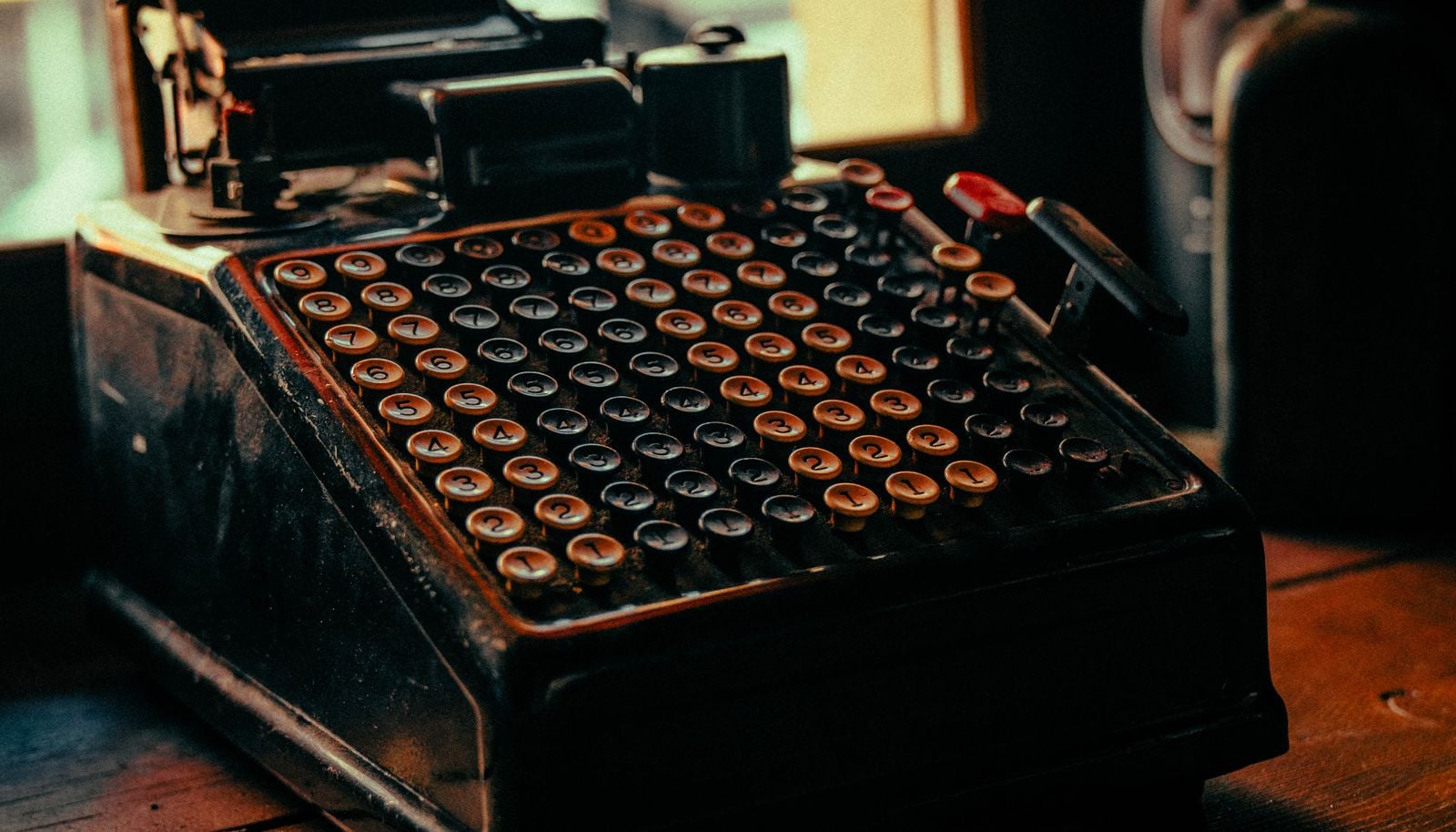
Samuel Morse was 53 years old, sitting in the chamber of the United States Supreme Court in the basement of the Capitol, when he closed a circuit and sent a jolt of electricity down 38 miles of copper wire toward Baltimore. The date was May 24, 1844. His assistant Alfred Vail, waiting at the Mount Clare railroad depot, read the incoming dots and dashes off a paper tape and confirmed the four words that would inaugurate the age of electric communication: What hath God wrought.
Morse did not choose the phrase. Annie Ellsworth did.
Her father, Henry Leavitt Ellsworth, was the first Commissioner of Patents and one of the few officials in Washington who had believed in Morse’s contraption when almost no one else would. When the funding bill finally passed in 1843, it was Annie who carried the news to Morse at his hotel, and he promised her the first message on the finished line in return. The Library of Congress catalogue entry for the surviving tape records that Annie selected the text from Numbers, chapter 23, verse 23, and that she also traced over Morse’s pencilled letters in heavy pen and ink. Several accounts add that her mother had pointed her to the passage. Morse inscribed the strip and presented it to her at the demonstration itself.

A painter who wanted to be remembered as a painter
The man at the instrument that afternoon had spent most of his adult life trying to be recognised as an artist. Morse studied painting at the Royal Academy in London and helped found the National Academy of Design in New York, serving as its first president. When he sailed home from France in 1832 aboard the packet ship Sully, he was returning from a European trip meant to shore up his reputation as a history painter, not an inventor.
The idea for the telegraph came to him during a shipboard conversation about the electromagnet. He sketched early designs while the Atlantic pitched under him. It would take another twelve years, and a stretch of near poverty in which he sometimes went without meals, before those sketches produced the machine in the Capitol basement.
Even after his fame arrived, Morse kept painting. His obsession with the daguerreotype, which he first saw in Paris in 1839, sat alongside his telegraph work in the same restless mind. As Artnet reported in a feature on the Maillet Daguerreotype Collection, Morse wrote home to his brother about Daguerre’s plates in language that ranked them above the great painters, calling the interior views Rembrandt perfected. Back in New York he set up a studio with the physician and professor John William Draper on the Washington Square campus of what is now NYU, charging $5 a picture. It was only the second such studio in the city.
Thirty-eight miles of copper and a $30,000 argument
The line between Washington and Baltimore existed because Congress had grudgingly funded it. The Library of Congress puts the House vote of February 23, 1843 at 89 to 83, with 70 members not voting. Seventy men declined to be recorded either way on what many of them considered a swindle. The act appropriating the $30,000 was passed on March 3, 1843, on the last day of that Congress. During debate, Representative Cave Johnson of Tennessee had proposed, mockingly, that half the money go to experiments in mesmerism instead.
Morse’s original plan was to bury the wire in a lead pipe alongside the tracks of the Baltimore and Ohio Railroad. The construction engineer Ezra Cornell, the same Cornell who would later found the university, built a plough that cut the trench, laid the pipe and reburied it in one pass. The wire itself was the problem: one of Morse’s partners had bought stock with defective insulation, and the line kept failing. After roughly nine and a half miles, Morse abandoned the underground plan. Work on overhead lines began on April 1, 1844, strung from chestnut poles about 300 feet apart. That improvisation, forced by failure, became the standard for the next half century of telegraph construction.
The finished line ran 38 miles, or roughly 60 kilometres. That is shorter than a modern commuter rail line into any major city. Yet before May 1844, a message travelling that distance moved at the speed of a horse.

The verse itself
The full passage in Numbers 23:23 reads: Surely there is no enchantment against Jacob, neither is there any divination against Israel: according to this time it shall be said of Jacob and of Israel, What hath God wrought! In its original context, the words are spoken by Balaam, a prophet hired to curse the Israelites who instead blesses them. It is a statement of awe at something already done, not a question about what comes next.
The choice was not accidental. Morse was a devout and theologically conservative Congregationalist who had spent years writing theological and political tracts. His 1835 book Foreign Conspiracy Against the Liberties of the United States went through seven editions between 1835 and 1855, arguing that the sovereigns of Europe necessarily viewed the American republic as an existential threat. Morse was a man who thought in scriptural cadences and geopolitical stakes at the same time. A verse framing the message as an act of divine astonishment fit him exactly.
Vail transcribed the message in Baltimore and sent it straight back, so the assembled congressmen and journalists could watch the return tape emerge and match it against the original. Four tapes were produced that day: the outgoing strip from Washington, the incoming record in Baltimore, Vail’s repeat-back, and the record of that repeat-back in the Capitol.
What the machine actually did
The apparatus was deceptively simple. Closing the circuit sent current down the copper wire, energising an electromagnet in Baltimore. The magnet pulled down a lever carrying a stylus, and, in the Library’s own description of Morse’s receiver, the stylus pressed an impression into a paper tape drawn past it by a clockwork motor. Short contact, short mark. Long contact, long mark. A dot and a dash. Nothing was written in ink. The message arrived as a line of dents in paper, to be read off by an operator afterwards.
The code itself is generally credited more to Vail than to Morse, though it bore Morse’s name. In the late 1830s Vail went to a Morristown newspaper office and counted the movable type in each character bin. The most common letter, E, got the shortest signal: a single dot. The rarest letters got the longest strings. That efficiency, assigning the shortest codes to the most frequent symbols, is the same principle that would later underpin the compression algorithms inside every image file and streaming video today.
A signal at the speed of electricity, translated through a code weighted to the frequency of English letters, recorded by a magnet pressing a point into moving paper. The whole system fit on a table.
What happened three days later
The line stayed open, and its first real test as news infrastructure came almost immediately. The Democratic National Convention opened in Baltimore on Monday May 27, and James K. Polk was nominated there on May 29, on the ninth ballot, as the compromise nobody had arrived expecting. Politicians in Washington knew it before any newspaper could print it.
Then came the moment that showed how strange the new instrument still felt. The convention chose Senator Silas Wright of New York as Polk’s running mate, and Wright, loyal to the defeated Martin Van Buren, wired back that he would not accept. The delegates simply refused to believe the wire, even after four telegraphed refusals, and Wright had to send men overland to Baltimore with a letter before the convention would accept that the messages were real. The technology worked perfectly. The trust took longer.
The expansion, once trust arrived, was fast. In October 1861 Western Union completed the first transcontinental line, and the Pony Express, which had launched with such romance eighteen months earlier, announced it was shutting down within two days of the line’s completion. By 1866, Cyrus Field’s team had landed a working transatlantic cable at Heart’s Content, Newfoundland, cutting the time for a message between London and New York from the length of an ocean crossing to the length of a conversation.
The mechanism Morse operated in the Capitol basement had, within one working lifetime, wrapped the industrial world in copper.
The girl who chose the words
Morse died in New York in April 1872, by then one of the most famous men in the country. American obituaries and, after them, American schoolbooks settled on a single phrase for him, the father of the telegraph, and that phrase quietly wrote Vail, Cornell and the young woman with the Bible out of the story.
Silicon Canals has written before about the physical scale of that first line, 38 miles of chestnut poles between two cities that today sit at either end of a one-hour Amtrak ride. The physical infrastructure has changed. The problem the telegraph solved has not. Every text message, every push notification, every trading order that jumps a fibre-optic cable between exchanges is still doing what Morse’s instrument did in 1844: converting a thought into an electrical pulse, moving it faster than a person could travel, and reconstituting it as language at the other end.
The paper tape
The strip Morse inscribed and handed to Annie Ellsworth that afternoon is a narrow ribbon of paper, aged now to the colour of weak tea. The dots and dashes on it are not printing. They are raised marks, pressed into the tape by the stylus as it moved. Beneath each code character Morse pencilled the letter it stood for, and Annie went over those pencilled letters in heavy pen and ink, which is why the message is still legible more than 180 years later.
The tape stayed in her family for the rest of her life. In 1922, seventy-eight years after the demonstration, her daughter, Mrs. George Inness, gave it to the Library of Congress, where it is catalogued in the Manuscript Division among the Samuel F. B. Morse Papers and digitised for anyone to look at. It is a short strip of paper. It weighs almost nothing. It is the beginning of every wire in the world.
