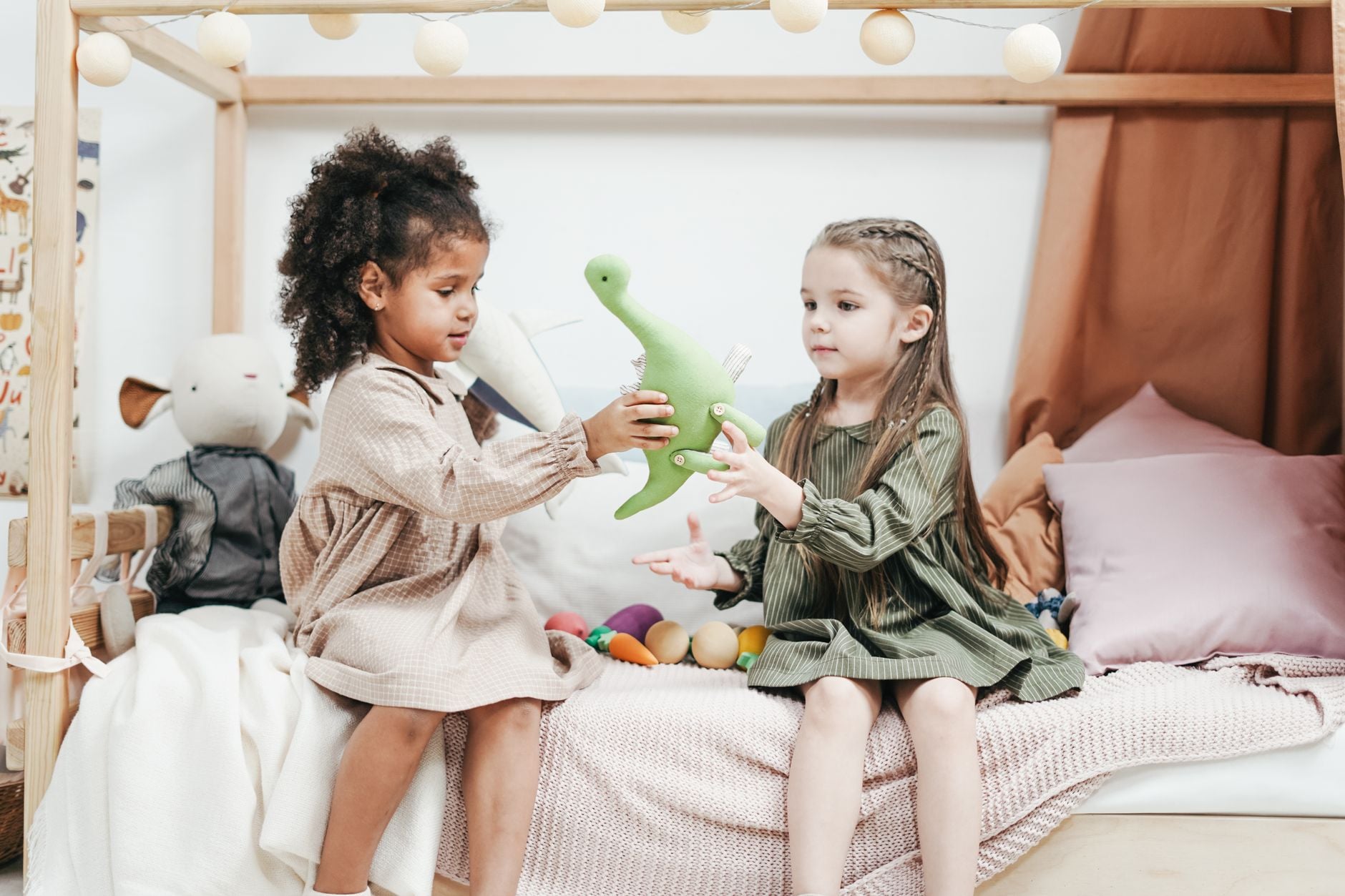
Two children reach for the same toy. An adult steps in with the lesson nearly every sibling hears: take turns, be fair, let your brother or sister have some.
It is easy to build an appealing theory from that scene. Only children never have to divide the household in quite the same way, so perhaps they remember childhood as happier. Children with siblings, meanwhile, supposedly learn the quiet cost of surrendering too much too soon.
Decades of family research support a less dramatic conclusion. Only children are not reliably less adjusted, selfish or lonely. Some studies find advantages in happiness or parent-child closeness, while others find benefits for children with siblings. What the evidence does not show is that being taught to share early makes childhood worse.
The more defensible story is about how attention, money, conflict, warmth and responsibility are distributed inside a family.
The old “spoiled only child” story did not survive contact with the data
For much of the twentieth century, an only child was treated as a developmental problem waiting to appear. Without a sibling, the theory went, a child would miss daily practice in cooperation and become self-centred or socially awkward.
By 1986, Toni Falbo and Denise Polit had enough research to test that assumption seriously. Their quantitative review covered 115 studies across achievement, adjustment, character, intelligence, parent-child relationships and sociability. Only children generally resembled first-born children and those from two-child families. They were not consistently deficient in adjustment or sociability, and stronger parent-child relationships helped explain some positive outcomes.
A related meta-analysis comparing only children with people raised alongside siblings found them broadly comparable in peer popularity, extraversion, maturity, autonomy, anxiety and behaviour problems. The 157-study synthesis did not reveal a damaged social type hiding inside the one-child home.
That is the sturdy finding across decades: sibling absence, by itself, is not a diagnosis.
The happiness evidence is narrower than the headline suggests
One of the most relevant modern studies surveyed 3,744 children aged nine and ten across public schools in Adachi City, Tokyo. Children rated their happiness, self-esteem and resilience, while caregivers completed a measure of behavioural and emotional difficulties.
Middle-born children reported the lowest happiness, including significantly lower happiness than only children. That result supplies a real foundation for the idea in the title. But it was a snapshot of current Japanese schoolchildren, not adults rating their entire childhoods. It also produced a much less flattering result for only children: they had the highest overall difficulties score. Last-born children had the lowest difficulties and the highest resilience.
The A-CHILD study therefore found a mixed birth-order pattern, not a ladder on which fewer siblings always meant greater happiness. Its cross-sectional design could identify associations but not show that a family position caused them. The researchers also stressed that culture, parenting and sibling relationship quality might change the picture.
“Only children are happier” is cleaner than the data. It is also less interesting.
Undivided attention is a benefit, but it is not free of context
Parents have limited hours, energy and money. When another child arrives, those resources do not double. Family researchers call this resource dilution.
The idea does not mean parents love each child less. It means one-to-one conversation, help with homework, private space and financial investment must be divided. The first child also loses a version of family life in which parental attention was previously undivided.
Research with Chinese junior-high students illustrates the pattern. After accounting for several family characteristics, children with one sibling were less likely than only children to report a close relationship with either parent; the difference was larger for children with two or more siblings. The authors interpreted parent-child closeness as one form of limited family resource.
Yet family size is not randomly assigned. Parents who have one child differ from those who have four in income, age, health, fertility history, relationship stability, values and support. In some settings, a sibling adds care and security. In another, a new baby arrives during financial strain or family conflict.
The number of plates at dinner cannot tell us the quality of what happens around the table.
A sibling can be a social teacher and a source of distress
Siblings offer something parents and classmates cannot fully reproduce: repeated interaction with a near-peer who remains in the family after the disagreement. Children negotiate games, repair arguments, imitate skills, form alliances and learn exactly which sentence will provoke a reaction.
A major review of sibling relationships describes these bonds as frequent, emotionally intense and embedded in the wider family system. Warmth and support can aid adjustment. Conflict can also provide practice in emotional regulation and problem-solving when it is contained and repaired.
But conflict is not automatically character-building. A US probability sample of 3,599 children and adolescents found that psychological, property and physical aggression from siblings was independently associated with greater mental-health distress. The researchers argued that sibling aggression should not be dismissed as harmless rivalry.
This is why “having a sibling” is too crude a variable to carry so much meaning. A protective older sister, a relentlessly hostile brother and a sibling separated by fifteen years are not the same developmental experience.
The “sharing too early” explanation points in the wrong direction
The sharing claim sounds psychologically sophisticated because it reframes a virtue as a wound. Yet I could find no good evidence that early sharing instruction lowers childhood happiness.
One longitudinal study followed 589 children in rural China, using games in which children chose how many stickers to give friends or strangers. At ages three and four, only children shared fewer stickers than children with siblings. Two years later, the difference in amount shared had disappeared. The developmental gap in sharing was temporary.
If siblings expose children to sharing earlier, that study suggests practice may accelerate a social behaviour rather than impose a lasting psychological cost. It says nothing about happiness, and it certainly does not show that sharing harms children.
There is a separate experience worth naming. A child may be ordered to yield every toy, absorb every interruption or accept less parental attention because “you are the older one.” That is not simply sharing. It is a family pattern in which fairness is confused with permanent self-denial.
The problem is not learning that another person has needs. It is learning that your own needs become less legitimate whenever someone younger or louder enters the room.
Family functioning matters more than the family diagram
A systematic review of 124 studies on happiness among children and adolescents found a consistent relationship with family functioning. Cohesion, communication and the quality of family relationships mattered across age groups and cultures. The review did not identify one ideal number of children. It found that how a family functions predicts happiness.
That conclusion leaves room for advantages on both sides. An only child may receive more parental time, privacy and material support. They may also want more companionship at home or carry parental expectations alone. A child with siblings may gain affection, humour and lifelong solidarity. They may also live with comparison, noise, diluted attention or aggression.
As a father, I understand the appeal of a rule that settles the question. Parents want to know whether one child will be lonely or whether a second will make the first happier. Research cannot promise either outcome because a sibling is not an intervention with a standard dose. It is another person and another relationship.
The useful question is not whether children should be protected from sharing. It is whether every child in the home can ask for attention, keep reasonable boundaries, experience fairness and feel that love is not awarded through competition.
Some only children are wonderfully happy. So are some children growing up in crowded, affectionate households. The quiet cost is not sharing too early. It is being unseen inside whatever family structure adults have chosen.