
What the EU AI Act’s first provisions meant for European startups
February 2, 2025 marks the first enforcement provisions of the EU's AI Act going into force.

Technology, AI, capital and institutions, examined through who builds systems, who controls them and who benefits.
11,488 articles · Technology & Power
February 2, 2025 marks the first enforcement provisions of the EU's AI Act going into force.
Europe has never had more money flowing into artificial intelligence.

Europe's AI researchers are increasingly choosing to stay put rather than move to Silicon Valley, driven by better local funding, quality-of-life advantages, geopolitical shifts, and a maturing institutional ecosystem that finally makes staying the rational choice.

The emotional whiplash isn’t just “too much screen time.” Gudrun M. Henemann, Mike M. Schmitgen, Sophie H. Haage, Jakob P. Rosero, Patrick…

The premise of the “are you dead?” app is almost offensively plain: once a day, you tap a single button to signal you’re alive.

On one IMF measure for 2025, Ireland's nominal GDP per capita exceeded Singapore's.

In 1965, Lee Kuan Yew wept on television as he announced that Singapore had been expelled from Malaysia, cast adrift as an independent nation nobody expected to survive.
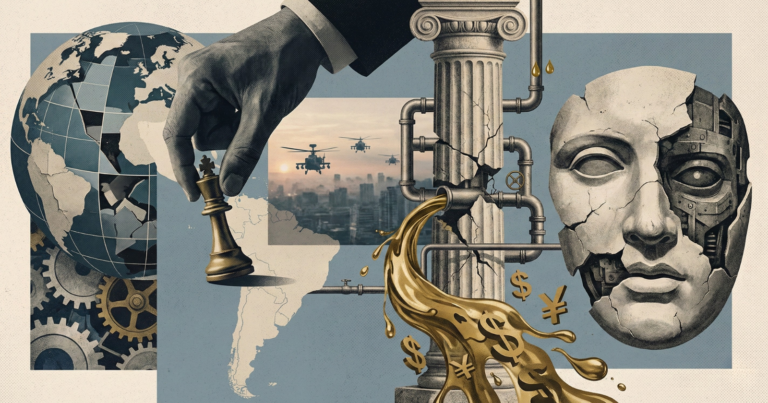
Trump captured a sitting president and announced America would "run" Venezuela.

The tech billionaire, who claims to have fathered over 100 children through sperm donation, frames his unconventional program as a response to a global fertility crisis.
Last month, I sat in a cafe in Singapore—a city that often feels like a scale model for the future—and watched a demo of Sora 2.0. On the screen, a hyper-realistic scene of a 1920s jazz club flickered to life.

When Samsung unveiled the Galaxy Z TriFold, the headlines focused on what you'd expect: the dual hinges, the 10-inch display, the fact that a tablet now folds into your pocket.

The surveillance state isn't coming.