

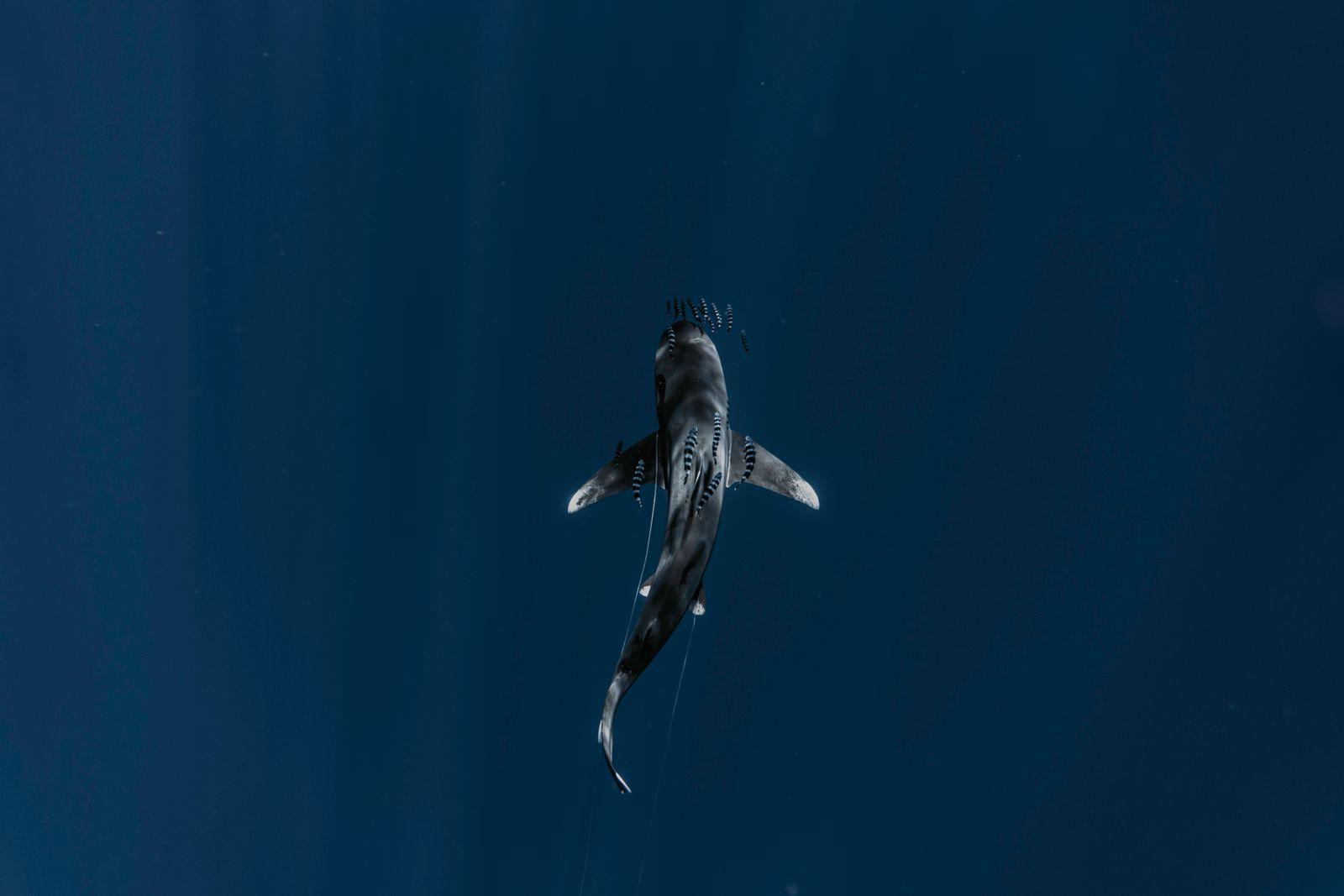
Somewhere a kilometer below the surface of the North Atlantic, in water just above freezing, a shark drifts. A copepod hangs from its cornea like a ragged streamer. The eye behind that fouled lens is still working, more or less, and it has been working for a very long time.
The animal may have been alive when Isaac Newton was. The oldest individual ever radiocarbon-dated, a five-meter female, was estimated at 392 years old, with a wide uncertainty range. That makes Somniosus microcephalus the longest-lived vertebrate known to science, according to the landmark 2016 study that dated proteins from Greenland shark eye lenses.
The animal is built for time, not speed.
How a shark gets to be 400 years old
Greenland sharks grow slowly. They reach sexual maturity at roughly 150. They move through cold water near freezing, often at great depths below the surface, and every part of their physiology seems tuned to slowness. The 400-year estimate came from an unusual workaround: these sharks lack the calcified vertebrae and otoliths that scientists often use to age fish, so a team led by Danish marine biologist Julius Nielsen turned to the eye. The core of a Greenland shark’s eye lens is laid down before birth and never replaced. Radiocarbon-date the proteins at the center of that lens, and you get a window into when the shark was an embryo.
When they applied the method to Greenland sharks, they found something startling. The youngest mature adults were already well over a century old. The largest female in the study was estimated at 392 years old, with a 95.4% probability range of 272 to 512 years. Even if she was toward the younger end of that range, she belonged to a world that began before modern science had a name.
The parasite on the cornea
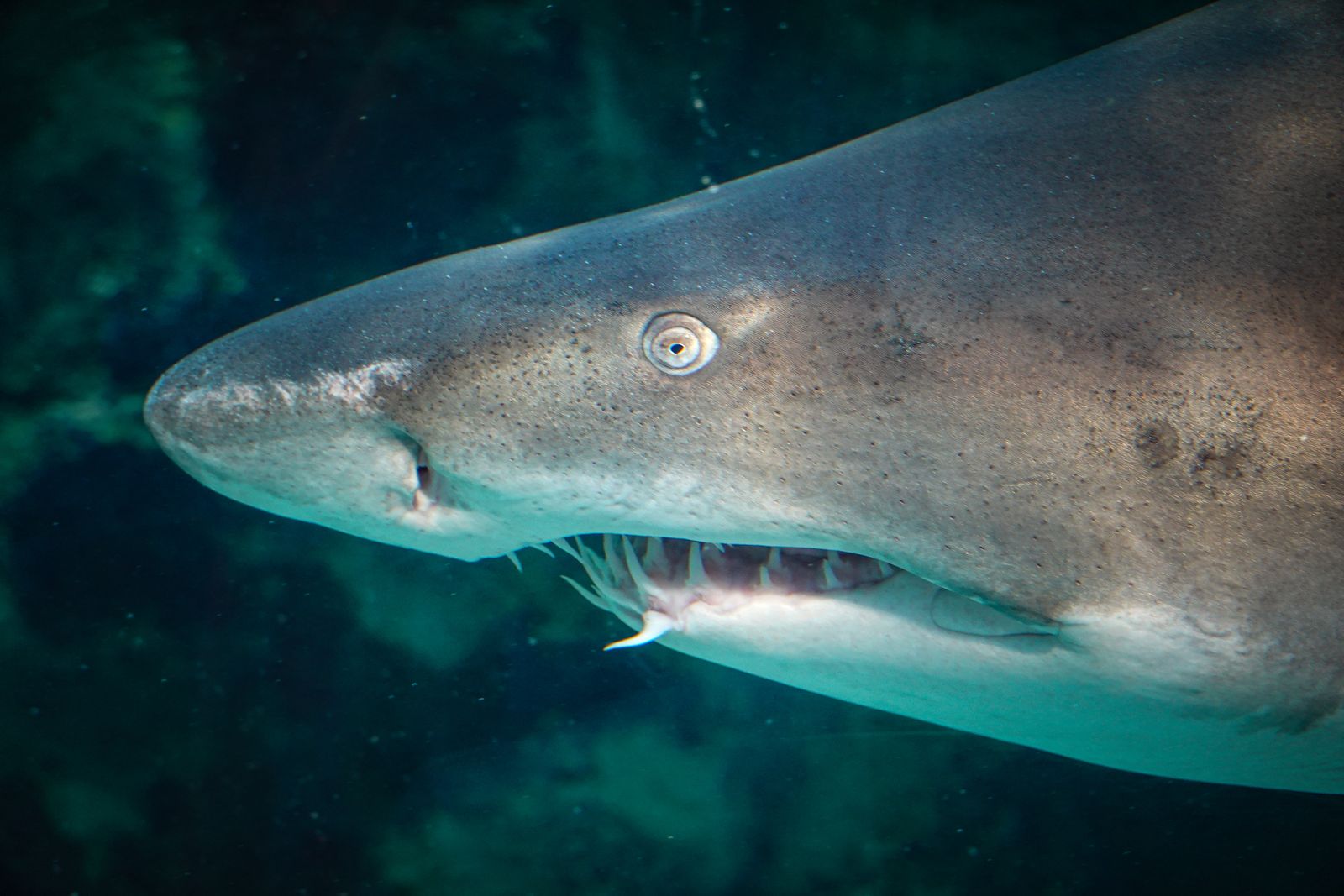
Greenland sharks are famous not only for their age, but for their eyes. In the waters around Greenland, their corneas are frequently parasitized by Ommatokoita elongata, a copepod that attaches to the surface of the eye. The parasite can dangle like a ragged streamer, becoming the shark’s most distinctive close-up feature.
For decades, the assumption was straightforward. The sharks lived in near-total darkness anyway. The copepods scratched and clouded their corneas. Vision, many assumed, was degraded enough to be almost beside the point, replaced by other senses such as smell and the lateral line.
That assumption is now in question.
The eyeball on dry ice
A recent study upended part of the story. Researchers at the University of Basel and the University of California, Irvine, examined eyeballs from ten Greenland sharks caught off western Greenland between 2020 and 2024. According to research co-author Emily Tom, receiving the shark eyeball samples was a striking experience, as reported by Smithsonian Magazine.
What the team found contradicted a century of assumption. The light-sensitive parts of the old eyes showed no obvious signs of degeneration. The parasites, despite sitting on the cornea, did not appear to be destroying the underlying retina. The sharks, even at well past 100, still seemed able to see in the limited way their environment allows.
So are they blind? Not quite. According to physiologist Dorota Skowronska-Krawczyk at UC Irvine, the sharks do not appear to have high-resolution vision. They can detect light and darkness, though probably not fine shapes or fast movement. The better description is not blind, but visually limited: the cornea may be scarred and clouded, while the retina behind it remains remarkably intact.
The DNA repair machinery
The reason may be genetic. The Basel and Irvine team zeroed in on DNA repair-associated genes, including ERCC1 and ERCC4, that code for proteins involved in repairing damaged DNA. Greenland sharks showed elevated expression of ERCC4 in their retinas compared with other sharks.
Comparative neurobiologist Laura Ryan of Macquarie University noted that elevated DNA repair gene expression may provide a molecular mechanism for maintaining retinal health across centuries, as reported by the Australian Broadcasting Corporation. The same broad repair logic may help explain why an animal that lives so long does not simply accumulate catastrophic cellular damage along the way.
Reading the whole genome
In 2026, a team led by Shigeharu Kinoshita at the University of Tokyo published the first whole-genome sequence of a Greenland shark in PNAS. The study, published May 19 and reported by Live Science, covered 96.7% of the animal’s DNA and pointed to several interlocking systems that may help explain how a vertebrate survives for centuries.
Linker histone proteins, which compact DNA into chromosomes, carry unique amino acid substitutions in Greenland sharks. The likely effect is a more stable chromatin structure, which could help slow the accumulation of DNA damage over time. Gene families related to immune response and DNA repair are expanded. Ferritin genes, which regulate iron storage and protect against oxidative stress, are notably amplified.
According to Kinoshita, extreme longevity appears to result from coordinated changes across multiple biological systems rather than a single genetic factor: genome stability, iron metabolism, immune function, stress resistance. All of it stacked into one animal moving slowly through cold water.
What the shark eats while it ages
Greenland sharks are opportunistic to a degree that occasionally borders on the surreal. They eat fish and seals, but they also scavenge. Researchers have found remains of terrestrial animals such as reindeer, horses, and polar bears in their stomachs; animals that likely drowned, fell through ice, or otherwise ended up sinking into the shark’s dark world.
This dietary opportunism fits the energetic budget. A slowly moving shark cannot chase every meal in open water. One theory is that they ambush sleeping or vulnerable seals, drifting up beneath them in the dark. Or they wait. Things die. Things sink. The shark is there.
A skepticism, and a rare Irish stranding
Not every scientist accepts the cleanest version of the 400-year estimate. Aaron MacNeil, a biologist at Dalhousie University, has noted that the radiocarbon dating relies partly on Cold War nuclear-bomb fallout reaching the deep sea, and that mixing into cold abyssal layers may have been slower than the original calibration assumed. The age estimates, in other words, could be somewhat inflated. MacNeil told Live Science that while the exact estimates carry uncertainty, the sharks are still definitively very old: at least 200 years.
The species’ mystery occasionally surfaces in a literal way. In April 2026, a rare Greenland shark washed up on the coast of County Sligo in Ireland, the first recorded stranding of the species on the Irish coast. The animal was recovered by the National Museum of Ireland, a rare chance to study a deep-water animal that usually lives far beyond ordinary human reach.
The liver oil years
One reason there are not more very old Greenland sharks left is that humans spent the 19th and early 20th centuries hunting them industrially for liver oil. Because the sharks reproduce so slowly and mature so late, the population has been slow to rebuild. Some marine biologists believe it is still recovering from hunting that effectively ended decades ago.
Today, many encounters are accidental, often as bycatch in deep-water fisheries. Their habitat, black and near-freezing water far below the surface, keeps them mostly out of human reach. It is one of the few advantages of living somewhere humans do not want to go.
What it means to look at one
The numbers, taken together, describe an animal operating at a different tempo from almost any other vertebrate. Growth is on the order of one centimeter per year. Sexual maturity arrives around age 150. The radiocarbon estimate of 392 years carries a 95.4% probability range of 272 to 512 years, an interval wide enough to encompass most of recorded modern history. Even MacNeil’s more conservative reading still places the oldest individuals at 200 years or more.
The method behind those numbers comes down to a small amount of protein at the center of an eye lens, fixed in place before the shark was born, then read against a baseline calibrated partly from mid-20th-century nuclear fallout. The genome sequencing adds a parallel line of evidence: amplified ferritin genes, expanded DNA repair families, altered linker histones, elevated ERCC4 expression in the retina.
None of that is poetic. It is just what the tissue shows when it is measured.
