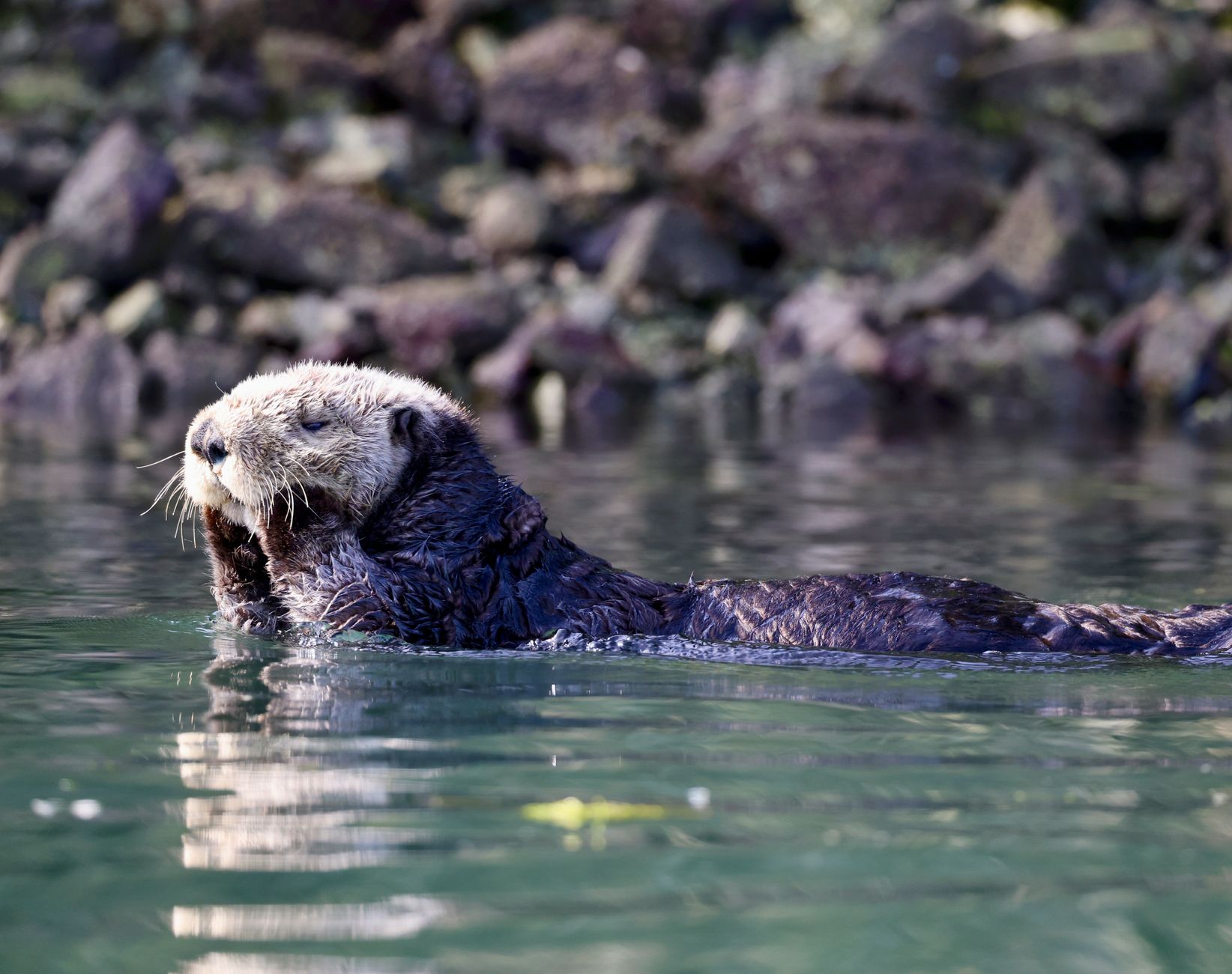
Fewer than one percent of mammal species are known to use tools at all, and the number that retain a specific tool across multiple uses drops to a handful. Chimpanzees make the list. So do a few crows and parrots. The only marine mammal on it floats on its back in the kelp beds off Monterey Bay, reaches into a flap of loose skin beneath her left foreleg, and pulls out a fist-sized stone she has carried through three dives in a row.
She balances it on her chest and hammers a mussel against it until the shell cracks. The pouch is real anatomy. The rock is the same rock she used yesterday. As field observation has documented, that single retained stone makes Enhydra lutris one of the only non-primate mammals on Earth known to keep and reuse a specific personal tool.
Most tool-using animals grab whatever is handy and drop it. The otter does not.
The pouch is the whole trick
Under each forearm, a sea otter has a baggy fold of skin that runs from the chest to the armpit. It is not a true pouch like a kangaroo’s. There is no muscular seal, no nursery function. It is a loose pocket of integument, and the otter uses it as cargo space.
Into that pocket goes the rock. Sometimes two rocks. Sometimes a half-eaten clam stashed for later, or a sea urchin held back for a slower meal at the surface. Field observers have watched individual otters retrieve the same stone over and over across a feeding session, tucking it back into the pouch between dives the way a carpenter slips a hammer into a belt loop.
The pouch sits where the loose skin gathers when the animal is swimming on its back. Gravity does part of the work. The otter does the rest, pressing the rock against its ribs with a forelimb as it dives.

The anvil on the chest
Watch the surface long enough and you see the routine. The otter dives, surfaces with a mussel or a clam or a crab clamped between paws and teeth, rolls onto its back, fishes out the rock, lays it flat on its sternum, and brings the shellfish down against the stone in sharp, percussive blows. Two strikes a second. Sometimes faster.
The chest becomes the workbench. The rock becomes the anvil. The shell becomes lunch.
Observation of otters in California has shown individuals striking shells repeatedly against the same stone. Over a lifetime, a hard-shelled diet means tens of thousands of impacts, and the wear shows. Not just on the rocks, but on the otter’s teeth, which fracture and chip in patterns that match the species’ tool-using habit.
The same rock, day after day
The reuse is what sets the behavior apart. Chimpanzees famously use stones to crack nuts in the forests of Guinea, but they generally leave the stone at the anvil site between meals. Egyptian vultures drop rocks on ostrich eggs, then walk away from the rock. Crows bend wires into hooks and abandon them.
The otter takes the tool with her.
Observation along the central California coast has shown that otters favor particular stones, often a flattish, palm-sized cobble with one slightly convex face, and carry that stone for days. The pouch makes the carrying possible. Without it, a marine mammal swimming through kelp and surf would have no way to keep a chosen object close.
Rocks that record history
The reuse leaves a mark on the world, not just on the otter. Along the California coast, biologists and archaeologists have begun cataloguing the shoreline rocks that otters use as larger anvils — boulders too big to carry, struck repeatedly by the same animals over years. The mussel shells pile up beneath them in distinctive scatters. The boulder itself develops chipped facets on the seaward side.
Researchers have argued that these sites constitute an archaeological record of a non-human species, the only marine mammal known to leave one. The damage patterns on the shells differ from those produced by waves, by gulls, by human harvesters. Dig a trench beside an otter anvil and you can read the history of that one boulder’s use back through the strata of broken mussels.
It is, in plain terms, an industrial site. Operated by an animal that eats a quarter of its body weight every day in shellfish.
Why the otter needs the tool at all
Sea otters are among the smallest marine mammals and lack the blubber layer that keeps whales and seals warm. They survive in 10°C Pacific water by running an extraordinarily hot metabolism, and that metabolism demands constant, calorie-dense food.
The richest food in their range is locked inside hard shells. Mussels, abalone, sea urchins, rock crabs, snails. Teeth alone are not enough. Brute jaw force on a thick abalone shell would crack the otter’s molars long before it cracked the shell.
So the rock does the work the jaw cannot. Behavioral biologists studying marine mammal cognition, including Ronald Schusterman’s long line of work on pinniped and otter learning, have shown that the animals select stones by feel and by experience, not at random. They test weight. They test edge. They reject stones that crumble.

Calves learn it from their mothers
The behavior is not purely instinct. Pups born to mothers in heavy-shell environments, places where abalone and mussels dominate, learn to use rocks early, often by watching the mother strike shells against her chest while the pup clings to her belly. Pups born to mothers in soft-prey environments, such as the crab-rich estuaries of Elkhorn Slough, use rocks less.
The tool tradition is passed down. Different otter populations along the same coast develop different preferences, different favored shell types, different striking rhythms. It is, by every standard biologists use for primates, a culture.
And the pouch is the infrastructure that makes the culture possible.
The pouch holds more than rocks
Field photographers in Alaska and California have captured otters pulling out stashes that suggest the loose-skin pocket functions as a general-purpose holdall. Observers have documented individuals keeping a preferred rock alongside backup food items. A clam tucked beside the anvil stone, a sea urchin saved for the next surface interval.
The pouches sag noticeably when full. From the right angle, a feeding otter looks like a small, wet smuggler.
A short list of animals that keep tools
The list of non-human species known to retain and reuse a specific tool across multiple uses is short. New Caledonian crows keep favored hooked twigs. Some chimpanzees in West Africa carry stone hammers between nut-cracking sessions. A few captive parrots and corvids will hide a tool for later.
Sea otters belong on that list, and they may be the only marine mammal on it. The behavior puts Enhydra lutris in a cognitive bracket usually reserved for great apes and a handful of birds. A bracket defined not by using a tool once, but by treating an object as a possession.
The species nearly went extinct before anyone watched it work
The maritime fur trade of the 18th and 19th centuries reduced the global sea otter population to a tiny fraction of its original size. The behavior described above, the carried rock, the chest anvil, the pouch, was nearly lost to extinction before modern field biology existed to record it.
The recovery is partial. California’s southern sea otter population remains listed as threatened. The animals at Monterey, at Elkhorn Slough, at Big Sur are the descendants of a tiny relict colony that survived in remote coves while the rest of the species was hunted off the coast.
The numbers stack up in the otter’s favor as a tool-user. A single animal eats roughly a quarter of its body weight in shellfish each day, much of it cracked against a carried stone. Field studies along the central California coast have documented individuals striking shells against the same retained rock at rates approaching two blows per second across feeding bouts that run for hours. Tens of thousands of impacts a year, per otter, against a tool kept in a pouch.
The archaeological footprint is measurable too. Catalogued shoreline anvil boulders show chipped facets and mussel-shell middens accumulating in strata that, in some cases, predate the fur trade. They were abandoned during the near-extinction and put back into service by returning otters in the twentieth century. One marine mammal species, one anatomical pocket, one favored stone, and a record of use written in shell fragments and stone wear that outlasts the animal that made it.