

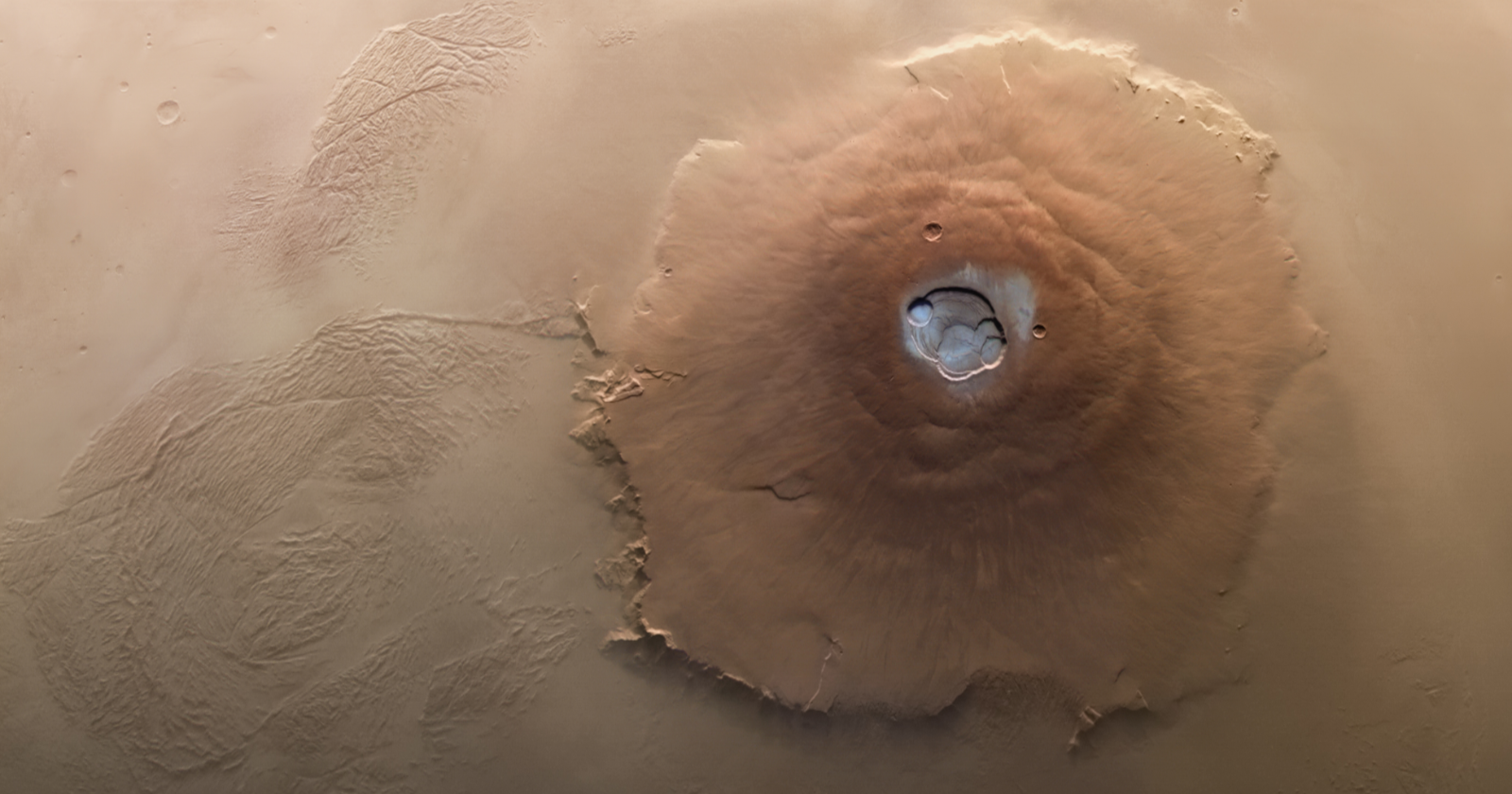
Imagine the largest mountain in the solar system, and then imagine not being able to tell you are on it. Not because the visibility is poor, not because you are distracted, but because the mountain itself has conspired, through sheer geometry, to disguise its own existence. This is the practical joke of Olympus Mons.
The volcano rises approximately 22 kilometres above the Martian datum, making it roughly two and a half times taller than Mount Everest measured from sea level and about three times Everest’s height when measured from the surrounding plains. It covers an area comparable to the state of Arizona, approximately 300,000 square kilometres, and its base would blanket the entire British Isles with room to spare. And yet if you were dropped onto its lower flanks in a pressure suit and asked to walk uphill, you would almost certainly not believe you were on a mountain at all.
The slopes average between 2 and 5 degrees. That is gentler than most wheelchair ramps built to modern accessibility codes.
You could climb the tallest mountain in the solar system and arrive at the top convinced you had been strolling across a parking lot.
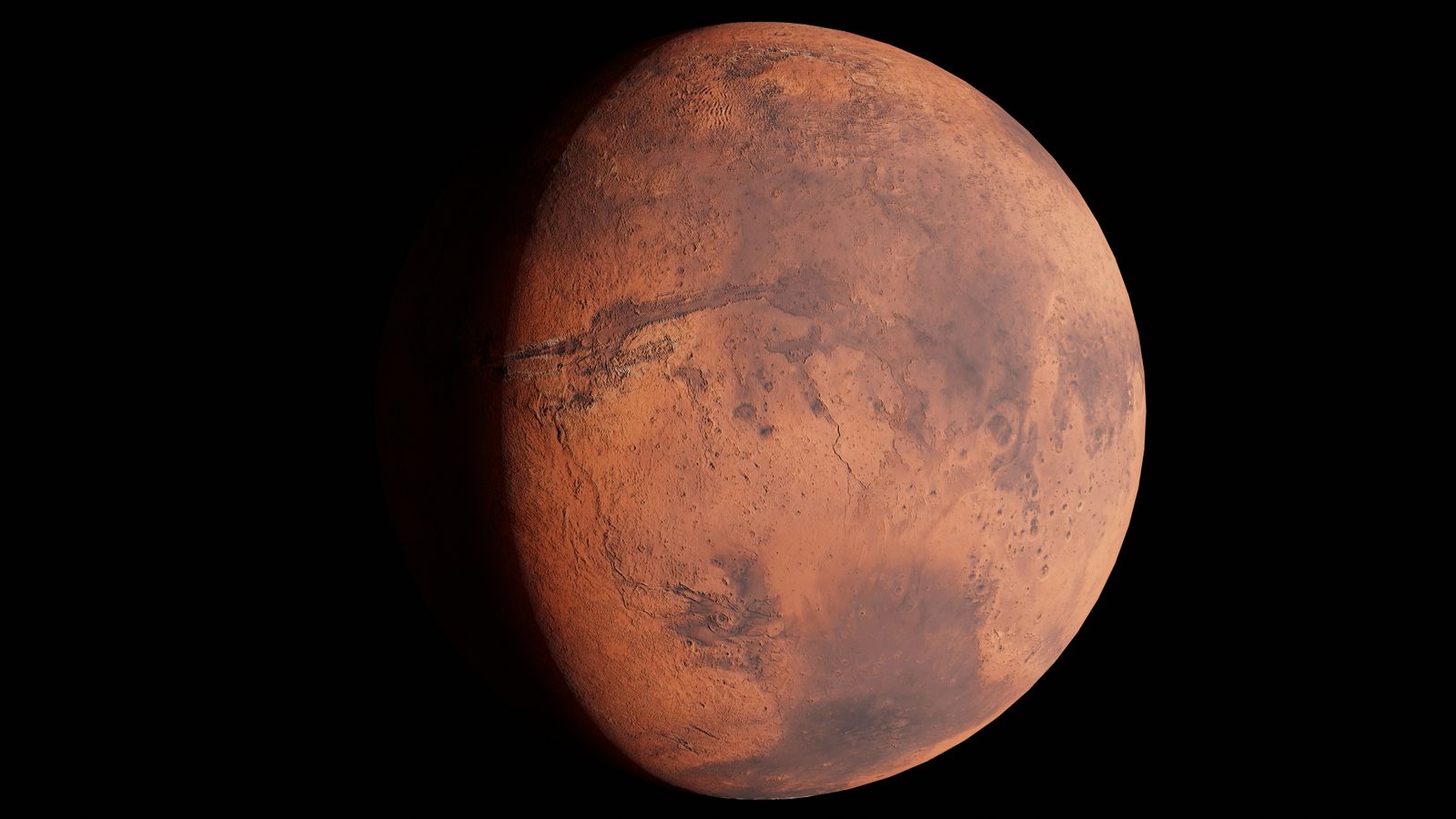
A volcano shaped like a pancake
Olympus Mons is a shield volcano, the same broad family that built the Hawaiian islands. Shields form when low-viscosity basaltic lava flows for tens or hundreds of kilometres before cooling, stacking thin sheets over millions of years. On Earth, Mauna Loa rises about 9 kilometres from the Pacific seafloor with slopes between 4 and 6 degrees. Olympus Mons used the same architecture, but Mars gave it three advantages Earth could not. There is no plate tectonics on Mars. A hotspot under Hawaii drifts beneath the moving Pacific plate, smearing the volcanic output across a chain of islands. The Martian crust sits still, and for something like three billion years, lava piled onto the same single point. Gravity on Mars is 38 percent of Earth’s, which means a mountain that would slump and collapse under its own weight on this planet can stand much taller on that one. And the Martian mantle, while cooler now, supplied prodigious volumes of fluid basalt during the Hesperian and Amazonian periods.
The result is a volcano that is enormous in volume and footprint, but almost flat in cross-section. If you drew Olympus Mons to scale on a piece of paper, the profile would look like a slightly raised lens, not a peak.
Why a climber would not feel the climb
A 5-degree slope rises about 9 metres for every 100 metres of horizontal travel. Walk a kilometre and you have gained roughly 90 metres of elevation, about the height of a 25-storey building, spread over twelve city blocks. The body barely registers it. On the lower flanks of Olympus Mons, the gradient is gentler still, often closer to 2 degrees, which is the pitch of a long airport jet bridge.
Human beings detect slope through three overlapping channels: vision, the vestibular system in the inner ear, and proprioception, the sense that tells you where your limbs are without looking. Kathleen Cullen at Johns Hopkins University has spent her career studying how the vestibular apparatus and proprioceptors feed the cerebellum the data it needs to keep you upright. When the ground tilts, hair cells in the semicircular canals respond, muscle spindles in the legs register changes in load, and the cerebellum integrates the streams into a sense of where gravity is.
At 2 degrees, those signals are barely above the noise floor. The vestibular system was tuned by evolution on a planet where meaningful elevation change usually meant steeper terrain. A gradient gentler than a parking garage ramp does not produce a strong enough cue.
Vision lies about slope, too
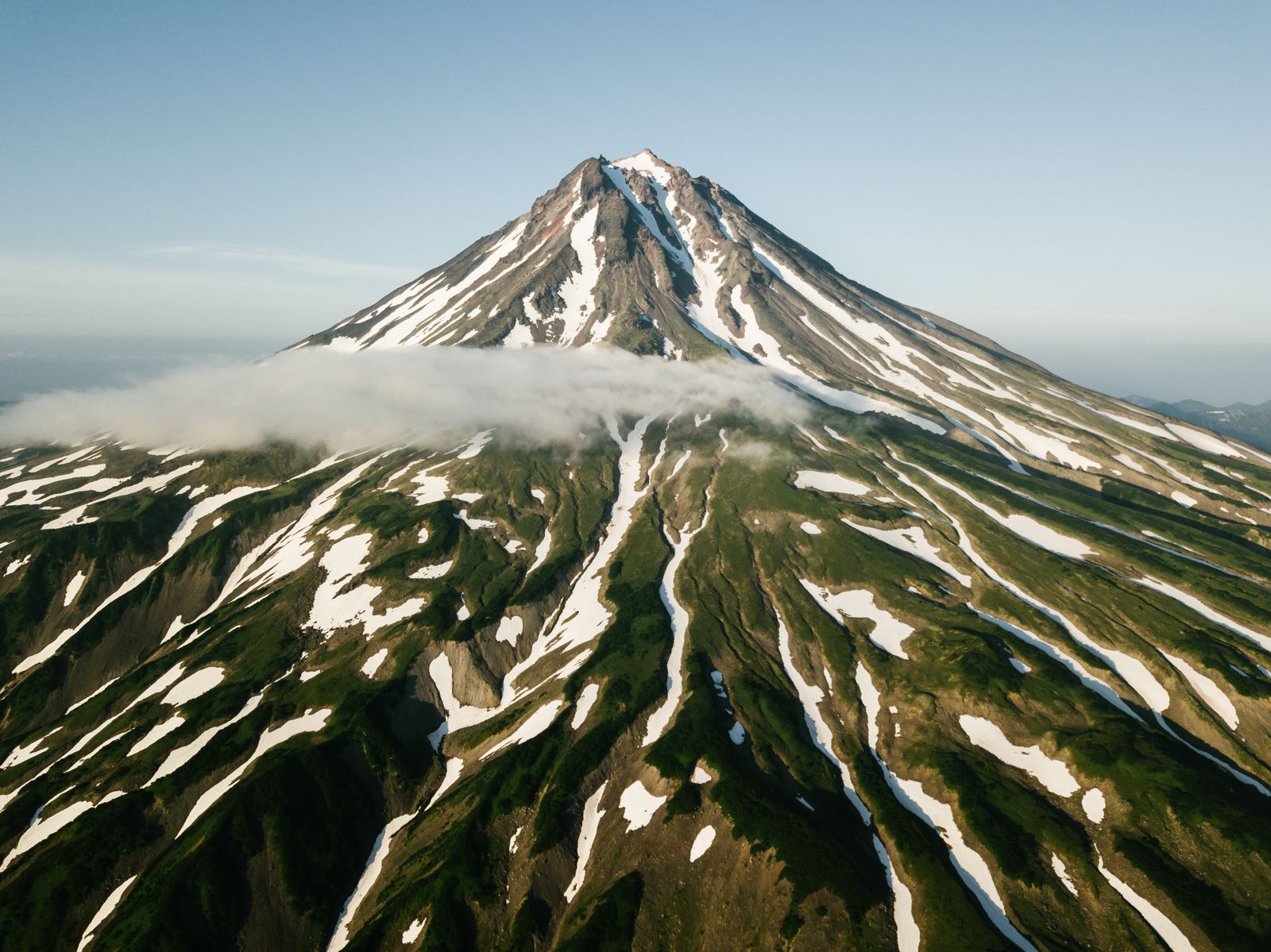
Even on Earth, the eye is a poor judge of incline. Psychology research on visual perception has found that people tend to overestimate the steepness of hills. A 30-degree hill is often perceived as much steeper. Research on visual perception shows that hills often appear steeper from a distance than they do when approached directly.
The brain uses the angle of regard, the relationship between the direction of your gaze and the surface in front of you, as a shortcut. The shortcut works most of the time on Earth, where slopes rarely exceed 35 degrees and the horizon provides a reliable reference.
On Olympus Mons, the shortcut breaks. The horizon on Mars is closer than on Earth because the planet is smaller, about 3.4 kilometres away on a flat surface for an average-height observer, compared to roughly 5 kilometres on Earth. On the volcano’s flanks, the curvature of the mountain itself bends the horizon downward. From most viewpoints on Olympus Mons, you cannot see the summit. You cannot see the base. You see a landscape that looks, to all practical purposes, flat in every direction.
The cliff at the edge
The slopes are gentle, but the edges are not. Olympus Mons is ringed by an escarpment, a near-vertical cliff that drops as much as 6 kilometres in some places, taller than any cliff face on Earth. Geologists are still arguing about how it formed. One leading explanation involves catastrophic landslides shearing off the original outer flanks. Another invokes ancient shorelines, the volcano having once stood at the edge of a long-vanished sea.
The escarpment matters because it is the only place on the volcano where a human observer would unambiguously know they were on something gigantic. Walk inward from the cliff and within a few kilometres the slope flattens to its characteristic shallow grade. The cliff becomes invisible behind you. The summit, 600 kilometres distant across the shield, never appears.
The caldera at the top
The summit complex is a nested set of calderas, collapse pits left behind when magma chambers emptied and the roof fell in. The largest is about 80 kilometres across and 3 kilometres deep. Standing on the rim of the central caldera, you would look across a depression wide enough to swallow Greater London and deep enough to hide three stacked Burj Khalifas.
Orbital missions have mapped the caldera floors in fine detail. The youngest lava flows in the central pit appear geologically recent enough that some planetary scientists suspect Olympus Mons may not be entirely extinct. It may simply be dormant on a timescale longer than humans have existed as a species.
What an astronaut would actually experience
The challenge of walking on Olympus Mons would not be the climb. It would be the climate. The summit pokes well above most of the Martian atmosphere. Air pressure at the top is a fraction of the already-thin pressure at the datum, itself less than 1 percent of Earth’s sea-level pressure. Dust storms that scour the plains rarely reach the upper flanks. The sky above the caldera would be closer to black than to butterscotch.
And the journey would be long. To traverse from the base of the escarpment to the central caldera is roughly 300 kilometres of horizontal travel. At a steady walking pace of 5 kilometres per hour, ignoring sleep, food, and the small matter of life support, you would need about 60 hours of continuous walking. In practice, with rest cycles, suit limitations, and the need to haul supplies, the trip would take weeks.
Throughout those weeks, the proprioceptive feedback that tells the body where it is in space — the same network of sensors in muscles, tendons, joints, skin, and the inner ear that lets you walk a forest trail without watching your feet — would be feeding the brain a near-constant signal of flat ground. The cerebellum would have nothing to push back against. You would feel as if you were crossing a slightly dusty plain.
The mountain that is also a continent
Olympus Mons occupies an awkward category. It is a volcano by composition and structure. It is the size of a small country by footprint. Its lower flanks merge so gradually with the surrounding lava plains of the Tharsis bulge that the precise location of its base is partly a matter of definition. Different planetary geologists draw the boundary in different places, depending on whether they trace the escarpment, the change in slope, or the underlying geological contact.
Tharsis itself is the largest volcanic province in the solar system, a bulge in the Martian crust the size of North America that contains three other enormous volcanoes. Arsia Mons, Pavonis Mons, and Ascraeus Mons would each be the tallest mountain on Earth by a comfortable margin. Olympus Mons stands off to the northwest of this trio, a separate beast on the same vast plateau.
The four volcanoes together released enough lava to resurface a continent-sized chunk of the planet and to outgas enough sulfur dioxide and water vapour to have plausibly altered the early Martian climate. The lava that built Olympus Mons did not just stack a mountain. It rewrote the atmosphere.
The view from orbit
The only place a human observer could truly perceive Olympus Mons as a mountain is from space. From the surface, it is too big to see. From a few hundred kilometres up, the shield finally resolves into its proper shape, a near-circular bulge with a dark scalloped caldera at its centre, ringed by the escarpment, ringed again by an apron of ancient landslide deposits that extend hundreds of kilometres outward.
The first clear orbital images came from NASA’s Mariner 9 in 1971, which arrived during a global dust storm and watched as the storm subsided to reveal four dark spots poking through the dust. Those spots, the only features visible above the swirling atmosphere, turned out to be the summits of Tharsis. The largest of them, the one set apart from the others, was given a name borrowed from the home of the Greek gods.
So ask the obvious question. If you walked from the escarpment to the central caldera over weeks of imperceptible tilt, never feeling the gain, never seeing the summit, never sensing anything but flat ground beneath your boots, have you climbed a mountain? Mountaineering as humans have practised it is a phenomenology of effort: the burn in the calves, the thinning of the air felt against the chest, the moment the horizon falls away below you. Olympus Mons offers none of these. It offers only the abstract fact of elevation, recorded by an altimeter that does not care whether anyone notices.
Perhaps Olympus Mons is not a mountain at all in any sense a climber would recognise. Perhaps it is something else, a category we do not yet have a word for, a feature so vast it ceases to be terrain and becomes geography. And perhaps, when the first boots do press into its dust, the most honest thing the wearer could radio back is not that they have conquered the largest volcano in the solar system, but that they have walked, for a very long time, across what felt like nothing at all.
