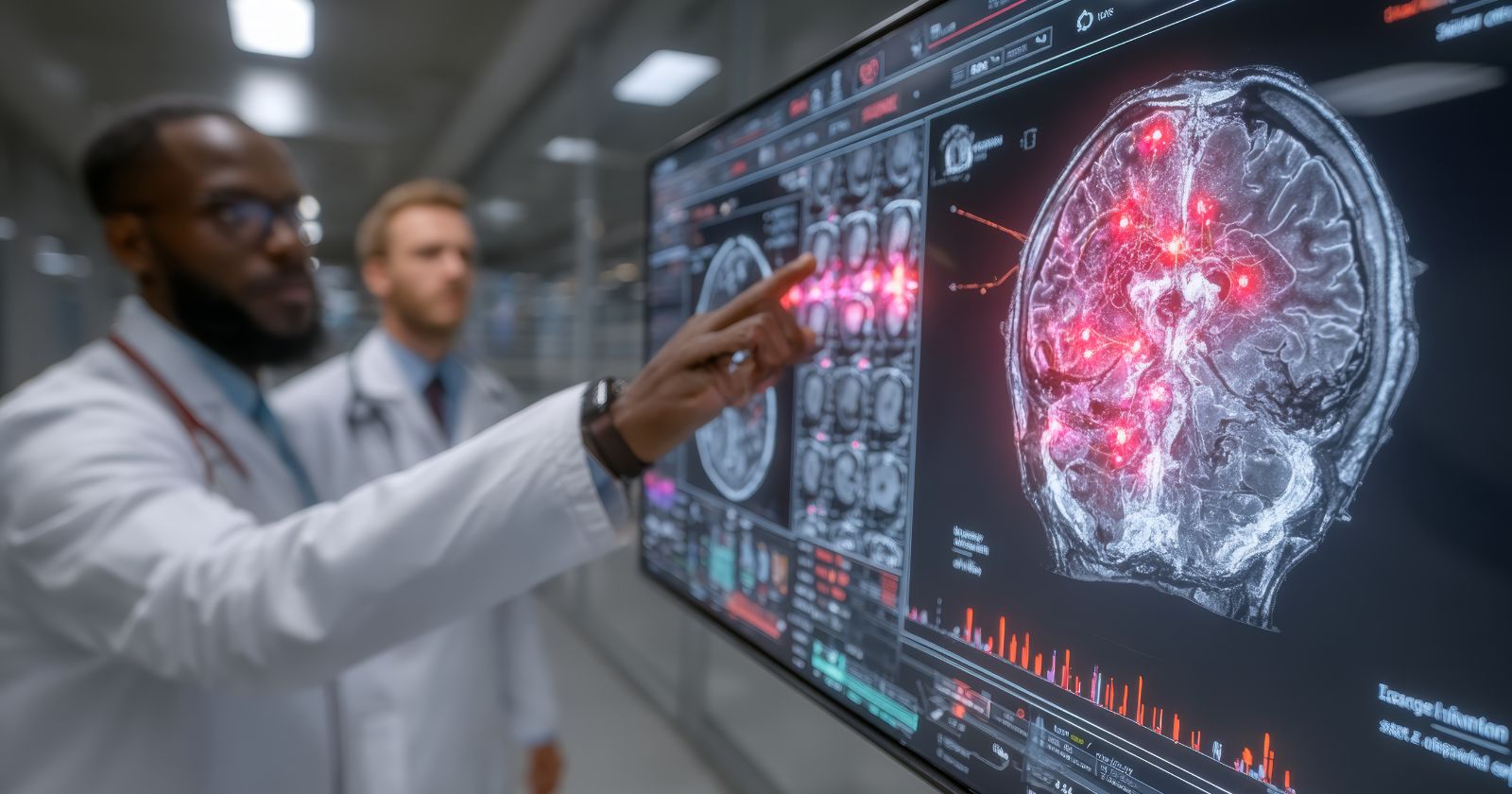
Casey Harrell’s care partner connects the cables in the morning, and then leaves him to it. After that, the device on his head — four arrays of 64 electrodes each, planted in the strip of cortex that used to send commands to his mouth — does the work his motor neurons no longer can. He sends emails. He works. He talks to his daughter. He keeps doing the climate advocacy he was doing before ALS took the muscles that move his lips and tongue. Five and a half hours a day, on average, every day, for nearly two years, with no scientist in the room.
A cochlear implant gives sound back to the ear by skipping the broken hair cells and speaking directly to the auditory nerve. A speech brain-computer interface does something stranger. It skips the broken motor pathway entirely and reads the intention to speak straight from the cortex, before the lips, tongue, and breath would have shaped it into air. Harrell has been living with that second invention for almost three years. The device in his skull has logged more hours than any speech BCI in history, and the people who built it have started calling him something the field has never had before: BCI researchers use the term power user to describe patients who achieve this level of sustained usage.
The phrase matters because BCI research has spent two decades on demonstrations. A patient sits in a lab. Cameras roll. A sentence gets decoded. Headlines follow. Then the equipment goes back in the cabinet and the patient goes back to whatever communication tools they had before, which for late-stage ALS is often a gaze tracker that spells one slow letter at a time.
Harrell’s case, reported this week by MIT Technology Review and published in Nature Medicine, breaks that pattern. He uses the implant at home. He uses it without researchers in the room. He uses it to do his job.
What 3,800 hours actually looks like
The headline number from the Nature Medicine paper is 3,800 hours of independent use within the first 22.6 months after implantation. That works out to roughly five and a half hours a day, every day, for nearly two years, with no scientist watching. For context, most published BCI studies report results from sessions measured in hours total, not thousands of hours. The shift from supervised demo to unsupervised tool is the entire point of the paper.
The accuracy figures are the other half of the story. On the first day the device was switched on in August 2023, Harrell hit 99.6 per cent accuracy on a 50-word vocabulary. The UC Davis team then expanded the dictionary to 125,000 words. Essentially every word an English speaker is likely to need. Accuracy held at 97.5 per cent. The system today runs at 99 per cent.
Those numbers are not marketing. They are the difference between a device a patient tolerates for an hour of testing and a device a patient chooses to wear for most of their waking life.
How the implant reads a word before it is spoken
Four arrays of 64 electrodes each, 256 in total, were implanted into Harrell’s speech motor cortex in July 2023 as part of the long-running BrainGate clinical trial. The speech motor cortex is the strip of brain tissue that sends commands to the muscles that produce speech: jaw, tongue, larynx, lips. In ALS, the motor neurons that carry those commands to the muscles die. The intention to speak survives. The pathway out does not.
The arrays sit on top of that intention. When Harrell tries to say a word, his cortex fires the same pattern it would have fired before his diagnosis. The electrodes record the activity. A model trained on his particular neural signatures translates the pattern into phonemes, the 39 sound units that make up every word in American English, and then assembles the phonemes into words and sentences. A synthesised voice speaks them aloud.
The phoneme approach is why a 50-word vocabulary could be scaled to 125,000 words without retraining everything from scratch. You do not have to teach the system every word. You teach it the sounds, and the sounds combine.
Two earlier New England Journal of Medicine papers, one in 2023 from the UC Davis group and a parallel study from a Stanford-affiliated team, established that high-density electrode arrays could decode attempted speech faster and more accurately than anything previously demonstrated. What the new Nature Medicine paper adds is durability. The signal did not collapse after a few weeks, and the patient kept using the device long after the novelty wore off.
The quiet ambition of “power user”
Mariska Vansteenel, a BCI researcher at Utrecht Medical Center who has worked with implanted patients for years, framed the threshold the field has been chasing. According to MIT Technology Review’s account, she argued that for these technologies to be relevant for patients, they need to be tested in the settings where they will actually be used, to show that they have value, that they are usable, and that they function without constant researcher involvement.
That is the bar. Not peak accuracy in a controlled session. Sustained accuracy across months in a kitchen, a bedroom, a home office, with the equipment connected by a spouse instead of a postdoc.
Jane Huggins, who develops non-invasive BCIs at the University of Michigan, described the milestone bluntly. Long-term, independent use with efficient and accurate communication is, she told the magazine, the holy grail of BCI.
The reason that grail has been so hard to reach is not algorithmic. The decoding maths has been improving steadily for a decade. The problem is biological. Electrodes implanted in cortex provoke immune responses. Tissue scars around the arrays. Signals degrade. Vansteenel pointed to a previous patient, a woman with ALS, who used a fully implanted BCI device for seven years before it stopped working. A long run, but eventually a finite one.
Harrell’s 22.6 months of stable, high-accuracy use is therefore not just an engineering result. It is a tissue result. The brain has accepted the implant well enough, for long enough, for the device to become part of how he lives.
What Harrell himself said about it
The quote from Harrell that the researchers chose to put forward is unusual for a clinical paper, because it refuses the framing the field usually offers patients. Living with a disease like ALS, he said, you are supposed to have diminished dreams. He does not. Any one of the capabilities the implant restored would, in his words, be an absolute godsend of improvement. To have all of them, and many more, is truly revolutionary.
Read that carefully. He is not thanking the researchers. He is correcting an assumption baked into how terminal neurodegenerative disease is discussed: that the appropriate response is to want less. He is reporting that he wanted more, and got it.
That distinction is going to matter as BCIs move from research to product. The patients who will benefit most are not looking for a slightly improved communication aid. They are looking for the restoration of a life they were told to grieve.
The voice problem nobody has solved yet
The current system speaks for Harrell in a synthesised voice. It is intelligible. It is fast enough to hold a conversation. It is not his voice.
The UC Davis team, led by neuroengineers Sergey Stavisky and Nicholas Card, is working on what they call a brain-to-voice system: decoding not just which word the user wants to say but the prosody, the cadence, the inflection, the emotional weight underneath it. Sarcasm. Hesitation. A question asked tenderly versus the same question asked impatiently. The features that turn speech from information transfer into actual communication.
This is a much harder problem than word selection. Word selection is discrete. Prosody is continuous, and it is wrapped up with motor control of the larynx and breath in ways that are still being mapped. Earlier foundational work on cortical control of speech production established that the motor cortex encodes articulatory gestures rather than acoustic outputs directly, which means reconstructing a person’s natural-sounding voice requires modelling the gestures and then resynthesising the sound.
If the team succeeds, Harrell will not just be able to say what he means. He will be able to sound like himself saying it. Family members of late-stage ALS patients tend to describe the loss of the voice as a second bereavement, separate from the loss of mobility. Restoring it would close a gap that current assistive technology cannot touch.
Why this is not yet a product
The temptation, given numbers like 99 per cent accuracy and 3,800 hours of home use, is to treat this as a solved problem awaiting commercialisation. It is not.
Harrell is one patient. The researchers themselves caution that results may vary across individuals: different cortical anatomy, different disease progression, different responses to the implant itself. Some ALS patients, faced with the choice between brain surgery and a non-invasive gaze tracker, will choose the tracker. That preference is rational and is not going away.
The device also still requires a care partner to connect it each day. The hardware on Harrell’s head is not the slim consumer-style implant that companies like Neuralink have advertised. It is a research rig, with cabling and external processing, designed for a clinical trial rather than for a shower.
And the regulatory path from compassionate-use trial to approved medical device runs through years of multi-patient studies, manufacturing qualification, and reimbursement negotiations. The patients who could benefit most — people with locked-in syndrome, late-stage ALS, severe brainstem stroke — number perhaps in the hundreds of thousands globally. That is a meaningful market for a serious medical device. It is not a consumer product timeline.
The competitive field around Harrell’s case
BrainGate is the longest-running invasive BCI trial in the world, and the UC Davis arm that implanted Harrell is one of several active sites. Parallel programmes at Stanford, UCSF, and several European centres are pursuing variations on the same idea. Some use surface electrodes that sit on the cortex rather than penetrating it. Some use deeper probes. Some use wireless transmission instead of percutaneous connectors.
Neuralink, the most publicly visible private entrant, has implanted its device in a small number of patients and demonstrated cursor control rather than speech decoding. Synchron has taken a less invasive approach, threading electrodes through blood vessels to reach motor cortex without open-brain surgery. Precision Neuroscience has focused on a thin-film array that sits on the cortical surface.
What the Harrell paper does to that competitive field is set a new floor for what counts as a serious result. A demo of cursor control in a lab is no longer the bar. The bar is now: can your patient use this device, by themselves, every day, for years, to do real work in their own home? Until a system clears that bar, it is a prototype.
What gets resolved when speech comes back
ALS strips function in a particular order that varies by patient but tends, in the bulbar form, to take speech early. Families report a specific kind of grief that arrives when the person they love is still mentally present but can no longer participate in dinner-table conversation, cannot tell a joke at the right speed, cannot interrupt. The mind is loud. The room is quiet. Assistive devices help, but they impose a tempo so slow that spontaneous conversation collapses around them.
A BCI that runs at conversational speed with 99 per cent accuracy changes the social geometry of the disease. The patient can interrupt. Can make a joke at the right moment. Can answer a question before the topic has moved on. Can be, in conversation, themselves.
This is the part of the result that does not show up in the accuracy tables. It is the part Harrell was pointing at when he refused the language of diminished dreams.

The longer arc
There is a question the paper does not try to answer, and probably cannot. When the device speaks for Harrell, in a voice that is not his, at a speed that mostly keeps up with the conversation, what exactly is happening? Is the synthesiser a tool, the way a keyboard is a tool? Or is it closer to a prosthetic part of him by now, after 3,800 hours of use, something his brain has learned to inhabit the way it once inhabited his tongue?
He has not said. The researchers have not asked, at least not in the paper. What he has said is that the dreams he was supposed to give up, he did not give up. The device on his head, connected each morning by someone who loves him, is how he keeps them.