The spiral staircase drops 131 steps into the limestone, and the temperature falls with it. By the bottom, twenty metres beneath the Place Denfert-Rochereau, the air has settled at around 14°C and stays there summer and winter. The walls sweat. Footsteps crunch on gravel laid over bedrock. For several minutes there are no bones at all, only low quarry galleries with engraved street names matching the roads overhead, and then a dark stone doorway carrying an inscription in carved capitals: Arrête! C’est ici l’empire de la mort. Stop. This is the empire of death.
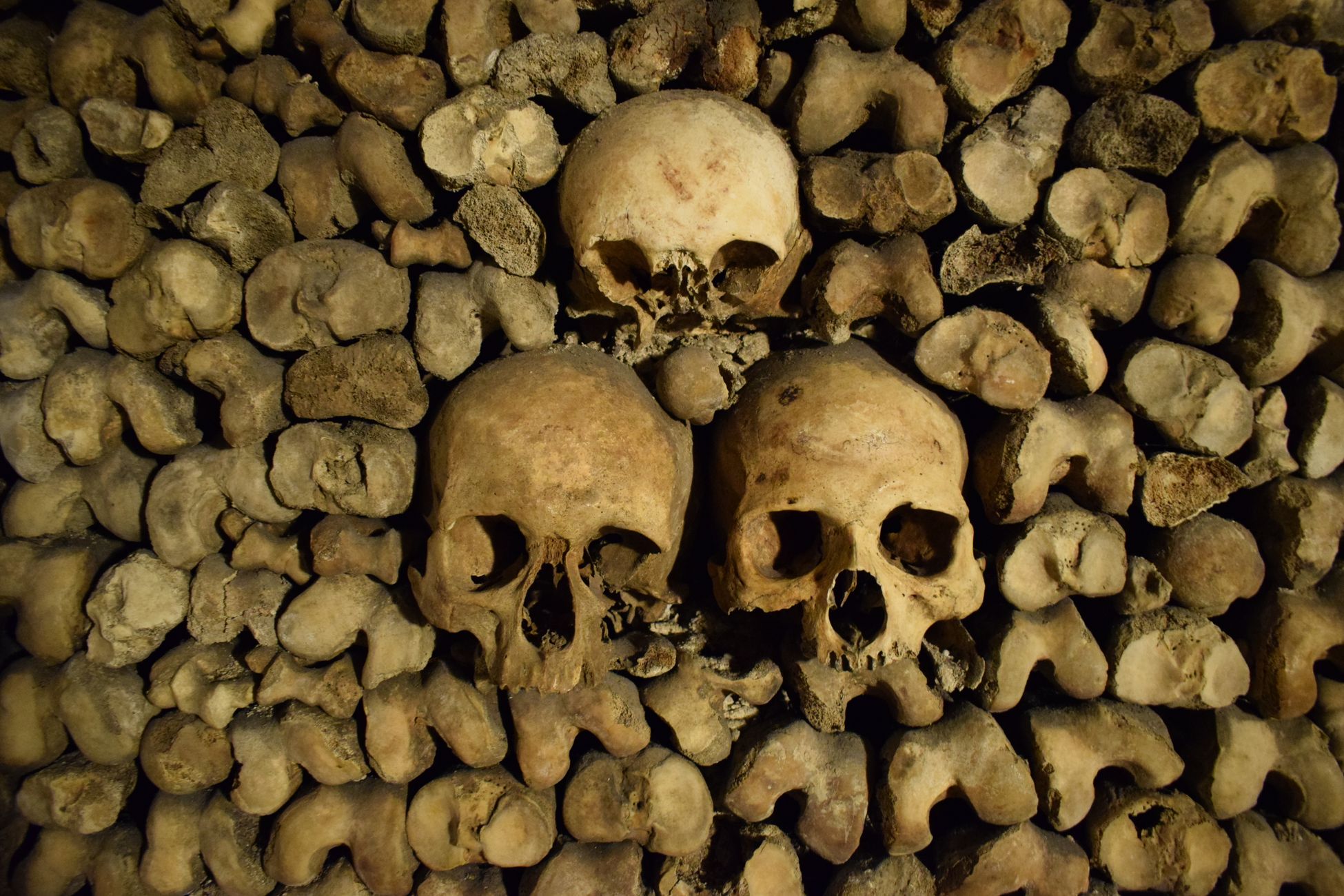
Beyond it, the walls become bones. Femurs laid lengthways form a façade; skulls are arranged in horizontal bands, in crosses, in hearts. Behind the neat fronts lie loose mounds of vertebrae, ribs, and fragments. The remains of an estimated six million Parisians are stacked in a roughly 200-kilometre warren of tunnels, of which only about 1.5 kilometres — a narrow, lit, signposted loop — is open to the public. The rest is dark, flooded in places, and officially forbidden.
The bones arrived here starting in April 1786, when a procession of black-draped carts began rolling out of the Cemetery of the Holy Innocents in central Paris after dark, carrying the disinterred remains of generations of Parisians toward an abandoned limestone quarry on the southern edge of the city. The cemetery had been the dumping ground for the dead of around twenty parishes for almost a thousand years, its earth so saturated with corpses that the walls of neighbouring cellars on the Rue de la Lingerie had burst open in 1780, spilling rotting remains into the basements of wine merchants.
Why the bones had to move
By the 1780s, central Paris had a smell problem that even an 18th-century nose could not ignore. Holy Innocents alone had absorbed around two million bodies into a plot smaller than a city block. Bodies were stacked in mass graves up to ten metres deep, covered with a thin layer of soil, and reopened as soon as the previous layer had decomposed enough to make room.
Wine spoiled in nearby cellars. Milk soured within hours. Residents complained of a constant sweet, putrid haze that clung to laundry hung in the courtyards above.
Louis XVI’s Council of State finally ordered the cemetery closed in 1780. The question was where to put the remains of a millennium of Parisians.
A quarry that already ran under the city
The answer lay beneath the Left Bank. Since Roman times, masons had been cutting the pale, fine-grained limestone now known as Lutetian limestone out of the bedrock under what is today the 14th arrondissement. That stone built Notre-Dame, the Louvre, and most of the older mansions of the Marais.
By the 18th century, the quarrying had left a chaotic three-dimensional honeycomb under the southern districts. Houses were beginning to fall into sinkholes. In 1774, a stretch of the Rue d’Enfer collapsed and swallowed buildings whole, prompting the creation of the Inspection Générale des Carrières to map and reinforce the underground.
It was the inspector general of that body, Charles-Axel Guillaumot, who proposed using a section of the consolidated quarry as a vast ossuary. The site sat far outside the city limits of the time, near the Barrière d’Enfer, the southern toll gate.
The night processions
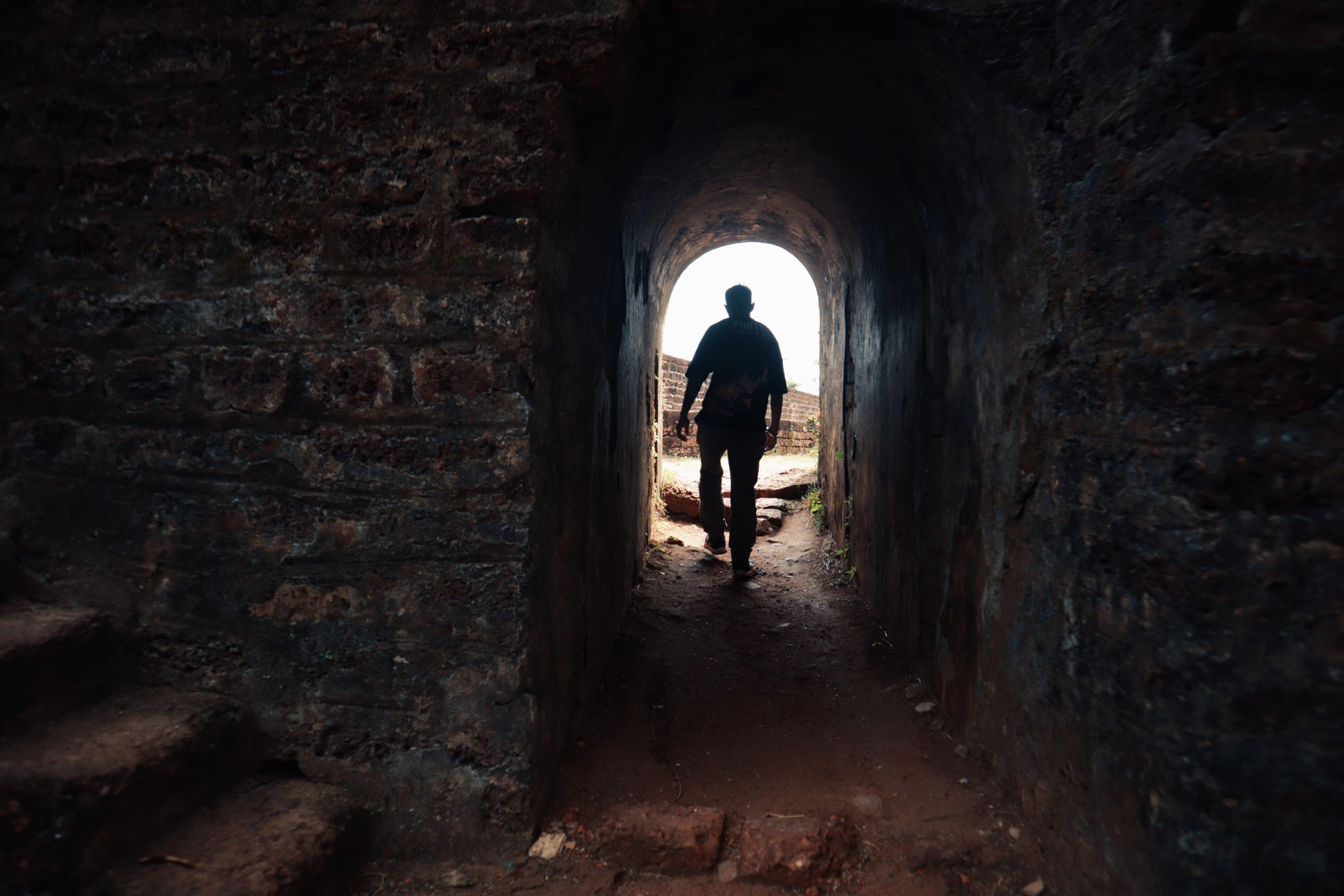
The transfers began on the evening of 7 April 1786 and continued, on and off, for decades. Carts moved only at night to avoid public distress, draped in black cloth, escorted by priests chanting the office of the dead. Workers tipped the bones down a well-shaft at the quarry entrance, where other workers below stacked them.
The first transfers from Holy Innocents took two years. Later campaigns emptied dozens of other parish cemeteries, including Saint-Eustache, Saint-Nicolas-des-Champs, and the burial grounds attached to hospitals and convents shut down during the Revolution. Bones from victims of the September Massacres of 1792 ended up in the tunnels. So did remains from the Tuileries graveyards after the storming of the palace, and from the cemetery of the Madeleine, where Louis XVI and Marie Antoinette had been buried before their exhumation.
Why the bones are arranged like that
The first deposits were simply heaped. Visitors in the early 1800s described shapeless piles of femurs and skulls visible by lamplight, with no order at all.
That changed under Louis-Étienne Héricart de Thury, who took over the Inspection des Carrières in 1810. He decided the ossuary should be a place fit for visitors and reflection, not a charnel pit. Under his direction, workers spent years restacking the bones into the neat walls now visible: long bones laid lengthways to form a façade, skulls arranged in horizontal bands or crosses or hearts, smaller bones used as fill behind.
Each wall is, in effect, a stone-faced curtain. Behind the visible femurs and skulls lie loose mounds of vertebrae, ribs, hand and foot bones, and fragments. The parts that do not stack as photogenically.
Héricart de Thury also added the carved inscriptions in French and Latin that still punctuate the route, drawn from Lamartine, Virgil, and the Book of Job.
What a visitor actually sees
The official entrance sits in a small green-roofed pavilion on the Place Denfert-Rochereau. A spiral staircase of 131 stone steps drops visitors twenty metres down, roughly the height of a five-storey Haussmann apartment block, taken in reverse.
Engraved into the limestone along the early galleries are small models of fortresses carved by an 18th-century quarry worker named Décure, a veteran of Louis XV’s armies who died in a tunnel collapse before finishing his work. Then comes the doorway with its warning, and the ossuary begins.
The fascination with going down there
Around half a million people visit the official route each year, queueing for hours on the pavement above. The pull is old. Charles X toured the catacombs in 1814. Napoleon III brought his son in 1860. Otto von Bismarck went down in 1867.
The draw of such sites lies in what some describe as morbid curiosity, a rehearsal of mortality rather than a taste for the grotesque. The Catacombs were designed with exactly that reading in mind. Héricart de Thury’s inscriptions are explicit invitations to meditate on death.
The phenomenon now extends well beyond Paris. Sites associated with violent or untimely death, from Pompeii to the homes of recent crime victims, pull steady streams of visitors who describe wanting to feel something specific about being alive.
The 198 forbidden kilometres
The lit loop is a sliver. The total network of former quarries under Paris stretches across roughly 200 kilometres, threading under the 5th, 6th, 13th, 14th, and 15th arrondissements. Entering any part of it outside the official route has been illegal since 1955, punishable by a fine.
That has not stopped the cataphiles, the loose community of urban explorers who slip in through manhole covers, railway tunnels, and basement passages. Inside, they have found chambers with carved stone benches, a clandestine cinema discovered by police in 2004 complete with a film projector and a working bar, and walls covered in graffiti from every decade since the 1830s.
A specialised unit of the Paris police, the ERIC (Équipe de Recherche et d’Intervention en Carrières), patrols the network. They carry maps, lights, and dry clothes, because in some galleries the water reaches chest height.
The unofficial system is dangerous for reasons beyond drowning. Anyone uncomfortable in tight spaces will find the off-route tunnels punishing. Some passages narrow to crawlspaces that go on for tens of metres, the kind of environment that triggers claustrophobic panic even in people who consider themselves unbothered by enclosed places.
What is still down there
The bones themselves are mostly anonymous. A few notable exceptions are marked by plaques: a section associated with remains from the Hôtel-Dieu, another with the cemetery of the Madeleine. Jean de La Fontaine, Charles Perrault, François Rabelais, Blaise Pascal, Jean-Paul Marat, and Maximilien Robespierre are all believed to lie somewhere in the heaps behind the decorative walls, their individual remains long since mixed with everyone else’s.
Sections of the official route have been closed in recent years for structural reinforcement. Above ground, the catacombs still cause occasional sinkholes, a reminder that the limestone the city is built from is also the limestone the city scooped out from beneath itself.
Walking the lit route takes about 45 minutes. What visitors actually tour, in those 45 minutes, is not death but a 19th-century inspector’s idea of how death should be presented: bones arranged into pleasing patterns, inscriptions chosen for their literary weight, the messy parts hidden behind the photogenic ones. The six million people themselves were stripped of name, parish, and place a long time before any tourist arrived.
That is perhaps the harder thing to sit with on the way back up the staircase. Paris built its cathedrals, its palaces, and its grand boulevards from the same limestone it then used to store the dead it had no more room for. The monuments above and the ossuary below are cut from one rock. The question worth carrying out into the daylight is not how the bones got there, but what kind of city decides that erasure, neatly stacked, counts as remembrance.