

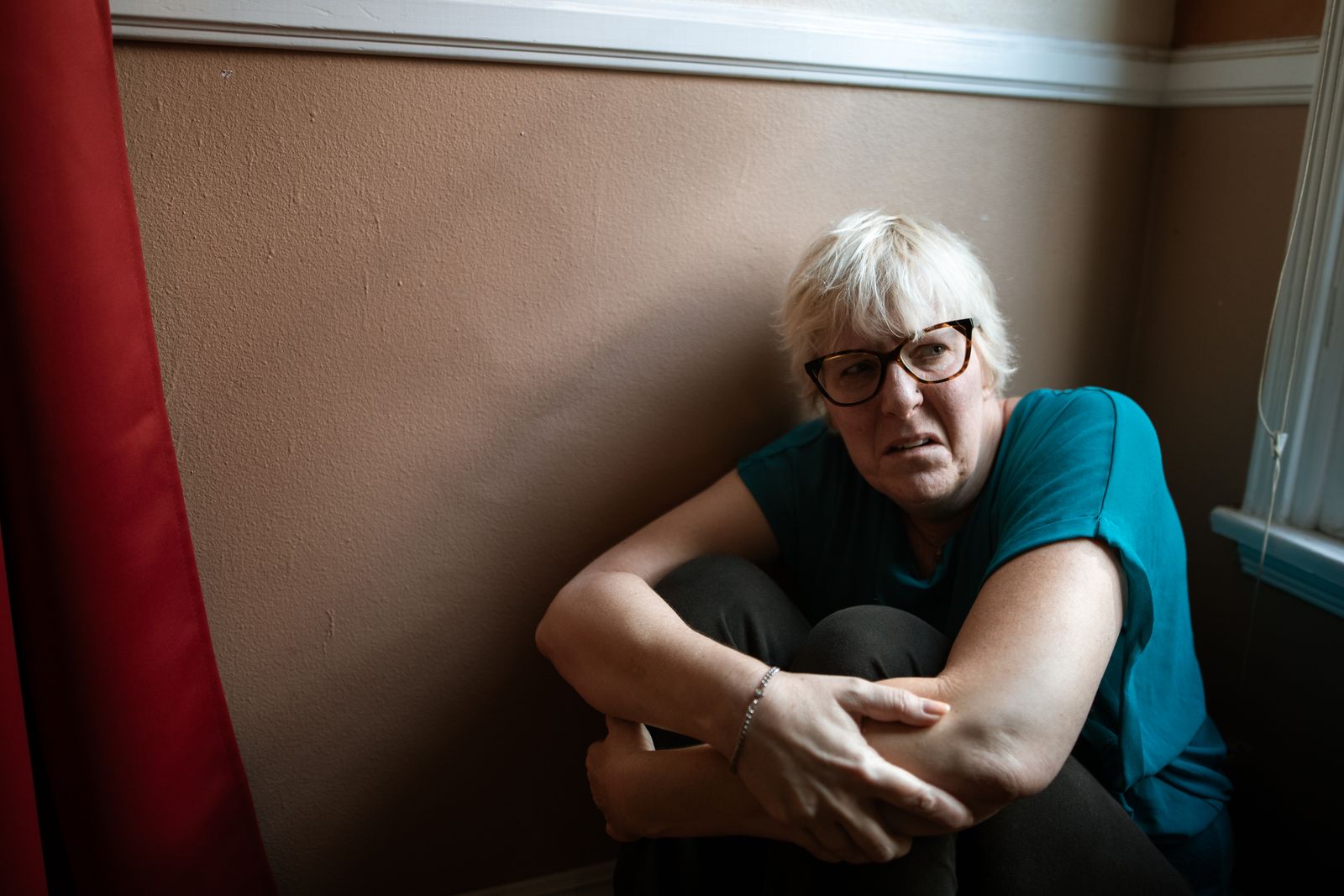
It is 11:47 on a Tuesday night. The dishwasher is humming. A woman is standing at her own kitchen sink, holding a mug she has not drunk from, and her eyes have started to sting for a reason she could name if anyone asked. No one is asking. No one is there.
She whispers sorry anyway.
She is not apologising to the empty room. She is answering an old household rule — a rule learned around someone whose mood once set the emotional weather for everybody else. From the outside, the reflex can look like oversensitivity. Up close, it looks more like an old form of emotional organisation that never quite realised the situation had changed.
The household that organised itself around one person’s tears
In some families, one adult’s emotional state becomes the central thermostat. If they are fragile that morning, voices drop. If they cry, the children learn to become quieter, more useful, more watchful, or less visible. Crying, in that house, is not just crying. It is a signal that someone needs to step in, soothe, perform, fix, explain, distract, or disappear. A child watching this learns very quickly that tears are not always treated as a private release. They can become a public event with consequences. Birthdays are still remembered, school lunches still packed, but underneath the ordinary rhythm a second schedule runs: who is upset, who is about to be, who can be approached and when.
That child grows up. The household dissolves. The parent moves on, or does not. And still, years later, the body can respond to its own wet eyes as though someone else is now owed reassurance.
So they apologise. Even to no one.
The mechanism has a name, and it isn’t oversensitivity
This kind of role-reversal — emotional parentification — describes a family pattern in which a child takes on responsibilities that ordinarily belong to the parent, including emotional support, mediation, and comfort.
It is not always dramatic. It rarely looks obvious from the outside. Often it looks like a sensitive, helpful, observant child in a home where one adult is a little too much, a little too often.
The child learns to read micro-expressions before they have language for what they are doing. They learn that their own distress may need to wait. They learn that the safest emotional position is often the one that causes the least disruption.
That same watchfulness can travel into adulthood. Decades later, it may be the reason someone finds themselves apologising to a kitchen.
Why the old rule can stay active
Children do not simply observe the emotional life of a home. They adapt to it. Recent writing on brain-to-brain coupling between parents and children describes how communication, emotion, attention, and shared experience can shape the way people attune to one another.
In a steady home, that attunement can help a child feel connected and understood. In a home where one person’s mood is unpredictable, the same attentiveness can become more burdensome. The child is not simply learning one person’s habits. They are learning a rule: watch the room carefully, because the room can change fast.
That rule can outlive the household that produced it. It can move out, get a job, sign a lease, and stand in a kitchen at thirty-eight years old, apologising for the inconvenience of its own grief.

It is not always one big event
The instinct to apologise for crying does not always trace back to one terrible night. More often, it traces back to accumulation: the dropped voices, the careful timing, the emotional weather reports children learn to make before they know they are making them.
This is part of what makes the pattern confusing for adults trying to understand themselves. As Iowa State developmental researcher Carl F. Weems argues in a new theory of adverse childhood memory, people’s memory and perception of adverse experiences can evolve over time, shaped by later development and later life.
That matters here because a person may have spent years saying nothing really happened. No one was hit. No one left. No obvious catastrophe took place. Yet the adult body may still hold evidence of a childhood spent carefully managing someone else’s state.
The apology in the kitchen is not proof of a diagnosis. It is a clue about what once felt necessary.
The homes that looked fine on paper
Some of the most persistent patterns of self-suppression come from homes that looked ordinary from the outside. There was food in the fridge. The child went to school. Birthdays were remembered. Nobody outside the family would necessarily have known that one person’s distress quietly organised the entire room.
Writing in Psychology Today, therapists have described the ways well-meaning parents can leave lasting marks on children, especially when emotional responsiveness is inconsistent or limited.
That is the kind of household this article is concerned with: not necessarily the house with visible disaster, but the house with a thermostat. The house where one adult’s state determined everyone else’s volume, timing, honesty, and permission to need anything.
The child in that house may become extremely good at appearing fine. The adult version may still be trying to figure out why crying alone feels like something they should apologise for.
The signs an adult learned this script
The kitchen apology is the most visible version of the pattern, but it often travels with relatives.
Adults who grew up monitoring a parent’s mood may flinch at the sound of their own raised voice. They may preface bad news with reassurance for the listener. They may cry in cars and bathrooms because those rooms feel private, contained, and less likely to inconvenience anyone.
They may thank people for letting them be upset. They may apologise for taking up time on a phone call about their own bad day. They may say I’m fine, I just need a minute the way other people say excuse me.
None of this has to be performance. It can be the continuation of a job description nobody ever formally revoked.
The apology is doing two jobs at once
The first job is obvious: to neutralise the imagined burden of the tears on whoever might walk in. Even when no one is walking in. Even when no one lives there but the person crying.
The second job is older. It is a form of self-soothing. The child who learned that apologising could soften a parent’s reaction may also have learned that apologising softened their own fear of that reaction. The word sorry became less a moral statement than a familiar way of lowering the emotional temperature.
This is why telling an adult you have nothing to apologise for may not immediately reach the part of them that keeps saying it. The apology is not aimed at a moral accountant. It is aimed at an old alarm system that still associates visible emotion with danger, inconvenience, or fallout.

It overlaps with other quiet adaptations
Children who grew up managing a parent’s emotions often develop a particular relationship to expression in general. Direct feeling may have seemed too risky. Anger might have been softened into helpfulness. Hurt might have been converted into silence. Need might have been packaged as humour, competence, or practicality.
The kitchen-apologiser often shares that history. Direct emotion was not safe upward, sideways, or even inward. It had to be edited before anyone else saw it.
They may also fit the pattern of adults who fall apart privately and reassemble without fanfare. Not because privacy is some noble form of strength, but because privacy was the only place falling apart ever felt permitted.
Why the mood-management role is hard to put down
Building on research into emotional availability in parent-child relationships, healthy attunement can be understood as a two-way exchange: caregiver and child read and respond to each other, while the adult carries most of the responsibility for regulation, safety, and repair.
When that responsibility quietly shifts toward the child, the child may develop skills that are genuinely useful. They become perceptive, empathetic, conflict-averse, quick to read a room. These traits can earn praise. They get called mature for their age, an old soul, so easy.
Adults rarely surrender skills that once earned approval, closeness, or calm. The mood-management role may not be experienced as a wound. It may be experienced as an identity. And identities do not dissolve just because they stopped being necessary.
The estrangement era has complicated this
Berkeley’s Greater Good Science Center has reported on the rise in family estrangement, citing Cornell research that 27% of adults are estranged from a family member. In the same piece, psychologist Joshua Coleman describes a cultural shift in which parent-adult-child relationships are increasingly judged not only by obligation, but by whether they support happiness, growth, and emotional well-being.
For the adult who spent childhood managing a parent’s tears, that shift can create a strange split. They may now have language for the household they grew up in. They may have distance from the parent. They may have read enough, talked enough, and reflected enough to know that the old role was too much for a child.
And still, the kitchen apology remains.
The vocabulary changes faster than the reflex.
What a gentler reframe allows
The instinct, on recognising this pattern, is often to try to stop apologising. To catch the word, correct it, and demand that the reflex retire.
But a reflex learned around safety rarely responds well to being scolded. The more humane starting point is noticing. Noticing when the apology appears. Noticing who it seems to be for. Noticing whether the room actually contains the person the body is still answering.
That does not turn the piece into advice or treatment. It simply changes the meaning of the moment. Instead of treating the apology as a flaw, the adult can recognise it as residue from a time when their feelings were not allowed to be just feelings.
Over time, that recognition can make the apology less mysterious. The kitchen is empty. No one is waiting to be managed. No one’s mood depends on the next thirty seconds. The tears can simply be tears.
The reframe that matters
It is worth saying plainly: the adult who apologises for crying alone is not weak, not broken, and not too sensitive for the world. They may be someone who learned very young that their feelings were not just feelings. They were inputs into someone else’s emotional system. They were variables to be controlled.
That is a remarkable thing for a child to be assigned. It is an exhausting thing for an adult to keep carrying. So the harder question is the one the kitchen keeps asking: what does it actually cost to keep apologising to a room that contains no one?
Every sorry whispered into an empty house is a small payment. Paid to whom? For what? On a debt that was never the child’s to begin with, and that the adult has long since overpaid.
What might open if the apology were refused entirely — if the next time the eyes sting at the sink, the word simply did not come? Probably not freedom. Probably not even comfort. Maybe only silence, and the strange, unfamiliar sound of crying that is not also performing its own clean-up. That may be the question worth sitting with. Not how to stop saying sorry, but who, exactly, is still being protected — and whether they are owed one more word.
