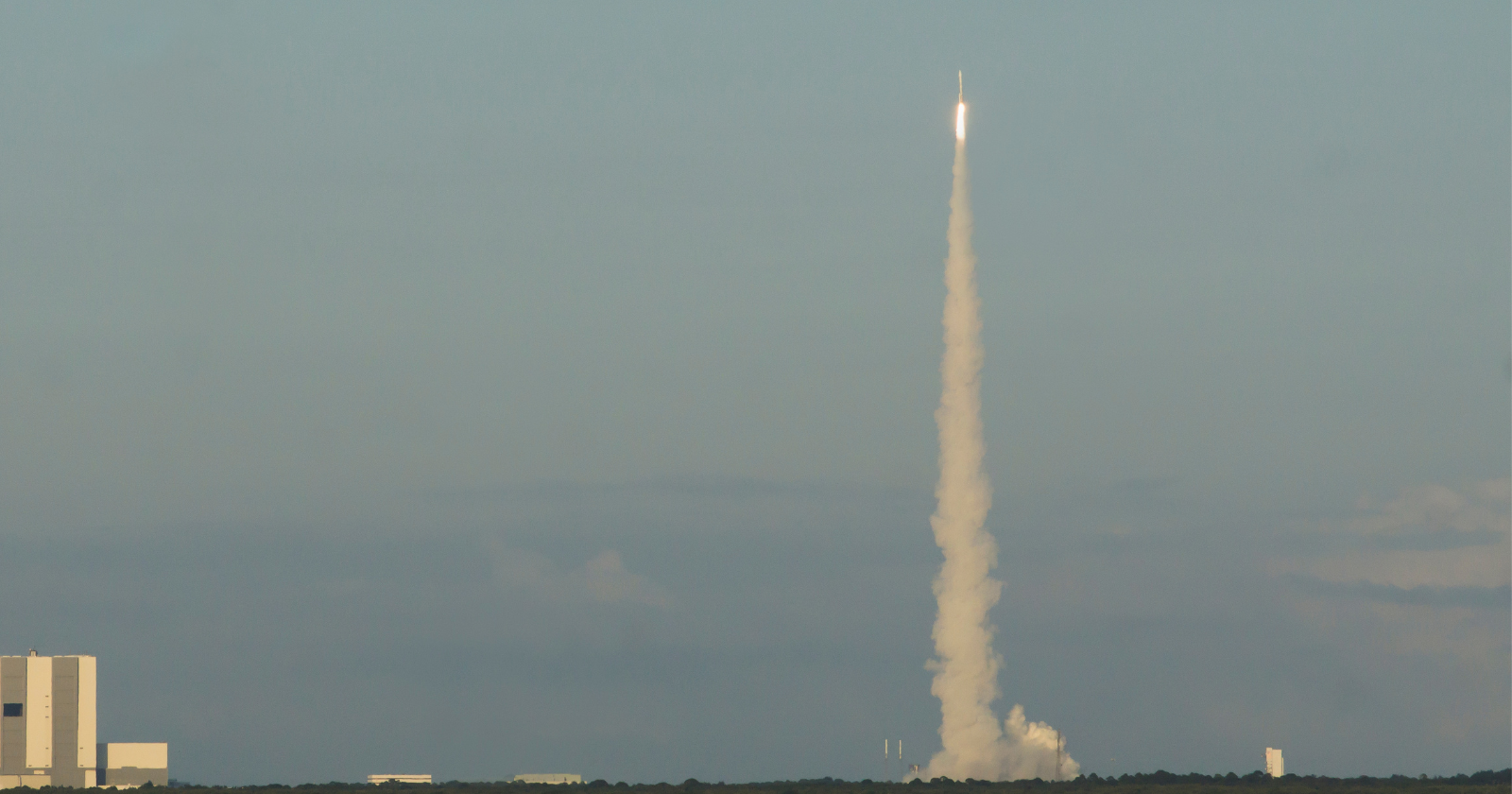
A four-tonne projectile returning ballistically from 100 kilometres up hits the ground at something close to terminal velocity. Nothing bolted to its nose cone will survive the impact intact. The engineering question, in the autumn of 1946, was not how to keep a camera alive through that crash. It was how to keep the film alive after the camera was already pulverised.
The answer was a steel cassette, machined thick enough to act as its own crash vault, sized to bury itself nose-first in soft gypsum sand and decelerate over several feet of give. Wrap the exposed film inside it. Trust physics. Trust the geology of southern New Mexico.
On October 24, 1946, a team of American engineers and a handful of German rocket scientists stood in the New Mexico scrub at the White Sands Missile Range and watched a captured V-2 rocket lift off the desert floor with a 35mm camera bolted into its nose cone. High above the Earth, somewhere above the line where the atmosphere thins into something closer to vacuum, the camera kept clicking until the rocket arced over and came screaming back down at several thousand miles per hour.
It hit the desert and disintegrated.
The camera was pulverised. The film survived. That film, when the engineers spliced it together a few days later, showed the curve of the Earth. The first photographs of our planet ever taken from space.
The reason any of it survived is almost absurd in its simplicity. Engineers from the Applied Physics Laboratory at Johns Hopkins had wrapped the film cassette in a steel cartridge, calculated that the rocket would bury itself nose-first in the soft gypsum sand, and trusted physics to do the rest. The cartridge was found in the crater. The film inside was intact.
A Nazi rocket in the New Mexico desert
The V-2 that flew that day was not American. It was German. One of the V-2s and parts that U.S. Army intelligence officers and the men of Operation Paperclip had shipped out of the Mittelwerk underground factory in the summer of 1945, packed onto trains and freighters and sent across the Atlantic before Soviet troops could claim them.
The same rockets that had killed thousands in London and Antwerp the previous year were now sitting on flatbed trucks rolling into a remote stretch of southern New Mexico, where the U.S. Army had set up a proving ground. White Sands had been formally established in 1945, shortly before the Trinity atomic test went off to the north.
The V-2 program at White Sands began in the mid-1940s. According to the U.S. Army’s official history of the range, the V-2 program at White Sands marked the United States’ entry into space technology.
Who put a camera in the nose
The idea did not come from the military. It came from engineers at the Johns Hopkins Applied Physics Laboratory in Maryland, who had been asked to figure out what a captured German weapon might do for science once the warhead was pulled out.
The team replaced the explosive payload with instruments: cosmic ray detectors, spectrographs, atmospheric samplers. On the October 24 flight, they added a 35mm motion picture camera, the kind of machine that would have been used in a 1940s newsroom or training film unit. They mounted it to look back along the rocket’s flank as it climbed.
The rocket reached an altitude well above the Kármán line, the conventional boundary of space that sits at 100 kilometres. The frames shot above that altitude, grainy, black-and-white, slightly tilted, were the first photographs of Earth taken from space.
Why the steel cartridge mattered
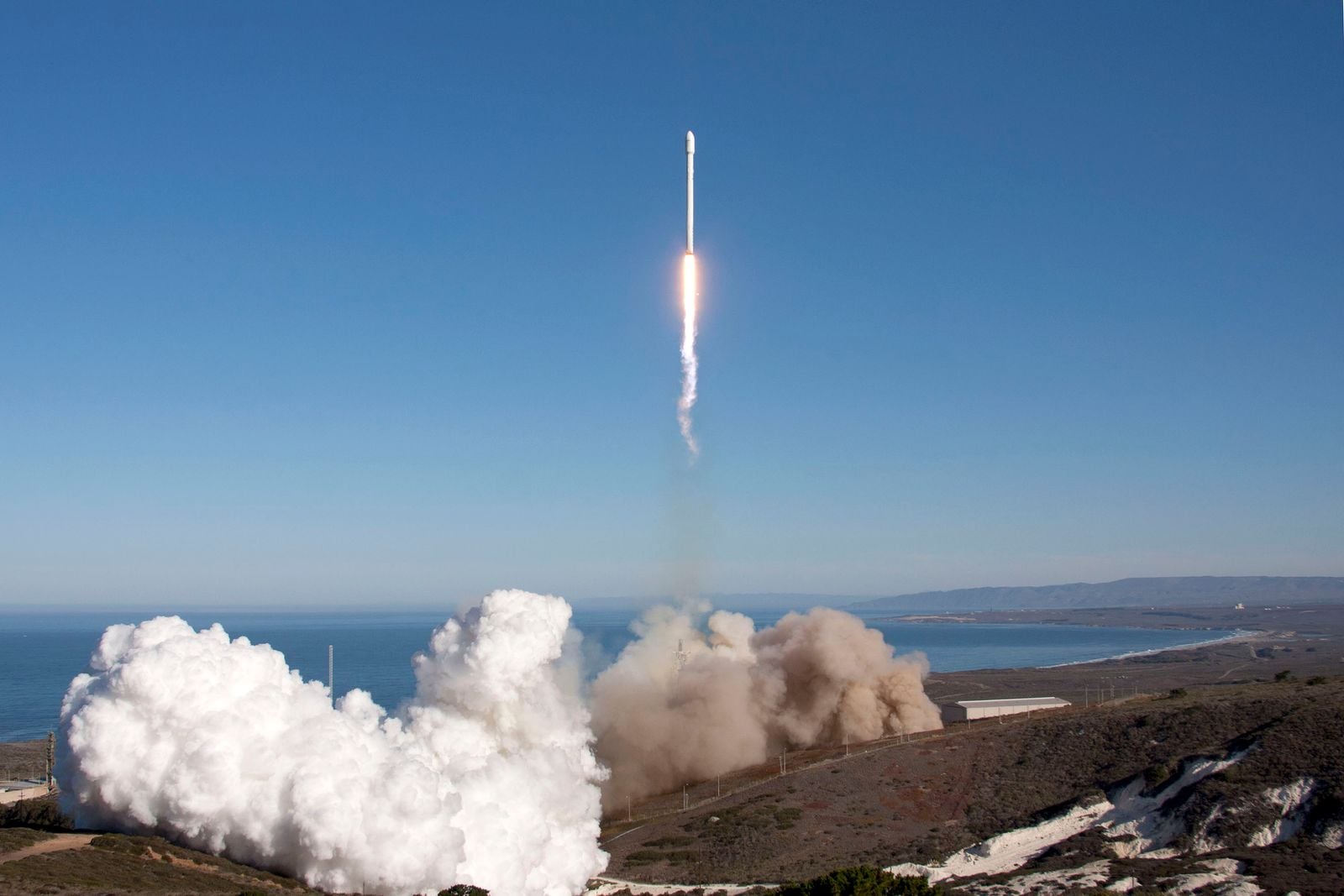
A V-2 returning ballistically from 100 kilometres up is not a gentle thing. It comes down nose-first, accelerating until air resistance balances gravity at something like terminal velocity for a four-tonne projectile, which is to say very fast. The rockets did not so much land as excavate.
The Johns Hopkins engineers had a problem and they solved it the way engineers in 1946 solved problems: by overbuilding. They housed the exposed film in a thick steel cassette, betting that the cassette’s mass and shape would let it survive the crash even if the rest of the rocket did not. They were also counting on the geology of the site. White Sands is named for its gypsum dunes, soft, fine, almost like flour in places. A steel cartridge fired into that sand at high velocity would decelerate over several feet of give rather than smashing against bedrock.
That was the plan. It worked. The recovery team dug the cartridge out, opened it in a darkroom, developed the film, and saw something no human had ever seen photographed before: the planet, edge-on, curving away into black.
The pictures themselves
The images are not beautiful in any conventional sense. They are smudged. The horizon tilts at strange angles because the rocket was spinning and tumbling near apogee. Clouds appear as bright streaks against darker terrain. The curvature of the Earth is clearly visible across the frame.
One of the most reproduced frames shows a band of cloud and what appears to be the Gulf of California, faintly. Another shows the New Mexico desert from directly above, the dunes white against the brown plain. The pictures were stitched together into a panorama and presented to the public the following year.
Before October 1946, photographs of Earth from high altitude had been taken from balloon flights, but well inside the stratosphere. The V-2 photographs pushed that ceiling dramatically higher in a single flight.
The view that nobody quite knew what to do with
The pictures arrived without the cultural apparatus to process them. There was no Earth Day yet. Earth Day would not happen until 1970. There was no environmental movement in the modern sense. The phrase “overview effect” would not be coined for another four decades, when space philosopher Frank White explored the phenomenon in his work on how views from space change us.
Astronauts who have experienced this view from space often describe an overwhelming sense of unity, beauty, and vulnerability. What has come to be known as an instant global consciousness, a people orientation, an intense dissatisfaction with the state of the world, and a compulsion to do something about it.
That language did not exist in 1946. The men at White Sands looked at the developed film and saw what they had bet would be there: that the Earth was curved, that the atmosphere had a visible upper edge, that a camera could be flown to the edge of space and brought back. The philosophical weight came later.
What the brain does with that view
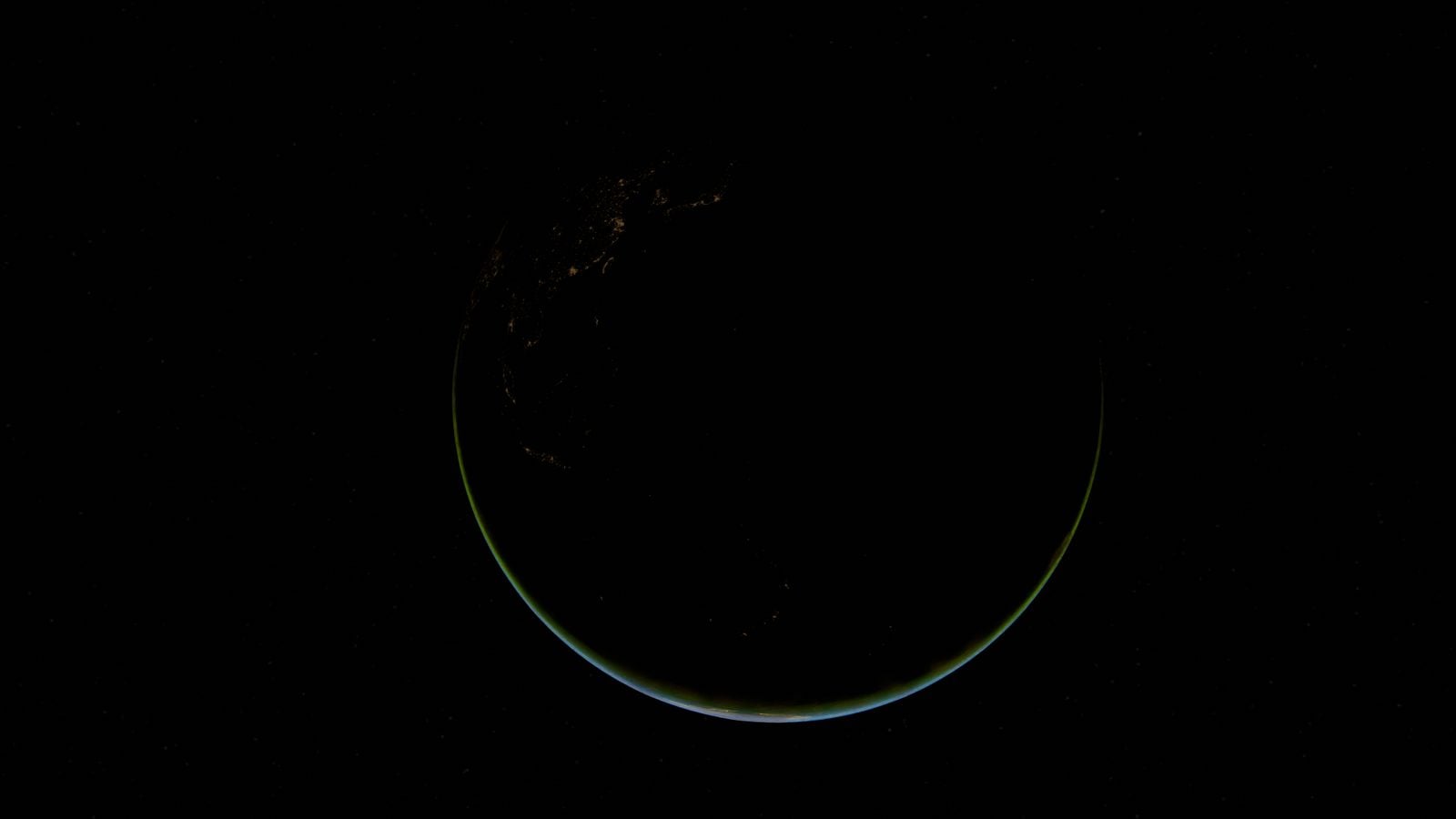
The psychological research on what astronauts now call the overview effect has caught up only in the last few years. Research on meditation and self-transcendence has explored how the brain responds to experiences of vastness and connection, revealing patterns of reduced mental processing and disruption of habitual thought patterns. The default mode network, the brain regions associated with self-referential thinking, appears to become less active during such moments.
Awe of this kind is not always pleasant. Writing for Scientific American, Allison Parshall noted that the word itself comes from an Old English term meaning terror or dread. William Shatner, after his Blue Origin flight, described the view as triggering profound feelings of grief. The overview effect is something so complex, so vast, that it transcends our understanding of the world.
None of that was available as a frame for the 1946 picture. It was just a picture. But the picture was the seed.
What followed in the desert
White Sands continued launching V-2s in the years that followed. Cameras improved. Telemetry got better. The instruments grew more sophisticated. Animal payloads followed: fruit flies on a V-2 in 1947, a rhesus monkey named Albert on another in 1948. (Albert suffocated before reaching altitude. Albert II, the following year, became the first monkey in space but did not survive the parachute failure on the way down.)
By the end of the decade, the rockets at White Sands had stopped being German hand-me-downs. The Redstone, designed at Huntsville under Wernher von Braun, the same von Braun who had designed the V-2, was being tested at the range. A Redstone would carry Alan Shepard on the first American crewed spaceflight in May 1961. The same range that had hosted the V-2 launches in 1946 would later support test work for the Mercury, Gemini, and Apollo programs.
The line from October 24, 1946, to the Artemis II crew watching Earth recede behind them in 2026 is straight. The camera in the steel cartridge is the same project, only smaller, only earlier, only built out of a weapon someone else had made.
The film canister
The original 35mm motion picture film from the October 1946 flight is held at the White Sands Missile Range Museum in New Mexico. The camera did not survive. The rocket did not survive. The film canister, the steel pressure vessel that the Johns Hopkins engineers welded shut and bolted into the nose of a captured German missile, is the part that came back. Buried itself in the gypsum like a seed, was dug out, opened in red light, and gave up its frames.
You can see the pictures online now. They look like nothing. Washed-out grey, a band of cloud, a tilted line. But that line is the edge of the planet, and the first thing humanity ever did with the technology to see it was strap a camera to a weapon that had killed thousands of civilians the year before.
There is a question buried in that fact, and it has not gone away. The view of Earth as fragile, as one thing, as a curve against black: we inherited it from a Nazi ballistic missile and a U.S. Army proving ground. The hardware that lets us photograph the planet today, the launch vehicles, the imaging satellites, the orbital sensors, still runs largely on military money and military lineage. The pictures look like peace. The supply chain does not.
That is not an indictment. It is the bill of materials. Eighty years on, the question is whether anyone has built a way to look at Earth from space that did not start with something designed to destroy a piece of it.