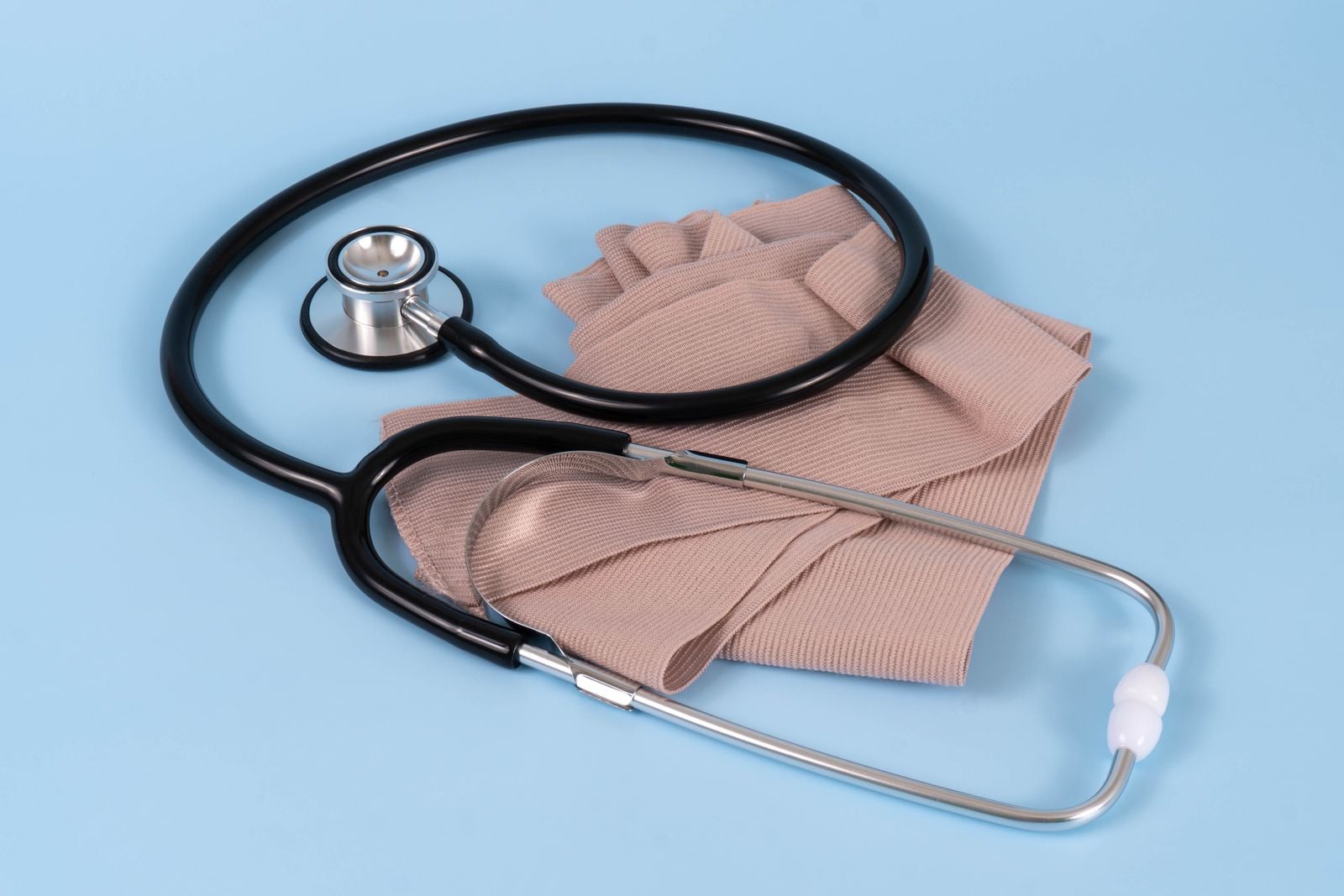
In September 1816, René Laennec walked into the Necker Hospital in Paris and met a young woman with a labored heart. He was 35, the hospital’s newly appointed chief physician, slight and tubercular himself, and the patient in front of him was overweight enough that the standard method of the day, pressing an ear directly to the chest, a practice called immediate auscultation, would tell him almost nothing. He was also, by the standards of post-Revolutionary French medicine, painfully modest. So he reached for a sheaf of paper on a nearby table, rolled it into a tight cylinder, set one end against her ribs and the other against his ear.
He heard her heart more clearly than he had ever heard a heart in his life.

The hospital, the patient, the paper
The Necker Hospital still stands on the Rue de Sèvres in the 15th arrondissement. In 1816 it was a charity hospital for the poor, and Laennec had been appointed its chief physician the year before. The patient that day has gone unnamed in the historical record, but Laennec himself described the encounter in the introduction to his 1819 treatise De l’Auscultation Médiate, the book that introduced the stethoscope to the world. He wrote that he had recalled a simple acoustic phenomenon. If you scratch one end of a wooden beam, the sound travels clearly to an ear pressed against the other end. He decided, almost on impulse, to try the same principle on a human chest.
The paper tube worked. Within days he was experimenting with wooden cylinders turned on a lathe in his own apartment. The version he settled on was about 25 centimeters long and 2.5 centimeters wide, hollow down the middle, made of light wood, and split into two pieces that screwed together for transport. He called it le cylindre. The name stéthoscope, from the Greek stēthos for chest and skopein to examine, came later, and Laennec himself was never entirely happy with it.
What he could suddenly hear
The reason the moment matters is not the embarrassment. It is what the embarrassment forced him to invent. Direct ear-to-chest listening had been practiced since antiquity and had barely improved in two thousand years. A doctor pressed an ear to bare skin and tried to interpret a muffled blur of sounds. Through a hollow wooden tube, Laennec could suddenly distinguish the lub from the dub, the wet crackle of fluid in a lung from the dry rasp of pleural friction, the murmur of a leaking valve from the steady thump of a healthy one.
Over the next three years he catalogued these sounds against autopsy findings on patients who had died in his ward. He developed vocabulary that cardiologists and pulmonologists still use: rales, rhonchi, egophony, pectoriloquy. He correlated the wet bubbling he heard in a living patient’s chest with the fluid he later found in that same patient’s lungs on the dissection table. Tuberculosis, pneumonia, mitral stenosis, pericardial effusion. Diseases that had been opaque guesses became, for the first time, audible.
Why he reached for the paper at all
The conventional story emphasizes propriety. Laennec, a devout Catholic and a shy man, did not want to press his ear against the chest of a young woman. That is true as far as it goes, and the cultural context matters: in early 19th-century Paris, a male physician laying his head on a female patient’s bare sternum was the kind of intimacy that physicians of his class actively avoided. But the obesity of the patient mattered more than the modesty. Laennec wrote that direct auscultation was impractical in that specific case. Fat absorbs sound, and pressing harder only flattens the breast tissue against the ribs without bringing the heart any closer to the ear.
The discomfort was the trigger. The acoustics were the reason it worked. A retrospective in Psychology Today frames Laennec as an innovative problem-finder, someone whose contribution was less the cylinder itself than the willingness to treat a moment of social awkwardness as a design constraint worth solving for.
From wooden tube to two-eared instrument

Laennec’s monaural cylinder dominated medicine for nearly four decades. Doctors carried them in their coat pockets the way a carpenter carries a folding rule. The shift to the binaural design, the two-eared rubber-tubed instrument that hangs around every doctor’s neck today, came in the mid-19th century, when Irish and American physicians adapted the cylinder with flexible tubes leading to both ears, refining it into the form still recognizable in any clinic.
Laennec did not live to see any of this. He died in 1826, at 45, of the same disease he had spent his career learning to hear: pulmonary tuberculosis. His nephew Mériadec diagnosed him using one of his own wooden cylinders.
The instrument that still resists obsolescence
Two hundred and ten years after the paper tube at the Necker Hospital, the stethoscope is still the single most recognizable object in medicine. It outlasted the typewriter, the slide rule, the cathode ray tube, and most of the diagnostic technologies invented to replace it. Echocardiograms, MRIs, CT angiograms. None of them have killed the wooden idea that started this. A primary care doctor in São Paulo or Lagos or Mumbai still presses a small cold disc to a patient’s chest and listens.
But the limits Laennec acknowledged in his own treatise remain. The stethoscope exam is famously inconsistent. Two cardiologists can listen to the same patient and disagree about whether they heard a murmur. Eko Health, a California startup that raised $41 million in 2024, has built a stethoscope that records the heart sounds digitally and runs them through machine learning models trained on millions of recordings. The device aims to identify patients with heart disease earlier and more accurately than traditional auscultation.
The fix is essentially the one Laennec was reaching for in 1816, a more reliable way of converting body sound into clinical information, but with a neural network in place of a wooden tube.
The longer arc of listening
Medicine has been bending toward this kind of augmentation for a while. The stethoscope was the original version of that move. It replaced an act of direct bodily contact with a small intermediary object that did the work better.
What Laennec also accidentally invented was the idea that what the patient feels and what the doctor measures should be triangulated. A wooden tube against the chest gave the physician a second channel of information beyond the patient’s spoken description of their symptoms. Two centuries later, a 2025 paper in Nature Medicine argued that patient-reported outcome measures, the patient’s own account of their symptoms, functioning and well-being, belong as primary endpoints in clinical trials, not as soft secondary data. The wheel turns. The instrument that taught doctors not to rely solely on what patients said is now being supplemented by formal protocols that ask, more carefully than ever, what patients say.
The embarrassment problem, two centuries on
The squeamishness that pushed Laennec to roll the paper has not gone away. Patients still flinch at physical examinations. Doctors still struggle with the intimacy of touch in a clinical setting. Writing on patient-doctor communication has long noted that the friction of the medical encounter, the awkwardness, the unspoken negotiations of what gets said and what doesn’t, shapes diagnosis as much as any instrument does. The cases hardest to diagnose are often the ones where the patient and the physician cannot quite align on what they are each perceiving.
A digital stethoscope that records and replays a heartbeat removes some of that friction. So does a telemedicine consultation conducted through a phone camera. Each new layer between doctor and patient is, in a small way, another rolled sheet of paper, a workaround for the awkwardness of two bodies in a room together, trying to figure out what is happening inside one of them.
What remains of the original cylinder
From a single 25-centimeter wooden tube in 1816, the instrument spread through European hospitals over the following decade, arrived in American teaching wards by the 1820s, and within forty years had been redesigned into the binaural form still standard today. Laennec’s 1819 treatise ran to two volumes and went through multiple editions in his lifetime, carrying the technique into French, German, and English medical schools. Several of the original wooden cylinders he turned on his own lathe survive in the collections of the Musée d’Histoire de la Médecine in Paris.
Two hundred and ten years on, the descendants of that paper roll hang from the necks of millions of clinicians worldwide. The Necker Hospital is still open. The disease that killed Laennec at 45 still kills more than a million people a year, and the instrument he invented to hear it remains, in clinics from Paris to Mumbai, the first tool a doctor reaches for.