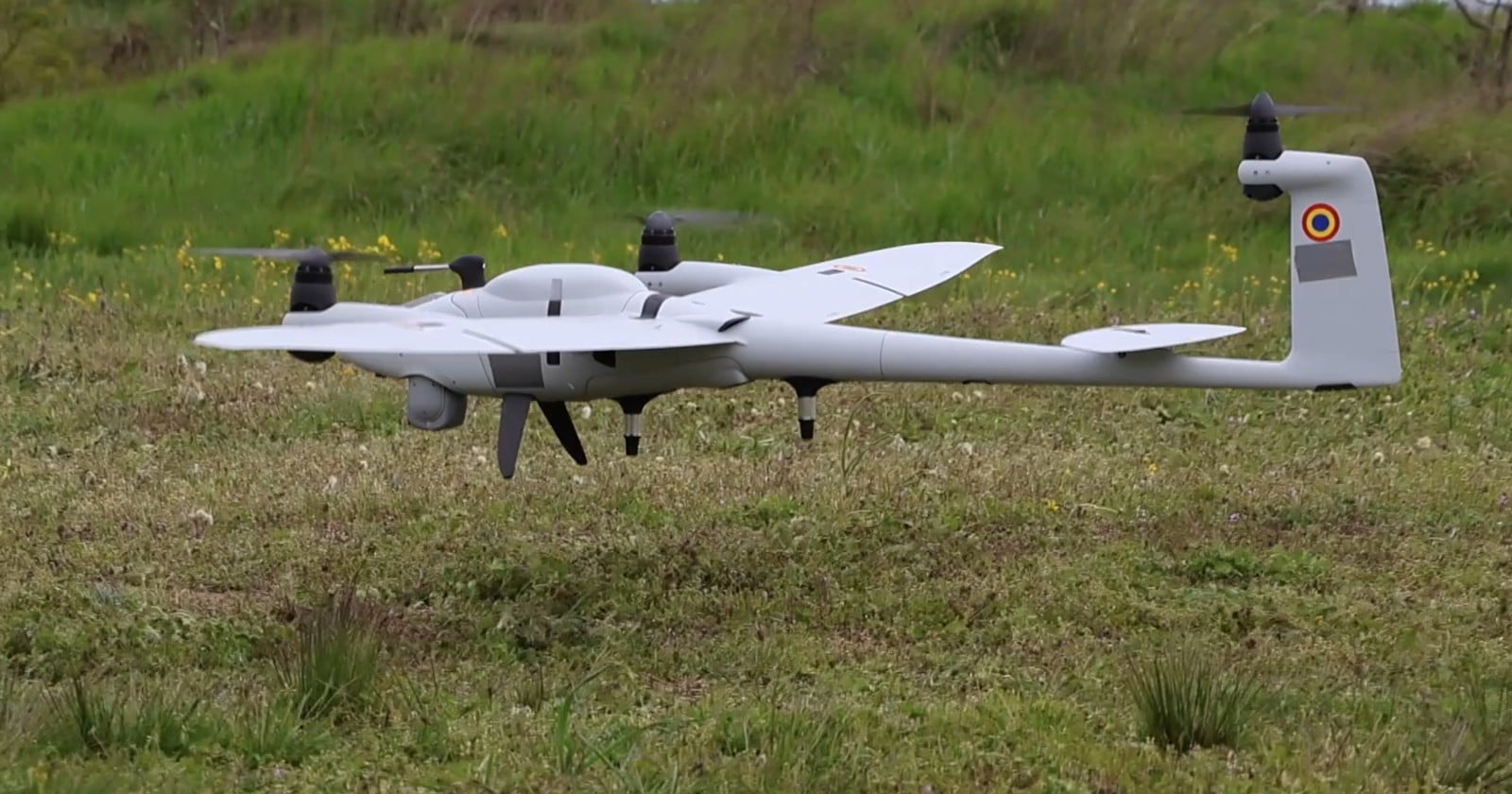
Munich-based Quantum Systems said Thursday it has signed a $1.2 billion Series D financing round, valuing the maker of autonomous drones and uncrewed systems at roughly $8 billion post-money. The round was co-led by Blackstone, Noteus, Advent — and Airbus, the European aerospace and defense group.
That last name is the detail worth pausing on. Florian Seibel, Quantum Systems’ co-founder and co-CEO, described his company in the announcement as “a next generation neo prime that has the potential to disrupt defence as we know it today.” The category of company a “neo prime” would displace is the traditional defense prime — the role Airbus holds in Europe. Airbus invested anyway, and agreed to deepen its strategic collaboration with the startup in the same breath.
The deal
The financing more than doubled Quantum Systems’ valuation, according to the company’s press release. Beyond the four co-leads, the syndicate includes BOND, Fidelity Management & Research Company, Wellington Management, A.P. Moller Holding, and Elephant Lake Ventures, alongside existing shareholders such as Balderton and HV Capital. Morgan Stanley acted as exclusive financial adviser and placement agent.
The company says the proceeds will go toward expanding production capacity, strengthening its supply chain, scaling delivery across allied markets, and continued investment in software and AI. Seibel said the company is profitable; CFO Jonas Jarosch described its financial profile as “triple-digit growth, double-digit profitability.” Quantum Systems’ products span air, land, and sea, tied together by MOSAIC UXS, its software layer for connecting uncrewed platforms, sensors, and counter-UXS (counter-uncrewed) systems into one network.
The operational résumé behind the valuation is largely Ukrainian. The company says its systems flew more than 19,000 missions in Ukraine in 2025, and its production footprint now spans Germany, Ukraine, the United States, Australia, Romania, the United Kingdom, and the Baltics.
Why the incumbent is buying in
Airbus Defence and Space agreed to deepen its strategic collaboration with Quantum Systems alongside the round. Its CEO, Michael Schoellhorn, framed the logic in the same announcement: modern combat is won through “decision speed,” autonomous systems are force multipliers for it, and the payoff comes when they run with human oversight, trusted command-and-control, and integration with crewed assets. Then came the sentence that reframes the whole deal: “This is where Airbus’ role as a large defence prime is evolving into that of an architect and ecosystem builder.”
Read together, the two CEOs’ quotes describe the same bet from opposite ends. The startup’s pitch is that the future prime looks like a software company that ships drones. The incumbent says the future prime looks like an integrator that orchestrates other companies’ systems — including, now, ones it part-owns. Whether that is a hedge, a partnership, or an acquisition pipeline in slow motion is the question the deal leaves open.
A crowded moment for defense money
The round lands in a sector that is absorbing capital at a record pace. Defense tech companies have raised $17.4 billion so far this year, according to Dealroom figures cited by CNBC — already well past the $11.2 billion raised in all of 2025. Anduril took in $5 billion in May; Saronic and Shield AI raised $1.8 billion and $2 billion in March. In Europe, Stark raised 500 million euros in June, and Helsing is reportedly set to raise $1.2 billion at an $18 billion valuation, per a Financial Times report from May.
What the announcement establishes, and what it only asserts
The round is signed, not closed — the company announced the signing of the transaction, and closing conditions were not detailed. The most striking numbers are the company’s own: profitability, “triple-digit growth,” and the 19,000 Ukraine missions are all self-reported by a private company, and the roughly $8 billion valuation is what investors agreed to pay in a sector where prices are moving fast — this year’s fundraising total passed last year’s full-year figure barely past the year’s midpoint.
The Airbus collaboration, for all its framing weight, was announced without financial terms, delivery commitments, or a timeline. And “neo prime” is a pitch, not a market position — a label the company gives itself in its own announcement. None of that makes the deal less real; it means the story so far rests on what the participants chose to say about it.
Europe’s defense establishment and its self-declared disruptors are, for the moment, funding each other. Someone in that arrangement is right about who ends up on top.