


When a team at the Swiss biotech Amazentis fed a glass of pomegranate juice to a hundred healthy volunteers and tracked what happened in their blood, they watched something unsettling. About 40 percent of the participants converted enough of the fruit’s compounds into a molecule called urolithin A to send meaningful levels of it into their bloodstream over the following day or two. The rest produced almost none. Same juice, same seeds, same ellagitannins — and yet the majority of the group was, in metabolic terms, drinking a very expensive glass of red water. The finding was published in 2021 in the European Journal of Clinical Nutrition.
The difference was not in the fruit. It was in the gut bacteria the drinkers happened to be carrying.
Urolithin A is the compound longevity researchers have been quietly obsessed with for the past decade. It appears to trigger mitophagy — the cellular housekeeping process that clears out worn-out mitochondria, the tiny power plants inside every cell. Aged mitochondria are one of the reasons muscles weaken and organs slow down after fifty. And a small 2022 clinical trial in JAMA Network Open found that four months of urolithin A supplementation measurably improved muscle endurance in adults aged sixty-five to ninety.
Here is the catch that nobody puts on the pomegranate carton. Your body cannot make urolithin A directly from food. Only certain gut microbes can perform the conversion, and most people alive today do not host them in sufficient numbers.
The bacteria doing the work
Pomegranates, walnuts, raspberries and strawberries all contain a family of large polyphenols called ellagitannins and their breakdown product, ellagic acid. On their own, these molecules are almost useless to human cells. They are too bulky to cross the intestinal wall in any meaningful quantity.
What happens in a lucky eater is this. The ellagitannins tumble down into the colon still largely intact. There, specific bacterial species — chief among them Gordonibacter urolithinfaciens and Gordonibacter pamelaeae, along with a strain called Ellagibacter isourolithinifaciens that Spanish researchers first described in 2018 — crack the molecule open through a multi-step enzymatic conversion. The final product, urolithin A, is small, fat-soluble, and slips into the bloodstream easily.
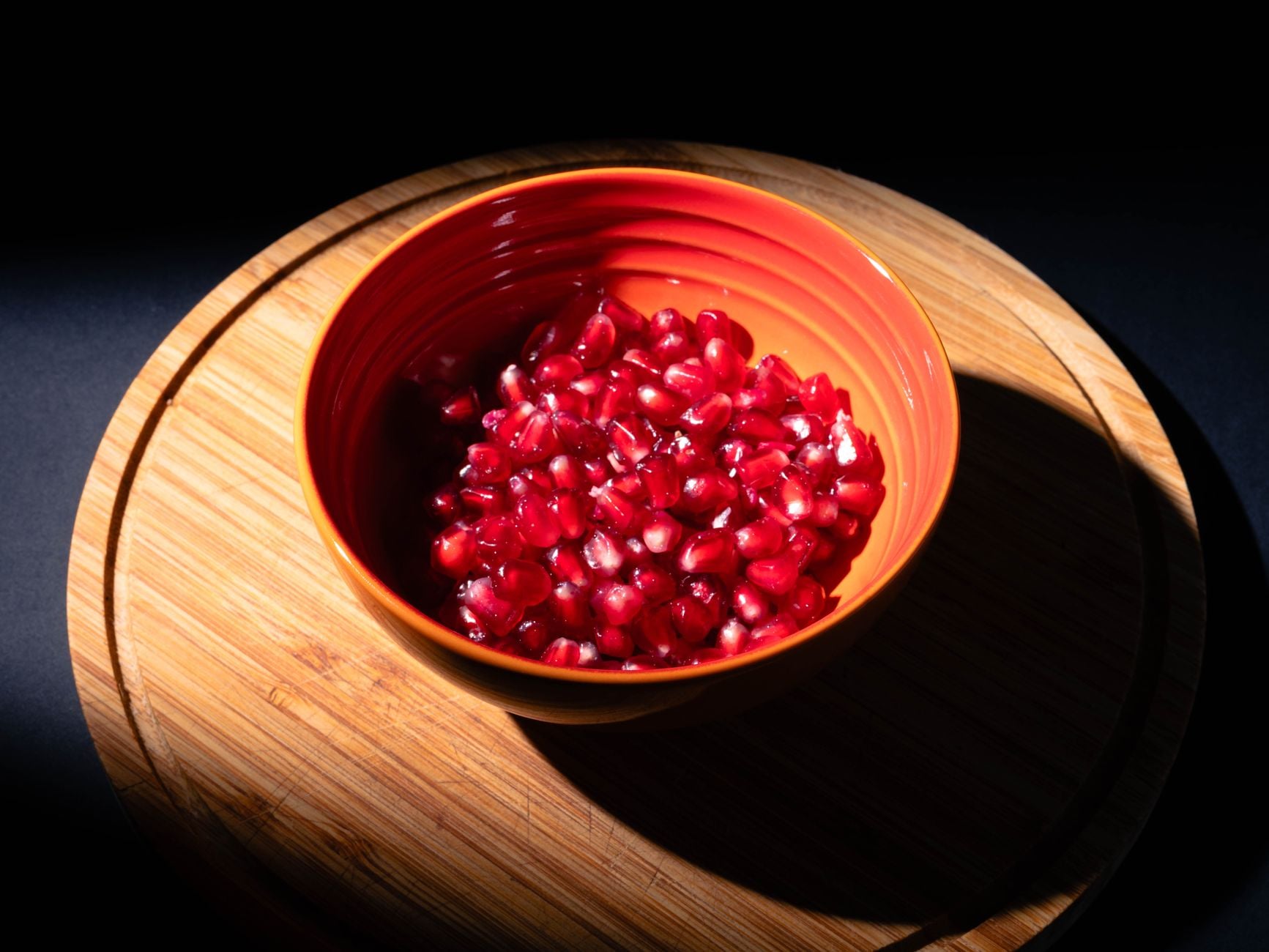
In an unlucky eater, the ellagitannins hit the colon, encounter a microbial community that lacks those species, and are excreted largely unchanged. The fruit still delivers fibre and vitamin C. It does not deliver mitophagy.
Three metabotypes, one bowl of fruit
Researchers at CEBAS-CSIC in Murcia, Spain, led by food scientist Francisco Tomás-Barberán and biochemist Juan Carlos Espín, spent years mapping who converts what. They found the human population sorts into three urolithin metabotypes. Metabotype A produces urolithin A. Metabotype B produces a mix of urolithin A, isourolithin A and urolithin B. Metabotype 0 — a substantial minority that grows larger with age — produces essentially nothing.
The distribution shifts with age, geography, and diet. Metabotype 0 becomes more common as people get older, which is the cruel twist: the group who would benefit most from mitochondrial cleanup is also the group least likely to make the molecule that triggers it.
Two friends can split the same pomegranate at the same lunch. One walks away with a slow trickle of urolithin A in her bloodstream for the next forty-eight hours. The other walks away with a pleasant taste and nothing else measurable.
Why the microbes vary so wildly
The gut microbiome is shaped by birth mode, breastfeeding, antibiotic history, geography, diet and cohabitation. Two siblings raised in the same house diverge within years. A course of antibiotics in childhood can wipe out a species that never recolonises.
The PREDICT-1 study, which fed identical meals to more than a thousand adults in the United Kingdom and measured what happened in their bloodstream over the next few hours, found enormous differences from person to person in how they responded to the same food — with gut microbiome composition explaining more of the variance in the fat response than the macronutrients of the meal itself. The urolithin story is the same principle in miniature — a single functional pathway that either exists or does not exist in a given person’s colon.
Gordonibacter species are picky. They are strict anaerobes, they grow slowly, and they seem to depend on a broader community of fibre-fermenting bacteria to keep their environment hospitable. A diet high in ultra-processed food and low in plant fibre tends to starve them out. So does chronic low-grade inflammation.
The Scarb2 clue
The link between gut composition and what the body actually absorbs runs deeper than polyphenols. A 2024 paper in Protein & Cell on a rare neurodegenerative condition found that Scarb2 deficiency alters gut microbiota composition in ways that impair fat absorption and the renewal of the intestinal lining — meaning the same meal delivers different amounts of usable fat to the body depending on which bacteria are colonising the gut.
That study was about a specific disease, but the principle generalises. Nutrient bioavailability is not a property of the food. It is a property of the food-plus-microbiome system. The pomegranate seed is only half of the equation.
What the anti-aging effect actually looks like
Mitophagy sounds abstract until you see the physiology. Mitochondria accumulate damage over decades — bent membranes, leaky electron transport chains, mutations in their tiny circular DNA. In young cells, damaged mitochondria are tagged and eaten by the cell’s own recycling machinery, and replaced with fresh ones. In old cells, this clearance slows down. The dysfunctional mitochondria pile up. They leak reactive oxygen species. They stop making enough ATP. Muscles get tired faster. Neurons fire less reliably.
Urolithin A appears to poke this system back into action. In the JAMA Network Open trial, older adults taking a purified urolithin A supplement for four months showed significant gains in the number of contractions their hand and leg muscles could produce before fatigue. An earlier four-week trial in Nature Metabolism found that the same molecule ramped up the expression of mitochondrial genes in muscle biopsies taken from healthy elderly volunteers. The effect sizes were modest but real, and they appeared without any change in exercise routine.
Which means the pomegranate — if your gut cooperates — is doing something no amount of vitamin C can replicate. It is delivering a signal that tells old cells to clean their own basements.
The supplement workaround
Because a large fraction of the adult population cannot make useful amounts of urolithin A on their own, the obvious commercial move was to skip the bacteria entirely and sell the molecule directly. Amazentis now markets a synthesised urolithin A supplement called Mitopure, which delivers a standardised dose without asking the colon to do any chemistry. It is expensive, and its long-term effects are still being studied.
For everyone else, the question is whether the converter bacteria can be coaxed back. Some evidence suggests that a sustained high-fibre, polyphenol-rich diet — pomegranates, walnuts, berries, plus the resistant starches that feed the broader anaerobic community — can slowly shift a person from metabotype 0 toward metabotype A over months. Some evidence suggests it cannot, if the founding species were lost early in life.
Clinicians working on gut health point out that microbial imbalances often present without obvious digestive symptoms — the person converting no urolithin A may feel perfectly fine, and only discover the gap through a metabolite test after eating a controlled dose of walnuts.
The wider lesson hiding in a pomegranate
The urolithin story punctures one of the tidiest assumptions in nutrition writing — that a food contains a compound, and eating the food delivers the compound. For most macronutrients this is roughly true. For the more interesting molecules, the ones tied to longevity and cellular repair, it often is not.
Turmeric’s curcumin is barely absorbed without piperine and fat. Soy isoflavones are converted to the more active equol only by people whose gut hosts Adlercreutzia equolifaciens and its relatives — roughly 25 to 30 percent of Westerners, up to 60 percent of some East Asian populations. Green tea catechins are metabolised differently depending on the same microbial variables.
A superfood list on a magazine cover is, in this sense, a list of raw materials handed to a factory whose workforce varies from person to person. The seeds do not care who eats them. The bacteria decide what happens next.
Popular health advice often turns out to be less universal than it sounds, and personalised nutrition is where that pattern is now being stress-tested at the molecular level.
What it feels like from the outside
Sit two people down with an identical bowl of ruby seeds. Both crunch through the arils. Both swallow the same ellagitannin load. For the next two days, one of them is quietly running a cellular renovation project, mitochondria being tagged and recycled in muscle tissue and possibly brain tissue and possibly the lining of blood vessels. The other is not.
Neither of them can tell from the taste. Neither of them will feel it that afternoon. The difference will show up, if it shows up at all, decades later, in how quickly they climb stairs at seventy.
A pomegranate has around 600 seeds. Whether any of them do more than colour your fingers depends on a colony of anaerobic bacteria you have never seen, whose census was taken by the food you ate as a toddler, and whose presence or absence you will probably never know without paying a lab to look.
