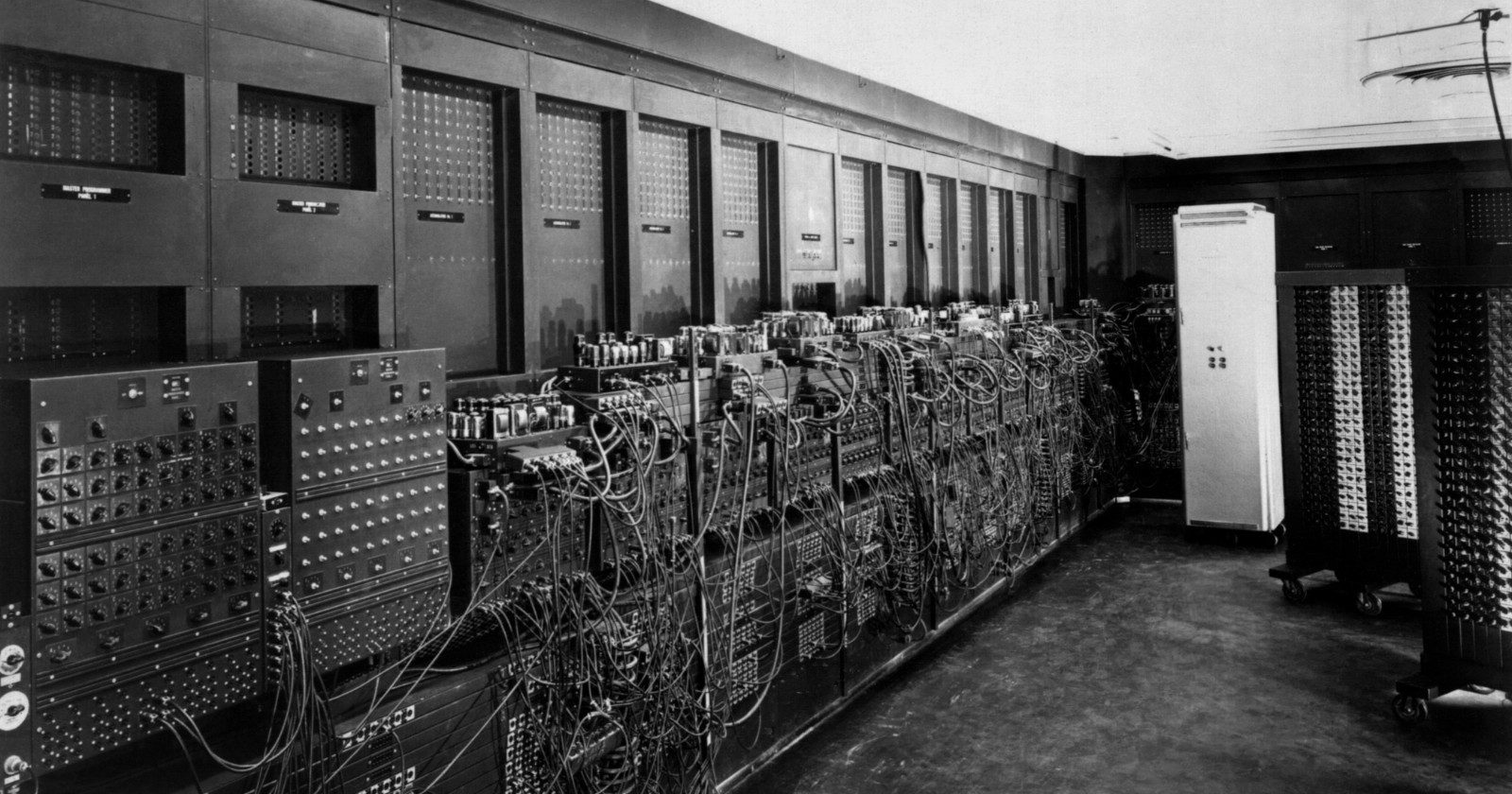
Betty Snyder was standing in a warm basement room at the University of Pennsylvania’s Moore School of Engineering in 1945, holding a stack of block diagrams that showed the internal wiring of a machine nobody had ever programmed before. The machine was ENIAC — the Electronic Numerical Integrator and Computer — and it filled the room with 40 black steel cabinets, 17,468 vacuum tubes, and about 5 million hand-soldered joints. Snyder and five other women had been given the diagrams, told the machine could compute a ballistic trajectory faster than a shell could fly, and left to figure out how to make it do so. There were no manuals. There was no programming language. There was not even a word for what they were about to invent.
The trajectory they finally got running became the centerpiece of ENIAC’s public unveiling on February 15, 1946 — the first time working software was demonstrated to the world on a general-purpose electronic computer.
The six women who were handed a machine and told to teach it math
Their names were Betty Snyder (later Betty Snyder Holberton), Jean Jennings (later Jean Jennings Bartik), Kathleen McNulty (later Kay McNulty Mauchly Antonelli), Marlyn Wescoff (later Marlyn Meltzer), Frances Bilas (later Frances Bilas Spence), and Ruth Lichterman (later Ruth Teitelbaum). The Army had recruited them from a pool of women already working at the Moore School as “computers” — the job title, at that point, referred to a human being, almost always a woman with a math degree, who calculated firing tables by hand using mechanical desk calculators.
A firing table was a fat booklet an artillery crew carried into the field. It told a gunner exactly how to aim a shell to land on a target several miles away given the wind, air density, powder temperature, and the curve of the Earth. Each trajectory in the book required hundreds of multiplications to compute by hand, and one table might contain thousands of trajectories. A skilled woman with a mechanical calculator needed many hours to finish a single trajectory. The Army was falling months behind on tables for new weapons. That backlog is why the ENIAC project got funded in the first place.

A machine programmed by rearranging its nervous system
ENIAC did not have software in the sense anyone today would recognize. It had no stored program, no operating system, no keyboard. To make it calculate anything, the programmer had to physically rewire the machine — plugging thick black cables into switchboards the size of double doors, and setting banks of ten-position rotary switches by hand. A single calculation could require setting several thousand switches and running several hundred cables in a specific order.
The six women were not shown how to do this. The engineers who had designed ENIAC — John Mauchly and J. Presper Eckert — handed them the logical and electrical diagrams and told them the machine was theirs to learn. Jean Jennings Bartik, in her memoir Pioneer Programmer, remembered spending weeks with the diagrams spread across a table, tracing signals through accumulators and reading them the way a musician reads sheet music. The women were not allowed into the ENIAC room itself for months, because ENIAC’s location was classified. They studied a machine they were forbidden to touch.
When clearance came through, they climbed inside the cabinets. Kay McNulty later described crawling behind the units to replace burned-out tubes; vacuum tubes failed regularly, and the machine had thousands of them. Debugging meant physically walking to the panel where the fault lived and reading the state of the flip-flops off little neon lamps. A “bug,” in the ENIAC room, was often a literal moth pulled out of a relay.
The trajectory demo
The Army’s public unveiling of ENIAC was scheduled for February 15, 1946. Mauchly and Eckert chose the program: a full external ballistic trajectory of a shell in flight, computed faster than the shell itself would take to reach the ground. Snyder and Jennings were the lead programmers. They had a few weeks.
The program required integrating the equations of motion for a projectile — solving second-order differential equations in three dimensions, with drag terms that depended on the projectile’s current velocity — using numerical methods that stepped forward through the flight in tiny time increments. On paper, a human computer would take many hours to finish it. ENIAC, if the wiring was right, would finish it in seconds. The shell itself, in real flight, would land in less than a minute.
Two nights before the demonstration, the program failed. It ran, but at the end of the trajectory the shell simply kept going, sinking straight through the ground into the negative altitudes below. Snyder later recounted that she went home, went to bed, and thought about the problem. She woke up in the middle of the night, drove back to the Moore School, and flipped a single switch on the master programmer. The shell landed. The demo was saved.
The press saw the machine. The women were not introduced.
The reporters who filled the Moore School basement on the afternoon of February 15 saw the lamps flashing, saw a card come out of the IBM punch at the end of the run with the trajectory printed on it, and described ENIAC in terms like a giant brain, using the popular terminology of the era for early computers. Photographs from that day show the six women standing next to the machine, pulling and inserting cables, throwing switches. In the captions, they were not identified as the programmers who had created the demonstration. Mauchly and Eckert were named. The women who wrote the program that ran on it were not.
It took nearly 40 years for that to be corrected. In the 1980s, the computer scientist and historian Kathy Kleiman was researching women in computing when she came across the ENIAC photos and began asking who the women were. Kleiman spent the next several years tracking them down one by one, recording their oral histories, and eventually producing the documentary The Computers. Most of the six were still alive when she started.
Why the invisibility is not surprising
The pattern of a woman doing foundational technical work and being remembered as a helper — or not remembered at all — was the rule in mid-century computing, not the exception. Programming was originally treated as clerical work, an extension of the human-computer job the Moore School women had been doing before ENIAC. It was assumed to be a natural fit for female employees precisely because it was seen as tedious, patient, and not creative. The engineering — designing the hardware — was where the credit lived.
Contemporary research suggests this framing was installed early and reinforced hard. Work by Allison Master and Andrew Meltzoff found that gender stereotypes about who “belongs” in computer science and engineering appear in children as young as six, and shape motivation before formal education has any chance to intervene. Girls given programming experience showed markedly higher STEM motivation afterward — the interest was there; the assumption that it wasn’t there was the problem.
The invisibility was also structural in a way that goes beyond STEM. The kind of labour Snyder and Jennings did — the careful, invisible, get-it-working work that other people then took credit for on stage — belongs to a broader category of invisible women’s labour: work that is essential to the outcome, absorbed into the background, and rarely counted in the professional record. Psychologists studying workplace dynamics have documented a related version called the emotional labour tax — the accumulation of unrecognised tasks that hold a system together but never appear on the promotion memo. The ENIAC women held the system together. The system did not put their names on the memo.
What Snyder built after the trajectory
Betty Snyder Holberton did not stop at ballistic tables. She went on to write the first sort-merge generator, which fed the design of the first commercial computer, UNIVAC I, in 1951. She helped design the instruction set for UNIVAC, invented the numeric keypad layout still used on calculators (the one with the 7-8-9 on top), and was one of the authors of the COBOL and FORTRAN standards. Jean Jennings Bartik joined Eckert and Mauchly at their new company and led the team that converted ENIAC into a stored-program machine in 1948 — the moment software, in the modern sense, actually became possible.
Kay McNulty married John Mauchly. Ruth Teitelbaum kept working on trajectory problems at Aberdeen. Frances Spence left computing to raise a family. Marlyn Meltzer, likewise. None of them appeared in the standard histories of computing published in the 1970s and 1980s. The 1996 official 50th-anniversary celebration of ENIAC at Penn did not invite them. Kleiman had to push for their inclusion.
The room they programmed in still exists
The Moore School basement is now part of Penn’s engineering complex, and four of ENIAC’s original 40 panels are still installed there behind glass, along with cables that Snyder and Jennings almost certainly touched. The rest of the machine was broken up in the 1950s. Some panels went to the Smithsonian. One is at the Computer History Museum in Mountain View. One is at the U.S. Army Ordnance Museum. If you look closely at the switches, the little rotary dials from 0 to 9 are still set to the last positions someone left them in — a partial calculation frozen in place, waiting for the person who set it up to come back and read the result.
ENIAC’s cabinets are still here. Betty Snyder died in 2001. Jean Jennings Bartik died in 2011. Kay McNulty died in 2006. The trajectory they solved on February 15, 1946 landed on time, in the correct location, in about 20 seconds — and it has been quietly running through every piece of software written since.