

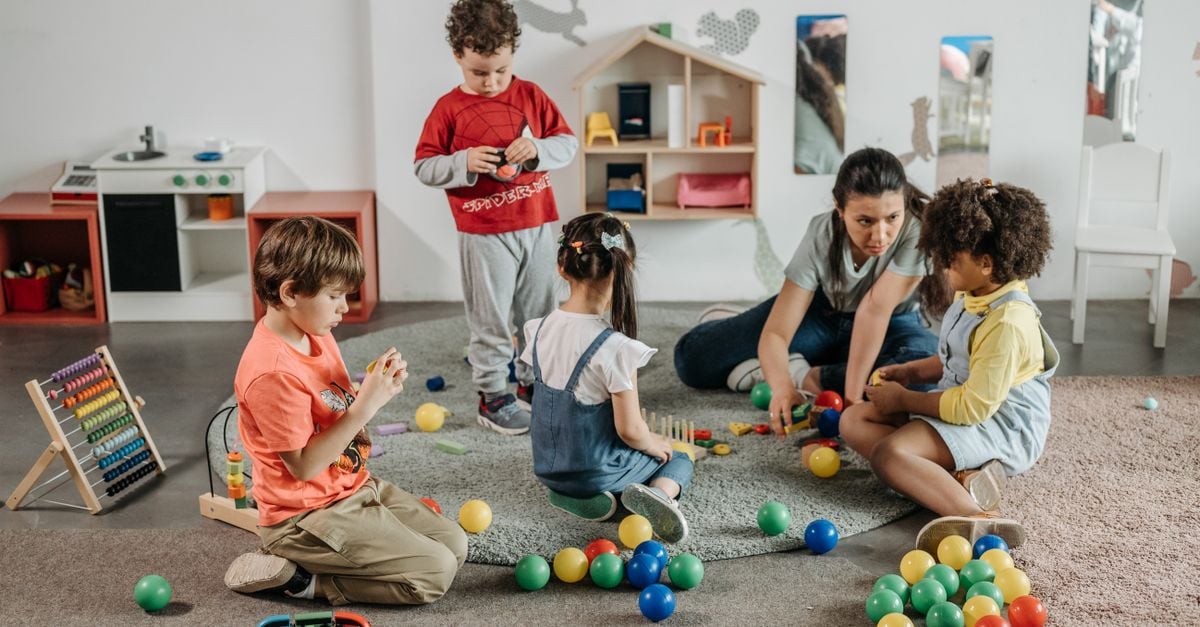
When we try to guess which small children will do well later in life, we tend to look at the academic markers, whether a five-year-old can already read, count or sit still for a worksheet. A long-running study points somewhere less obvious. It found that how a child got on with other children in kindergarten, whether they shared, listened and cooperated, predicted adult employment and college graduation, and did so even after the researchers accounted for that child’s early reading level.
This is one study rather than a settled body of law, and it describes a pattern rather than proof of cause. But it is a careful, long piece of work, and its central result is worth understanding properly.
What the researchers did
The study was led by Damon Jones and Mark Greenberg at Penn State, with Max Crowley, and published in the American Journal of Public Health in 2015. It drew on the Fast Track project, a long-running study run by a consortium of universities that included Duke, and followed more than 700 children, around 750, from lower-income neighbourhoods across three cities and one rural area in the United States.
The starting measurement was simple. In kindergarten, teachers rated each child on eight short statements about social behaviour, on a five-point scale. The items were the ordinary business of getting along: whether a child was helpful to others, shared materials, listened to others, and could resolve problems with peers on their own. That single early rating of social competence was then set against how the same people were doing many years later, through to age 25, across education and employment, public assistance, criminal activity, substance use and mental health.
The size of the association
The numbers attached to that early score were substantial. For each one-point rise in a child’s kindergarten social-competence rating, the study found they were roughly twice as likely to have gained a college degree, and about 46 per cent more likely to hold a full-time job, by the age of 25.
The pattern ran the other way at the lower end too. For each one-point drop in that early rating, a child was around 67 per cent more likely to have been arrested by their mid-twenties, and roughly 80 per cent more likely to be living in, or on a waiting list for, public housing. The same modest classroom assessment tracked with outcomes spread right across a young adult’s life.
Why the reading-level point matters
The most interesting part is not that social skills predicted anything, but what the result survived.
The researchers did not look at social competence in isolation. They adjusted their analysis for a list of things that plausibly drive later outcomes, including household poverty, race, having teenage parents, family stress and neighbourhood crime, and, importantly, for each child’s aggression and reading level in kindergarten. The social-competence signal held up through all of that. A child’s ability to get along with others still predicted adult employment and graduation after the early reading score had been taken into account.
That is the honest version of the headline claim. The study did not stage a simple contest and declare social skills the winner over literacy. What it showed is that social competence carried real predictive weight of its own, not merely standing in for how academically advanced or well-off a child was. Put plainly, the cooperative kindergartner was not just the already-privileged kindergartner wearing a different label.
The authors did go a step further. They noted that in many cases the social-competence rating was a stronger predictor, by statistical significance, than measures that seemed more obviously tied to the outcome. The clearest example was crime: the same teachers’ ratings of a child’s aggression barely predicted later arrests once other factors were accounted for, while their rating of prosocial skill did. Even so, the researchers were careful to add that for some outcomes early academic ability can be the better predictor, so this is not a blanket claim that social skills beat academics at everything.
What it does not prove
It is worth being clear about the limits, because this is exactly the kind of finding that gets stretched.
The result is a correlation, not a demonstrated cause. It does not show that drilling toddlers in sharing will manufacture a graduate, and the researchers do not claim it does. Social competence at five is partly a product of everything around a child, temperament, home life, health, and those same forces keep shaping outcomes for the next twenty years. The early rating is best read as an early signal of a trajectory, not the lever that sets it.
Two further cautions matter. The children came specifically from lower-income neighbourhoods that were being studied because they were considered at higher risk, so the pattern cannot simply be assumed to hold identically for every child everywhere. And the starting measure was a teacher’s subjective judgement rather than a hard test. None of this sinks the study. It just marks the difference between a strong, suggestive result and a settled fact.
Why it is more than a parenting story
For anyone thinking about skills and the workforce, the finding lands a little differently than it does for parents.
It offers evidence, from a serious longitudinal dataset, that the social and self-regulatory skills often treated as soft, cooperation, listening, handling a disagreement without it blowing up, carry measurable long-term value, including in plainly economic terms like holding a job. That is a reason to take social-emotional learning in early education seriously as an investment rather than a nicety, and it fits a wider pattern in which employers increasingly say the hard part of hiring is not technical ability but whether someone can work with other people.
The claim to resist is the tidy policy slogan that would turn one study into a curriculum. The claim worth keeping is quieter: how a small child manages the ordinary friction of being around others carries real information about the adult they are becoming, and it deserves at least as much attention as whether they were early to read.
That is not an argument for grading five-year-olds on friendliness. If anything it points the other way, towards valuing the parts of early childhood that are easy to dismiss as merely play, and treating the child who shares the blocks as someone already practising something that lasts.
