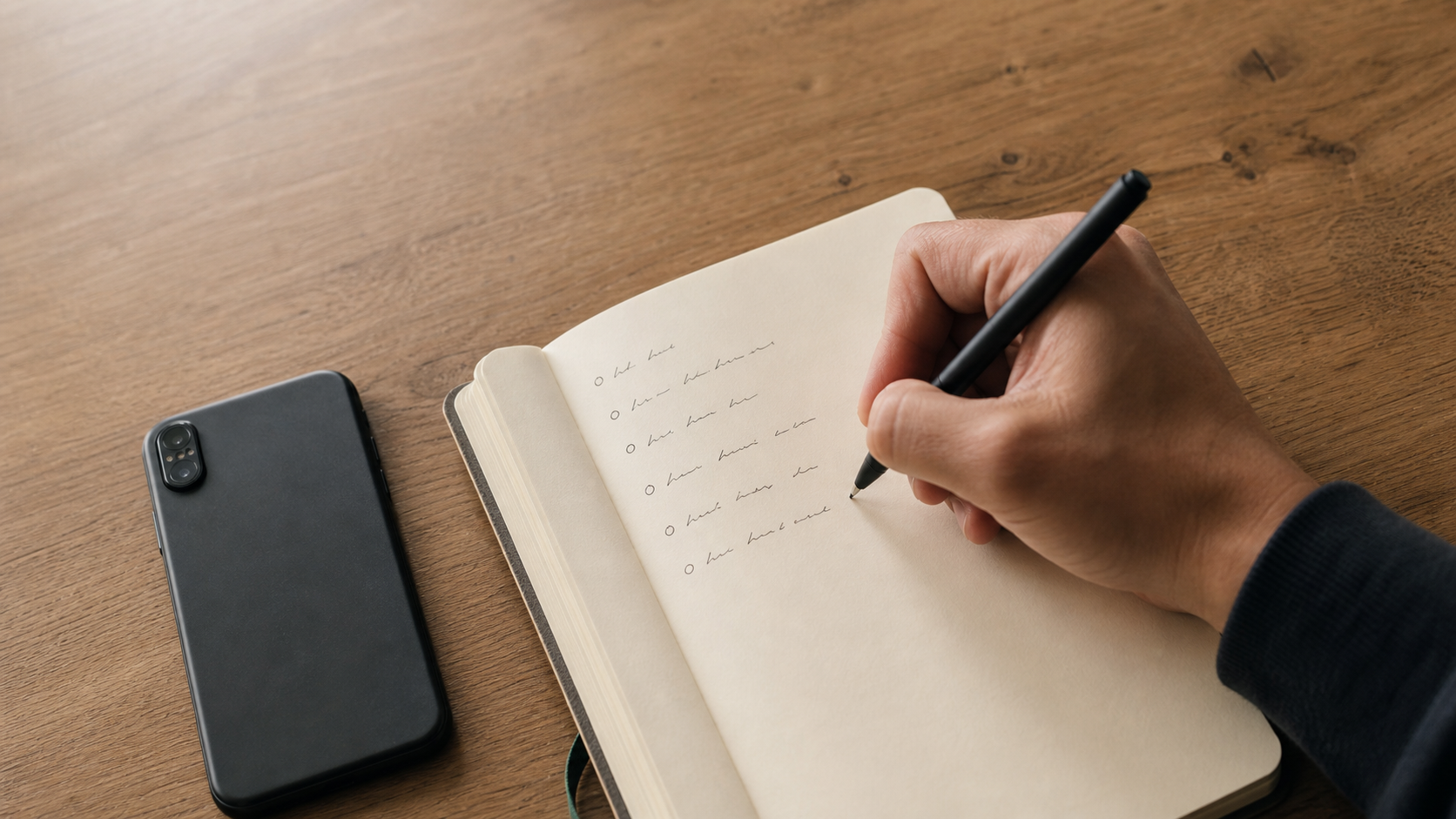
There is an oddly revealing moment in modern life: someone needs to remember something, reaches past the phone already in their hand, and looks for a pen.
Maybe it is a shopping list. Maybe it is the three things that have to happen tomorrow. Maybe it is an idea that will disappear if it is entrusted to a glowing screen full of notifications.
Psychology cannot identify a personality from stationery, and no credible researcher would diagnose someone by the contents of their notebook. But choosing paper when a faster digital option is available can express a cluster of habits: how a person directs attention, organises information and decides what deserves to be remembered.
If you still write things down by hand, these eight traits may feel familiar.
1. You are intentional about where your attention goes
A phone can hold a list, calendar and notebook. It also holds messages, news, social media, work and every unfinished conversation in your life. Opening it to record one thought can expose you to a dozen competing demands.
Paper does one thing. People who deliberately choose it often understand that attention is not simply something they possess. It is something their environment can redirect.
Research on the so-called smartphone “brain drain” effect is mixed. An influential study found that the mere presence of a person’s phone reduced available cognitive capacity, even when it was not being used. A later meta-analysis found only limited support for a smaller effect and warned about weaknesses in the evidence. The cautious conclusion is not that every visible phone destroys concentration. It is that some people sensibly manage attention by changing the object in front of them.
Your notebook may therefore be less about nostalgia than boundary-setting. You know that a tool cannot interrupt you if it has no alerts.
2. You naturally filter for what matters
Typing is fast enough to capture a conversation nearly word for word. Handwriting usually is not. A person taking notes on paper must constantly decide what to keep, what to shorten and what can be left out.
That constraint can encourage active selection. You are not merely storing language. You are turning it into your own smaller representation of the important idea.
The famous 2014 “pen is mightier than the keyboard” experiments reported that longhand note-takers performed better on some conceptual questions, possibly because laptop users transcribed more verbatim. But the result should not be treated as settled law. A direct replication and mini meta-analysis did not find evidence that longhand improved immediate learning overall. It did, however, find that greater verbatim overlap tended to be associated with poorer performance, although that relationship was not robust in every analysis.
The useful trait here is not magical penmanship. It is selectivity. Paper users often accept that a good note is not a complete note. It is a decision about what deserves space.
3. You think spatially, not only verbally
A paper page has edges, corners and a permanent physical layout. You can remember that the appointment was near the bottom, the important word was circled on the left, and the second idea was squeezed into the margin.
In a University of Tokyo experiment, 48 young adults recorded appointments in a paper notebook, tablet or smartphone. The paper group completed the recording task faster, and later memory retrieval produced stronger activity in regions associated with language, visual imagery and memory. The researchers argued that the stable location and tactile details of physical paper may create richer retrieval cues.
It was a small laboratory study, not proof that paper is always superior. Still, it captures something paper-preferring people often know intuitively: where a thought sits can become part of what the thought means.
You may be someone who builds understanding through arrows, boxes, underlining and proximity. A notes app gives you a sequence. A page gives you a landscape.
4. You are comfortable with useful friction
Digital tools remove effort. They search, copy, rearrange, autocomplete and synchronise. Those are genuine advantages. Yet not every form of friction is waste.
Writing by hand is slower and more physically varied than tapping keys. Each letter requires a changing movement, visual monitoring and fine motor control. A 2024 EEG study of 36 university students reported more elaborate patterns of brain connectivity during handwriting than during one-finger typing.
The authors connected those patterns to conditions favourable for learning, but a published commentary urged caution: the experiment tested brain activity while adults repeatedly produced prompted words, not whether students learned more in a real classroom. More activity does not automatically mean better learning.
Even with that caveat, your preference suggests patience with effort that serves a purpose. You do not assume the fastest process will produce the clearest thought.
5. You have strong metacognitive self-awareness
Metacognition is the ability to think about your own thinking. It includes recognising that you forget names unless you record them, that typing invites you to edit too soon, or that a physical list keeps a promise visible in a way a hidden app does not.
Psychologists call the act of moving mental work into the environment “cognitive offloading.” Writing a reminder, rotating a map or placing an object by the door can reduce the burden on memory. Research shows that people’s confidence in their memory helps determine when they offload information, although those confidence judgements are not always accurate.
If you keep returning to paper because experience tells you it works, that can reflect practical self-knowledge. You are not following an abstract rule about the best productivity system. You have noticed the conditions under which your own mind performs reliably.
6. You externalise memory without surrendering the thought
Writing something down is an admission that working memory is limited. That is not weakness. It is good cognitive engineering.
A list holds details so the brain can concentrate on decisions. A notebook preserves an unfinished idea without requiring constant rehearsal. Paper users often create a visible partnership between memory inside the head and information in the world.
But offloading has a trade-off. In some experiments, relying on an external record can reduce later recall, and one study found that writing down related word lists decreased accurate recall while increasing certain false memories. The point is not that lists are harmful. It is that recording and learning are different goals.
Experienced paper users often understand that distinction. Some notes are meant to free the mind; others are written precisely because the act helps the writer engage with them. You know whether the page is an archive, a prompt or part of the thinking itself.
7. You make room for reflection before reaction
A phone encourages immediate action. A message can be sent before the emotion that produced it has settled. Paper creates a private intermediate space. The first version can be contradictory, awkward or wrong without becoming public.
That makes handwriting attractive to people who process experience by naming it. Research on expressive writing does not show that every journal entry transforms mental health, but a systematic review and meta-analysis of journaling interventions found a small to moderate average reduction in symptoms among people with mental health conditions, with substantial variation between studies.
You may not keep a formal journal. Even a page of crossed-out sentences can slow an emotional reaction long enough for a more considered response to emerge. Your trait is not endless introspection. It is a willingness to let thoughts become visible to you before they become visible to everyone else.
8. You choose tools by fit, not fashion
Paper is not automatically better. A phone is unbeatable for shared calendars, searchable archives, recurring reminders and information needed in several places. A notebook has no backup and can disappear under a pile of mail.
Someone who continues using paper despite the cultural pressure to digitise everything may simply be resistant to novelty. More often, though, the choice shows pragmatic independence. You are willing to use an older tool when its limitations match the task.
This final trait is an inference, not a result psychologists can read directly from handwriting. But it follows from the behaviour: you have compared convenience with experience and decided that friction, physical space or freedom from interruption matters more than having every thought in the cloud.
That is a quiet form of confidence. You do not need the newest method to validate the one that works.
The page is a preference, not a personality test
People use paper for ordinary reasons. Their phone may be charging. They may enjoy a particular pen. They may have learned the habit at school and never felt a reason to replace it.
So these eight traits should not become another flattering internet diagnosis. Handwriting does not prove that someone is deeper, wiser or more disciplined than a person who types.
What the preference can reveal is a style of interacting with information. Paper asks you to choose, place, move and preserve a thought with your own hand. If you repeatedly choose that process when a faster tool is inches away, you may be showing intentional attention, selective thinking, spatial organisation, tolerance for effort, self-knowledge, smart use of external memory, reflectiveness and independence from fashion.
Sometimes a notebook is just a notebook. Sometimes it is also a small map of how its owner prefers to think.