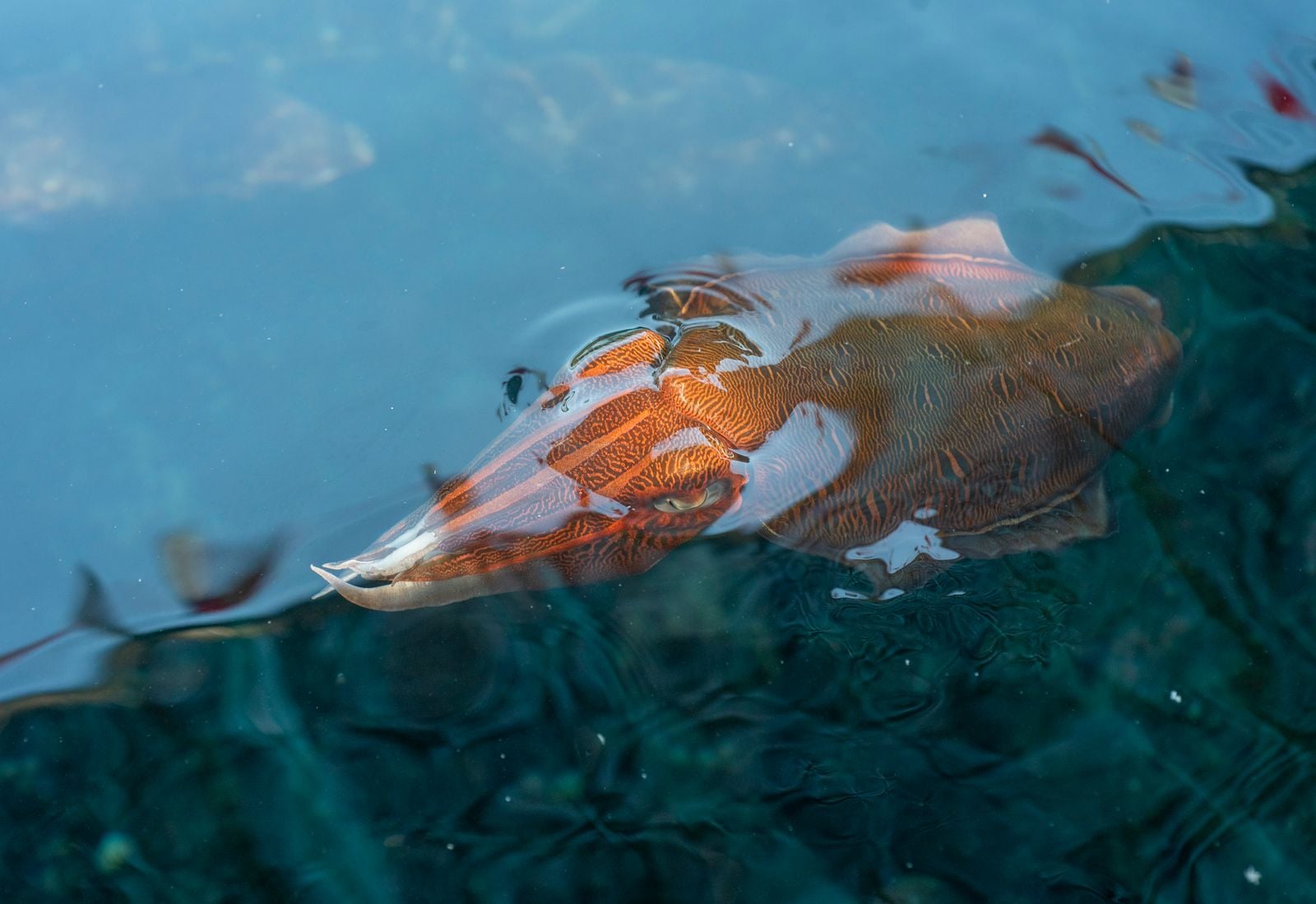
Cuttlefish camouflage presents a genuine sensory puzzle, but not quite the one suggested by the familiar checkerboard story.
In controlled experiments with the common cuttlefish Sepia officinalis, researchers created coloured checkerboards whose squares were matched for brightness as the cuttlefish visual system would register them. The animals did not respond as though they could distinguish the coloured checks. Instead, they produced non-disruptive patterns, suggesting that the boards appeared effectively uniform. The Vision Research experiment remains strong behavioural evidence that common cuttlefish cannot discriminate colour in the conventional sense.
Yet that is only half of the paradox. A separate study of cuttlefish on natural substrates found that the reflectance spectra of their skin patterns could correlate closely with those of the backgrounds beneath them. To another animal looking on, the result can therefore be a surprisingly good chromatic match — even though the cuttlefish may not experience the scene as a collection of different hues.
The W-shaped pupil
In darkness, a common cuttlefish pupil is broadly circular. In bright light, it contracts into the distinctive wavy horizontal opening commonly described as a W.
The best-established purpose of that shape is light management. A 2013 study in Vision Research found that the constricted pupil reduces illumination from the bright water above more strongly than it reduces light from the horizontal part of the scene. That helps limit glare and scattered sunlight while preserving useful vision towards the front, rear and dimmer seafloor.
Another proposed function is more speculative. Different wavelengths do not pass through a lens in exactly the same way: they come into focus at slightly different positions, an effect called chromatic aberration. Cuttlefish focus mainly by moving a fixed-shape lens relative to the retina. In principle, changes in image sharpness as the lens moves could contain some wavelength information even when every retinal receptor uses the same visual pigment.
That is an intriguing optical model, not proof that cuttlefish experience red, green and blue as humans do. Human cone cells also do not “fix” chromatic aberration; they allow the nervous system to compare the responses of receptors with different spectral sensitivities. The cuttlefish retina appears to lack that conventional comparison system.
One visual pigment, but real depth perception
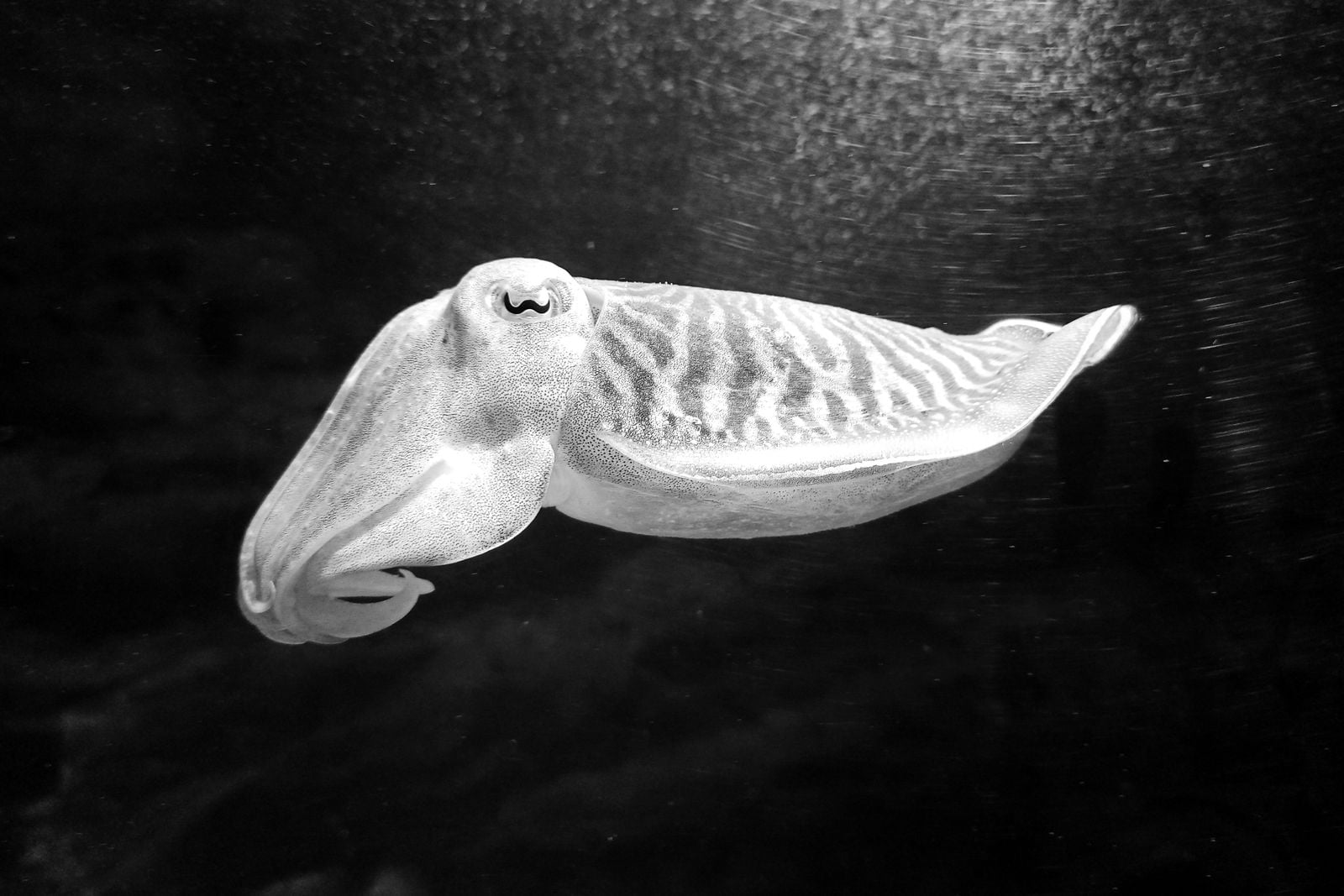
The common cuttlefish has one known retinal visual pigment, with peak sensitivity around the blue-green part of the spectrum. With only one spectral channel, a change in wavelength can be indistinguishable from a change in brightness. That is why experiments must carefully balance the intensity of coloured stimuli before drawing conclusions about colour vision.
None of this makes the eye simple. In the now-famous 3D-glasses experiment, researchers placed red-and-blue filters over cuttlefish eyes and showed the animals moving images of shrimp. As Nerdist reported, the animals adjusted their position and striking distance according to the binocular disparity in the images. The underlying experiment showed that cuttlefish can use stereopsis — differences between the views received by the two eyes — to judge prey distance.
Depth perception and colour perception are separate problems. The 3D glasses revealed a sophisticated method of calculating where something is, not what hue it is.
Polarised light is a different visual channel
Cuttlefish can also detect the orientation of polarised light. Polarisation describes the direction in which a light wave’s electric field oscillates; it is distinct from wavelength, which humans interpret as colour.
Underwater, polarisation can add contrast to reflections, transparent tissues and otherwise difficult-to-detect objects. Cuttlefish possess unusually fine polarisation sensitivity, giving them access to visual information that human observers normally miss.
Some cephalopod skin structures also produce polarised reflections. Researchers have investigated whether those reflections could carry signals between animals while remaining inconspicuous to predators with poor polarisation sensitivity. That remains a plausible communication hypothesis, not a demonstrated secret language. There is also no solid basis for saying that the W-shaped pupil itself preserves polarisation information that a circular pupil would necessarily erase.
Does the skin itself sense light?
Cuttlefish skin contains some of the molecular machinery associated with photoreception, including light-sensitive proteins related to those used in eyes. That finding raises the possibility that the skin can register local illumination rather than acting only as a passive display.
It does not yet show that cuttlefish skin independently distinguishes colours, calculates the appearance of the surrounding scene or controls whole-body camouflage without the brain. Evidence for eye-independent, light-triggered chromatophore expansion in detached skin is strongest in octopuses, and it should not be transferred to cuttlefish without qualification.
A Nature Research Intelligence overview of cephalopod neurobiology places this work within the broader idea of cephalopods as integrated sensor-display systems. That is a useful framework: eyes, brain, peripheral tissues and skin interact continuously. It is not, by itself, evidence that cuttlefish skin functions as a second colour camera.
Millions of pigment organs under neural control
The visible display is produced largely by chromatophores: elastic pigment organs controlled by motor neurons. Each contains a central pigment sac surrounded by roughly 15 to 25 radial muscle fibres. When those muscles contract, the sac expands into a broad coloured disc. When the neural input stops, elastic recoil draws it inward again.
A cuttlefish can coordinate enormous numbers of these organs, combining yellow or orange, red and brown-black pigment layers with reflective cells beneath them. Calling each chromatophore a biological pixel is useful, but recent work shows that the control system is considerably less uniform than that metaphor suggests.
A July 2026 study published in eLife applied the CHROMAS computer-vision pipeline to the hummingbird bobtail squid Euprymna berryi and the common cuttlefish Sepia officinalis. CHROMAS itself was introduced in a related 2025 methods paper.
By dividing chromatophores into radial slices and analysing their changing shapes, the researchers inferred an average of about four independent components within each chromatophore. Those components formed contiguous, petal-like regions rather than behaving as one perfectly uniform disc.
The analysis also identified putative motor units extending across multiple chromatophores. Most involved fewer than 14 chromatophores, and their inferred geometries ranged from compact groups to elongated or fragmented arrangements. Expansion was generally faster and more repeatable than relaxation, fitting a system driven actively by muscle contraction and returned more passively by elastic recoil.
These are computationally inferred control components, supported by limited electrophysiological validation. They should not be described as direct observation of a separate motor neuron attached to every detected slice.
Where the visible colours come from
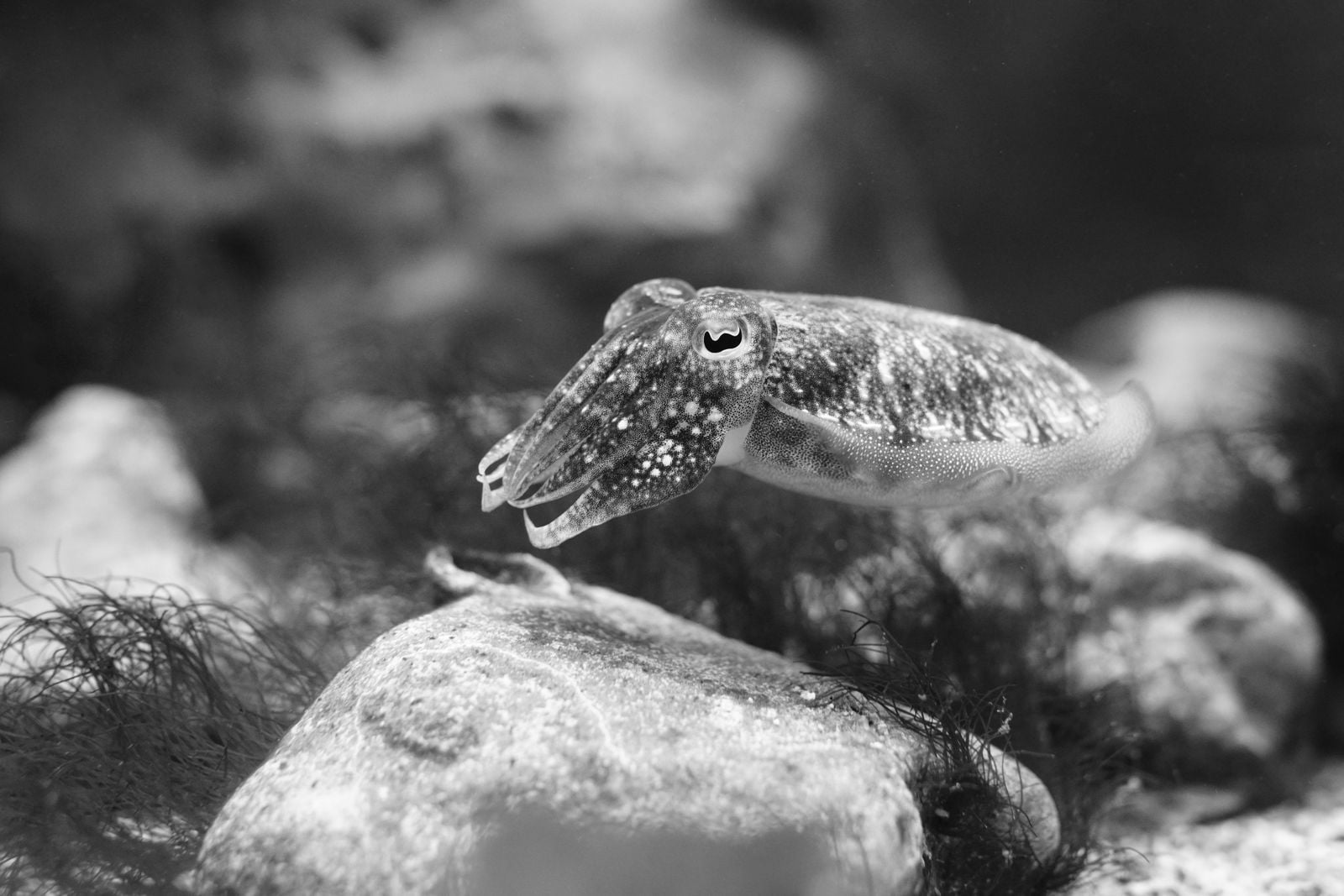
Chromatophores are only the upper part of the optical system. Beneath them sit iridophores, which create structural and sometimes iridescent colours, and leucophores, which scatter a broad range of incoming wavelengths.
Leucophores can therefore reflect much of the prevailing illumination: under reddish light they return more red, and under bluish light they return more blue. Chromatophores above them regulate darkness, contrast and the distribution of pigment, while iridophores add further wavelength-dependent reflections.
This helps explain how a colour-blind animal can produce a skin spectrum resembling its surroundings, but it is not as simple as saying that a red rock automatically makes the animal red. Visual control of camouflage is strongly influenced by brightness, edges, contrast, object size and spatial texture. Passive reflection and the limited pigment palette can then make the resulting pattern a closer chromatic match than the animal’s nervous system alone might appear capable of specifying.
Camouflage is more than a menu of three patterns
Cuttlefish camouflage has often been organised into broad categories such as uniform, mottled and disruptive. Those labels remain useful descriptions, but they do not mean that the animal simply selects one of three fixed templates.
In a 2023 Nature study, researchers analysed hundreds of thousands of images of common cuttlefish moving between camouflage states. The resulting pattern space was high-dimensional, and transitions were neither direct nor stereotyped. Even repeated journeys between similar starting and finishing appearances followed different routes.
The animals repeatedly slowed, changed direction and accelerated before stabilising. As they approached a final pattern, their pauses became more frequent and longer, while the correspondence between skin and background improved. The authors interpreted those dynamics as evidence for successive feedback-like corrections rather than one ballistic command from a fixed pattern library.
What the animal knows
Several parts of the puzzle are now well established. Behavioural tests support colour blindness in the common cuttlefish. Cuttlefish can perceive polarised light and binocular depth. Their brains directly control vast arrays of chromatophores, while iridophores and leucophores broaden the colours and reflectance patterns their skin can produce.
Other parts remain open. Researchers do not yet know whether chromatic aberration supplies useful wavelength information during ordinary behaviour, how much dermal photoreception contributes to camouflage, or precisely how brightness, texture, polarisation and the skin’s passive optics are combined.
The paradox is therefore not that cuttlefish reproduce a colour they cannot perceive at all. They perceive the background through channels that emphasise contrast, scale, edges, depth and polarisation, while their skin converts the resulting neural commands into an appearance built from pigments and reflectors.
To a human observer, the outcome looks like colour vision expressed across the body. The route by which the cuttlefish gets there may be fundamentally different.