

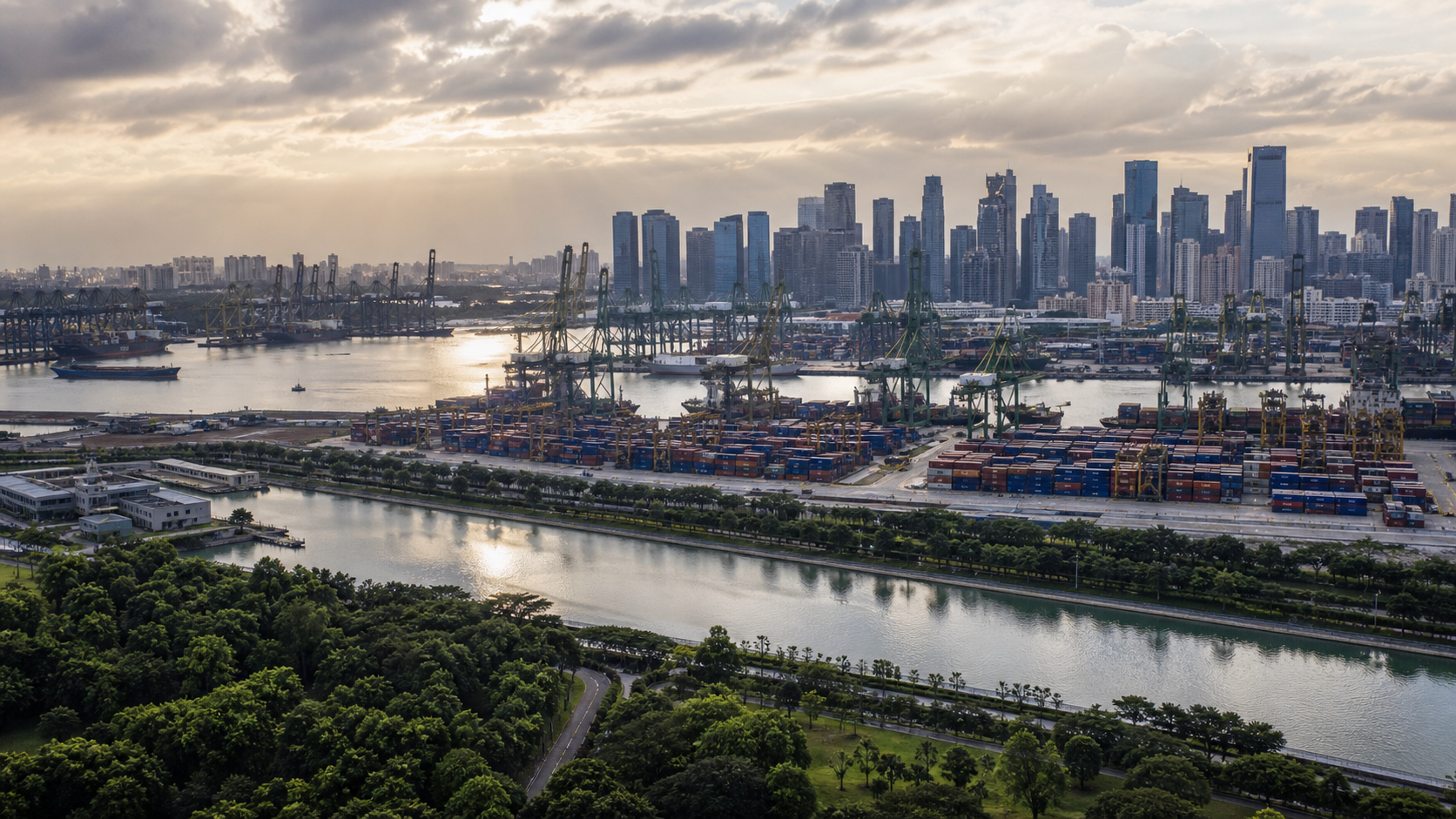
Singapore became an independent country on 9 August 1965 after a brief and bitter union with Malaysia. It entered that day with no hinterland, no industrial base, no significant natural resources and a water supply that depended heavily on agreements with the country it had just left.
“Expelled” is a fair description of the political shock, but it compresses a more complicated separation. Malaysia’s parliament approved the constitutional change unanimously, while Singaporean and Malaysian ministers had already negotiated and signed a separation agreement. A recent National Library Board account of those negotiations shows that figures on both sides had concluded the union was no longer workable.
The economic result across the next six decades is no less striking for being stated carefully. World Bank data put Singapore’s GDP per person at US$90,674 in 2024, compared with roughly US$517 in 1965 in current-dollar terms. That is not a clean measure of living standards across time because it includes inflation and currency movements, but it explains why Singapore is now routinely counted among the world’s richest economies per person.
It did not discover a hidden resource. It built an operating system for a small state.
The starting point was difficult, not empty
The phrase “no natural resources” captures Singapore’s lack of oil, minerals and agricultural land. “No fresh water” needs a little more precision. The island received abundant rain and had local reservoirs, but it lacked the land and storage capacity to collect enough reliable supply for a growing city. Singapore’s national water agency describes the early problem as a combination of limited catchment land, drought, flooding and pollution.
Singapore also possessed advantages that matter. It sat beside the Strait of Malacca on a major shipping route. Its colonial port had already made it an entrepôt, with commercial, legal and linguistic links to international trade. Resource scarcity is not the same as having no assets at all.
The break with Malaysia nevertheless removed the larger common market that Singapore’s leaders had expected merger to provide. The city had to sell to the world because its domestic market was too small to sustain industrialisation on its own. The National Library Board’s history of the post-independence economy records the shift to export-oriented development and the deliberate effort to bring multinational manufacturers into Singapore.
Foreign capital came with factories and skills
The Economic Development Board, established in 1961, did more than advertise the country. The government developed industrial land at Jurong, installed infrastructure, changed labour policy and expanded technical education. It offered foreign companies a stable base from which to manufacture for global markets.
The early products were not glamorous: garments, toys, wigs, fish hooks and mosquito coils. Electronics then provided a route into higher-value production. National Semiconductor began operating in Singapore in 1968, followed by companies including Texas Instruments, Hewlett-Packard and General Electric. An Economic Development Board history of manufacturing says labour-intensive industrialisation created a labour shortage by the 1970s, pushing the economy towards precision engineering, petrochemicals and more skilled work.
This was not laissez-faire growth. Public agencies chose sectors, built sites, trained workers and courted investors. Private capital supplied factories, technology and access to international markets. The model worked because those pieces were treated as parts of one system rather than as separate policies.
It also kept changing. Singapore moved from basic assembly into semiconductors and hard disk drives, then added aviation, biomedical manufacturing, finance and business services. When lower-cost neighbours could compete for labour-intensive production, the state sought activities in which logistics, reliability, specialised skills and dense supplier networks mattered more.
Housing was economic infrastructure
Industrial policy alone does not explain the transformation. Singapore also had to turn a crowded port city into a place where a large urban workforce could live, travel, study and remain healthy.
The Housing & Development Board was created in 1960 amid an acute shortage. HDB says it built more than 21,000 flats within its first three years, then introduced a home-ownership programme in 1964. From 1968, buyers could use compulsory Central Provident Fund savings for deposits and mortgage payments. Public housing connected social policy to savings, land planning and political stability.
That programme required unusually strong state power. The 1967 Land Acquisition Act enabled large-scale clearance and redevelopment for homes, roads and industry. It produced coordinated urban development at a speed that fragmented private ownership would have made difficult, but it also meant families and landowners did not always control the terms on which places were remade.
Clean administration was another part of the investment proposition. Singapore’s Prevention of Corruption Act was enacted in 1960 and gave the Corrupt Practices Investigation Bureau stronger powers. The bureau’s own history makes clear that corruption had not vanished at independence; enforcement reached police officers and senior political figures over the following decades. Institutional reputation was built through cases, not slogans.
Water and land became engineering problems
Singapore could not legislate away its physical limits. It could, however, change the way those limits operated.
Water supply is now organised around four sources: local catchment, imports from Johor, highly treated recycled water known as NEWater, and desalination. Two-thirds of the island functions as water catchment, feeding 17 reservoirs through drains, canals and rivers. The continuing 1962 water agreement allows Singapore to draw from the Johor River until 2061, so greater resilience has not made geography irrelevant.
Land was expanded as well as rationed. Reclamation enlarged industrial and urban areas, including Jurong Island, while dense housing and transport allowed more activity on each square kilometre. Singapore’s Department of Statistics reports 744.3 square kilometres of land at the end of 2025. The island was considerably smaller at independence.
The important point is not that scarcity disappeared. It became a permanent planning constraint around which institutions, prices and infrastructure were designed.
The economy still depends on the world
Singapore’s current economy shows how far the strategy diversified. Official 2025 figures assign 19.7 per cent of nominal value added to wholesale trade, 18.5 per cent to manufacturing, 14 per cent to finance and insurance, and 8.1 per cent to transport and storage. More than 70 per cent came from services, but manufacturing remained a substantial anchor rather than a discarded stage of development.
Success has brought new tensions. The economy depends heavily on foreign markets, international companies and mobile labour. Singapore’s Ministry of Manpower counted 1.64 million foreign workers at the end of 2025, including domestic workers and large numbers employed in construction, marine and process industries. The polished city rests partly on work done by people whose rights, wages and housing differ sharply from those of citizens.
Prosperity is not evenly experienced among resident households either. Singapore’s Department of Statistics put the 2025 Gini coefficient for household market income per household member at 0.452 before government transfers and taxes and 0.379 after them. Those figures cannot be compared casually with every international league table because methods differ, but the official household data show that redistribution narrows rather than erases inequality.
The model is therefore not a simple instruction manual. A small city-state could coordinate land, housing, education and investment in ways that larger, more politically fragmented countries may not be able or willing to copy. Its strategic location also gave it a commercial advantage that many resource-poor states do not possess.
What Singapore demonstrated was narrower and more useful: physical scarcity does not dictate economic destiny, but overcoming it requires institutions capable of making several long-term systems work together.
