
On the fourth day of the experiment, Ron Jones walked into a Cubberley High School classroom in Palo Alto and found roughly 200 teenagers waiting for him — nearly three times his official student roster. They had come from other classes, other buildings, other periods. Some carried membership cards. A few had appointed themselves informants, reporting classmates who broke the rules. None of them had been recruited. They had simply heard there was a movement worth joining, and they had joined.
Jones was a young teacher in an early year of teaching history. Five days earlier, a student had asked him a question he could not answer.

The question that started it
The class was working through a unit on Nazi Germany. A student wanted to know how ordinary Germans could later claim they had not seen what was happening around them — the camps, the disappearances, the neighbours who stopped coming to school. Jones did not have a textbook answer. He decided to build one.
His plan was modest. One day of strict classroom discipline. A small demonstration of how order feels from the inside. He would run it Monday, debrief on Tuesday, and get back to the syllabus.
That is not what happened.
Day one: strength through discipline
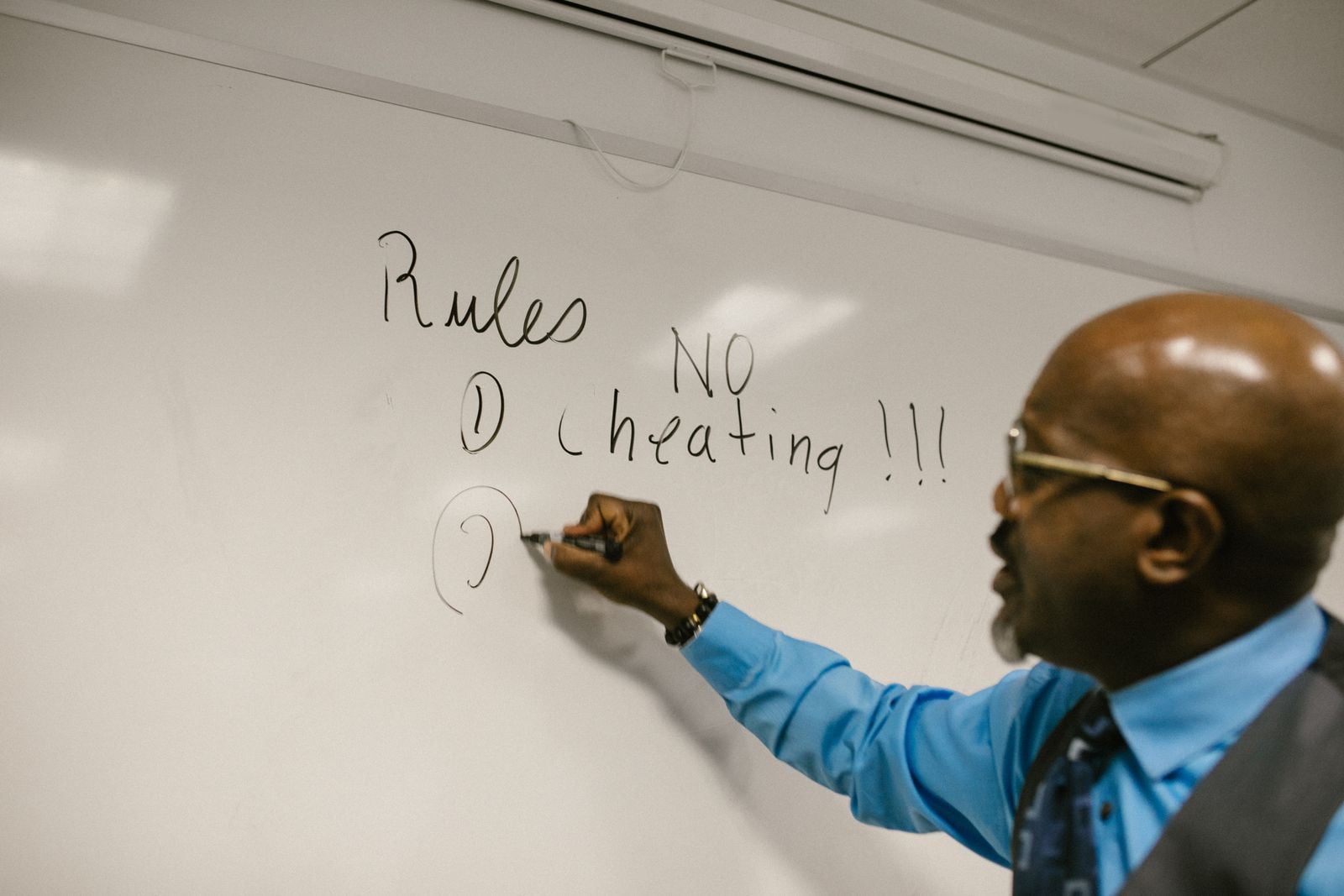
Monday morning Jones wrote three words on the chalkboard: Strength Through Discipline. Then he laid out the rules. Sit up straight. Feet flat on the floor. Back against the chair. To speak, stand beside your desk, address him as Mr. Jones, and keep your answer to three words or fewer.
The rules were small enough to feel like a game. The class complied instantly. Jones drilled them on posture, on entering the room silently, on standing to attention before answering. By the end of the period, students who had spent the previous week slouching were sitting like cadets. Jones was surprised by how quickly they liked it — and by how much sharper their answers became once the format was rigid.
There is a reason strict order can feel good. When someone else decides how you sit, speak and behave, the low-grade anxiety of small daily decisions disappears. Building on research into moral behaviour and conformity, people who are induced toward group-alignment often behave less like independent agents and more like extensions of whatever the group is doing — for better or for worse. The students in Room C-3 were not being forced. They were being relieved.
Day two: strength through community
Jones came in Tuesday expecting the novelty to have burned off. Instead, his students were already seated at attention before the bell, waiting. So he added a second line to the board: Strength Through Community. He gave the movement a name — the Third Wave — and taught them a salute, a cupped-hand gesture aimed at the opposite shoulder. Members were to use it whenever they saw one another, inside class or out.
By lunchtime, the salute was appearing in hallways. Students from other periods asked how to join. Jones printed membership cards. He appointed monitors. He told the class the Third Wave was part of a nationwide youth movement and that they had been selected for it.
None of that was true. He was making it up as he went.
Day three: the movement outgrows the room
By Wednesday the roster had swelled from around 30 students to over 40, then past 50. Kids were skipping other classes to attend. Jones handed out assignments — design a Third Wave banner, recruit a new member, report anyone violating the rules. Three students volunteered, unprompted, to report on their classmates. Others reported on them in turn. The informant network built itself.
This is the point in the story that historians of the experiment tend to linger on, because it is the point where the mechanics stopped being about Ron Jones. He was no longer pushing the movement. The movement was pulling him. Students were inventing rituals he had not authorised — a special way of entering the classroom, a code for identifying fellow members outside school, unofficial disciplinary actions against those who mocked the group.
There is a threshold beyond which spread becomes self-sustaining. Research on the tipping point for social change has examined how committed minorities can influence larger groups. Below a certain share, new norms tend to collapse. Above it, they tend to cascade. Jones needed only a few dozen visible converts before the cascade started doing his recruiting for him.
Day four: 200 students in a room built for 30
Thursday was the day Jones said scared him most. He arrived to find roughly 200 students waiting. Some had cut other classes. Some had been given permission by teachers who thought the Third Wave was an approved civics program. The room could not hold them. They stood along the walls, filled the aisles, sat on desks.
Jones told them the Third Wave was going national. There would be an announcement Friday at noon in the school auditorium. A presidential candidate for the youth movement would appear on television. The country was waiting for them.
None of it was real. All of it was believed.
What unsettled Jones was not the enthusiasm. It was the loss of dissent. A few students had privately told him they were uncomfortable. Almost none said so in front of the group. The commanding presence of the movement — its salute, its cards, its informants, its promise that they were part of something larger — had made ordinary disagreement feel like betrayal. Silicon Canals has previously looked at why the people who command the most respect in a room are usually the ones who can disagree without making others feel stupid. In Room C-3, that skill had quietly gone extinct.
Why the machinery worked so fast
The Third Wave is often filed next to Stanley Milgram’s obedience studies and Philip Zimbardo’s Stanford Prison Experiment. It belongs there, but it is also distinct. Milgram’s subjects were paid strangers in a laboratory. Zimbardo’s were volunteers signed up for a study. Jones’s were teenagers in their own school, following an adult they already trusted, in a building they walked into every morning.
The proximity mattered. Recent work revisiting Milgram’s experiment found that the physical closeness of the authority figure sharply increased obedience. In the replication, the obedience rate was highest when the experimenter shared a room with the subject and the person being harmed was elsewhere. Authority in the room. Consequences out of sight.
Jones was the authority in the room. The consequences — the students being ostracised, the ones being reported on, the ones too afraid to speak — were spread across a school large enough that no single student saw the full picture. Everyone saw their own compliance. Almost no one saw the cost.
Day five: the rally that was not a rally
Friday at noon, students filed into the auditorium expecting a televised address from the leader of the national youth movement. Jones had cultivated the setup all week — the television at the front of the room, the promise of a candidate, the sense that this was the moment they had been training for.
He turned on the television. Static. He let the silence stretch. Then he told them the truth. There was no national movement. There was no candidate. They had been part of an experiment about how ordinary people become part of things they would never normally choose. He played them footage of Nuremberg rallies. Some students cried. Some got angry. Some sat still.
Jones described the ending as the hardest part — telling children who had felt, for the first time in their school lives, like they belonged to something important, that the belonging had been engineered. He shut the experiment down that afternoon. Cubberley High School closed in 1979. The classroom is gone. The story is not.
What the experiment actually demonstrated
The lesson people take from the Third Wave is usually a warning about fascism, and it is that. But the mechanics are broader and more uncomfortable. Jones did not use fear. He did not use punishment. He did not use ideology. He used posture rules, a salute, a name, membership cards, and a story about being chosen. The students did the rest.
The relief of being told exactly how to sit, speak and behave; the pleasure of belonging to something with a name; the small social reward of turning in a rule-breaker; the way dissent starts to feel embarrassing once enough people are aligned — these are not exotic conditions. They are the default operating environment of most workplaces, most institutions, most online communities. Ron Jones did not invent them. He compressed them into five days.
Education systems have spent decades trying to build the opposite of Room C-3 — classrooms where trust replaces compliance, where questioning the teacher is treated as a skill rather than a threat. Silicon Canals has written about how Finland built the most trusted education system in the world by doing almost the exact opposite of what everyone else believed worked, refusing the tools of ranking, testing and enforced uniformity that most systems reach for. The Third Wave is a useful counter-image. It shows what a classroom can produce in a week when trust is replaced with the pleasure of being told what to do.
The part Jones could not undo
Interviewed decades later, some of the students who had been in Room C-3 said they still could not fully explain why they had joined. A few said they had known something was wrong and stayed silent anyway. One told Jones she had felt, during that week, more visible and more valued than at any other point in high school. That is the sentence that tends to stop people.
The experiment ended on a Friday. The mechanism it revealed did not. Every institution that has ever run on posture rules and membership cards and the quiet pressure not to be the one asking difficult questions is running a slower, more polite version of the same machine. Ron Jones’s contribution was to show how few days it takes, and how eager the volunteers are.
He never taught the unit on Nazi Germany the same way again. He did not need to.