

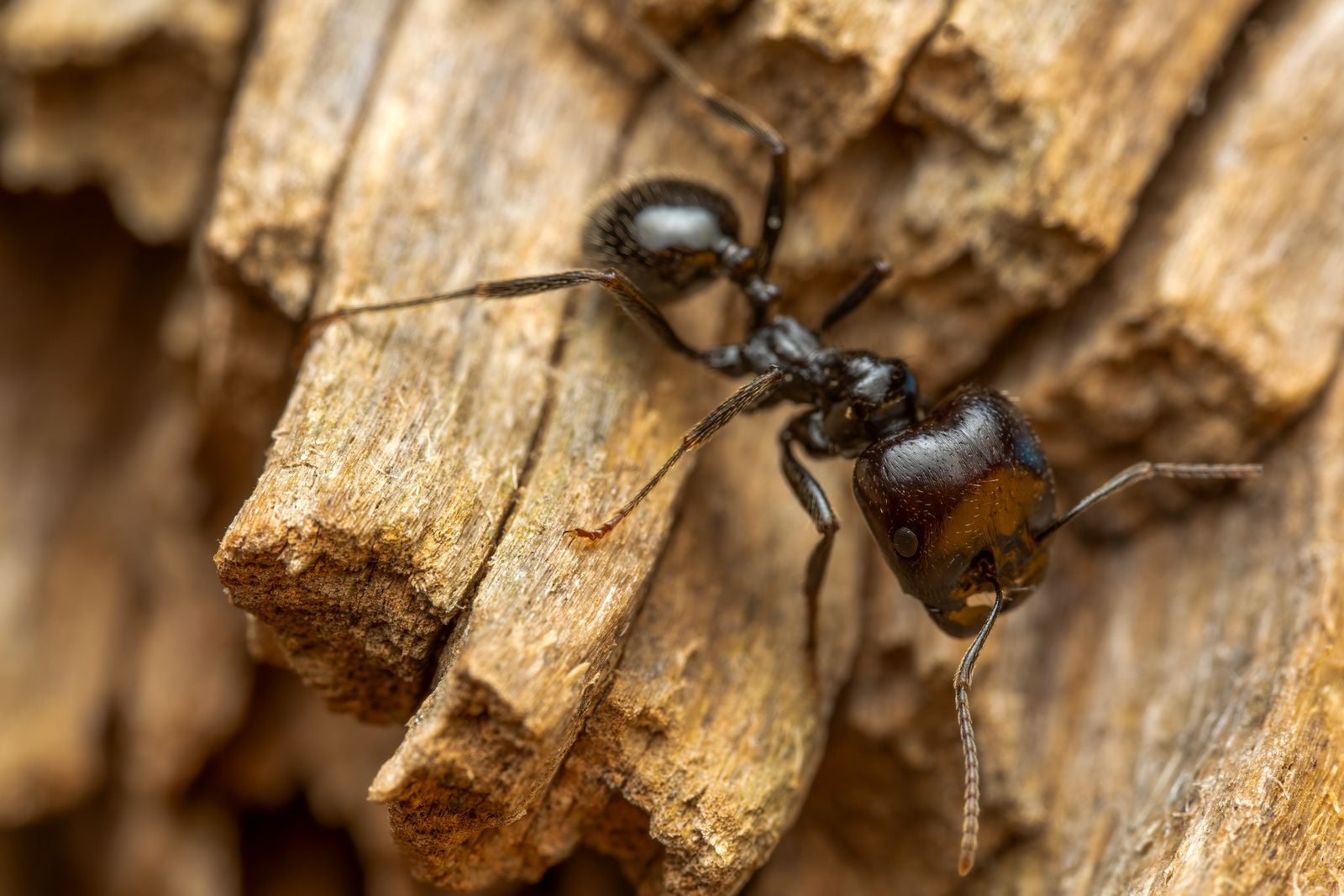
A fungal spore attaches itself to a carpenter ant and penetrates the insect’s outer cuticle. Over the following days or weeks, the fungus grows through the ant’s body until the infected worker leaves its normal routine, moves onto vegetation and clamps its mandibles around a leaf vein or twig. After the ant dies, a fungal stalk develops from its body and releases spores into the surrounding forest.
In one intensively studied population in Thailand, infected ants were commonly found biting leaves about 25 centimetres above the soil. That number is striking, but it is an average from a particular host, fungus and habitat rather than a universal altitude selected by every zombie-ant fungus.
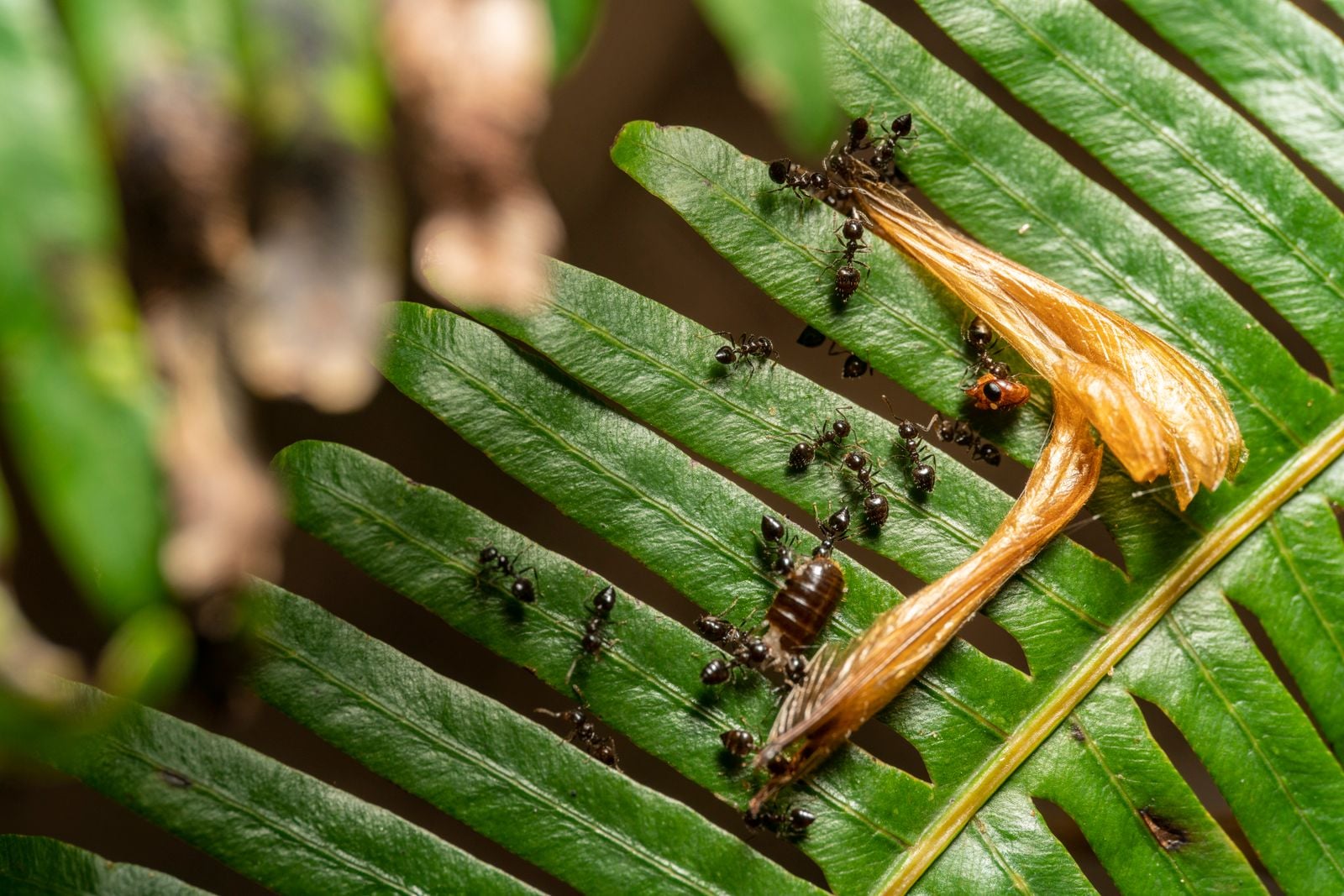
The infection begins on the ant’s outer shell
The fungi commonly called zombie-ant fungi belong to specialised lineages within the Ophiocordyceps unilateralis species complex. Their spores attach to suitable ant hosts, germinate and penetrate the cuticle before fungal cells multiply inside the insect.
The infection can remain difficult for nestmates to detect while it develops. A 2018 Penn State study found that infected carpenter ants were not attacked or isolated by their nestmates and continued participating in food sharing until they eventually left the nest. In that experimental system, development inside the ant took roughly 14 to 21 days.
The fungus spreads through the body but avoids the brain
The most surprising finding from modern imaging studies is that the fungus does not need to fill the ant’s brain with fungal tissue. Researchers examining infected ants found fungal cells distributed through the body, invading and surrounding muscle fibres while remaining outside the brain itself.
A Penn State report on the research compared the arrangement to a puppeteer controlling a marionette through its muscles. Three-dimensional reconstructions also showed fungal cells joining into extensive networks around the ant’s tissues.
That does not mean the brain is unaffected, and it does not establish that the ant remains consciously aware of the process. Researchers have suggested that fungal chemicals may alter signals in the brain or elsewhere in the nervous system, but exactly how the parasite coordinates the ant’s walking, climbing and biting is still being investigated.
The famous 25-centimetre height comes from one forest system
In the Thai rainforest system studied by David Hughes and his colleagues, infected Camponotus leonardi workers descended from canopy nests and moved through low vegetation. They eventually bit the underside of major leaf veins, with deaths concentrated at an average height of roughly 25 centimetres above the soil.
Research comparing different zombie-ant systems shows that the final location depends on local conditions. Tropical fungi often direct ants towards leaves, while some temperate species cause their hosts to bite twigs, which provide a more durable attachment through winter.
The selected location appears to improve the fungus’s chances of completing its development. Moisture, temperature, vegetation and access to passing ants can all affect whether a dead host becomes a successful platform for producing and dispersing spores.
The death grip is caused by damaged, hypercontracted muscles
At the end of the manipulated sequence, the ant closes its mandibles around the plant and remains attached after death. The grip keeps the body from falling to the forest floor before the fungus has finished growing its reproductive structure.
The bite is not simply caused by the mandibular muscles suddenly wasting away. A 2019 study in the Journal of Experimental Biology found extensive fungal colonisation and damage inside the jaw muscles, but it also found evidence that those muscles were hypercontracted. Motor neurons and the junctions connecting nerves to muscles were still present.
The researchers also observed fungal structures penetrating muscle tissue and particles resembling extracellular vesicles. Those findings offer possible pieces of the mechanism, but they do not yet provide a complete explanation for how the fungus times the final contraction so precisely.
The ant becomes a platform for fungal reproduction
Once the ant is dead and secured to the vegetation, the fungus continues consuming and restructuring the host’s tissues. A stalk eventually grows from the ant, commonly emerging from the head or the area behind it, and develops a spore-producing structure.
The spores are then released into the environment, often above the forest floor or routes used by foraging ants. The positioning of the corpse therefore serves the fungus long after the host has died, making the manipulated ant and its final bite an example of what biologists call an extended phenotype.
The fungus is also highly specialised. Different zombie-ant fungal species tend to infect particular ant species, and they do not all produce the same climbing behaviour, biting location or reproductive structure.
The colony does not always recognise the danger
Ant colonies possess collective disease defences, including grooming, corpse removal and the exclusion of contaminated material. However, the specialised relationship between carpenter ants and zombie-ant fungi does not always trigger those defences while the infected worker is still alive.
Laboratory observations found infected workers continuing to interact with nestmates until late in the infection. Leaving the colony is therefore not necessarily the result of healthy ants dragging a visibly sick worker outside; it can form part of the behavioural changes associated with the parasite itself.
The fungus also faces a practical problem inside the nest. Its large reproductive stalk needs space and suitable environmental conditions to mature, which helps explain why the manipulated death occurs on exposed vegetation rather than deep inside the colony.
A newly described fungus attacks the zombie-ant fungus
The ant and its parasite are not the final level in this ecological chain. A 2026 study by Muhammad Shahbaz, Jaya Seelan Sathiya Seelan and their colleagues described a newly identified member of the genus Pleurocordyceps from material collected in Malaysia.
The Phytotaxa paper named the species Pleurocordyceps cornusynnemata and reported it from an ant specimen. The study also recorded two previously known Pleurocordyceps species in Malaysia for the first time.
Reports from Popular Mechanics and Wired describe the new species as a hyperparasite. Rather than manipulating the ant itself, it attacks the Ophiocordyceps fungus already associated with the insect and feeds on fungal tissue.
The arrangement creates a biological chain in which a fungus exploits an ant and another fungus exploits the first fungus. It also complicates the familiar image of the zombie-ant parasite as an organism in complete command of its surroundings.
Why this is not evidence of a human zombie fungus
The Last of Us uses the real behaviour of insect-infecting fungi as the starting point for a fictional human pandemic. The leap from an ant-specialised parasite to a fungus capable of manipulating humans, however, would require an enormous series of biological changes.
Zombie-ant fungi are adapted to particular insect hosts, body structures and environmental conditions. There is no evidence that Ophiocordyceps can direct human movement or reproduce through human bodies in the manner shown in the series.
Fungal diseases in humans are real, but they involve different organisms and mechanisms. The zombie-ant system is extraordinary precisely because it is the result of a highly specialised evolutionary relationship, not a general power that the fungus can apply to any animal it encounters.
The death grip is at least 48 million years old
The behaviour also appears to have deep evolutionary roots. A Biology Letters paper described distinctive damage on a fossil leaf from the Messel Pit in Germany, dating to approximately 48 million years ago.
The marks resemble the scars produced when modern infected ants lock their mandibles around major leaf veins. They provide evidence that a comparable death-grip behaviour existed in the Eocene, although the fossil cannot reveal the ant’s height above the ground or every step in the parasite’s life cycle.
Modern imaging can show fungal networks wrapped around muscle fibres, and fieldwork can measure where infected ants die. The central mystery remains how an organism without a brain coordinates a living insect’s behaviour closely enough to place its own reproductive body in the right part of the forest.
