

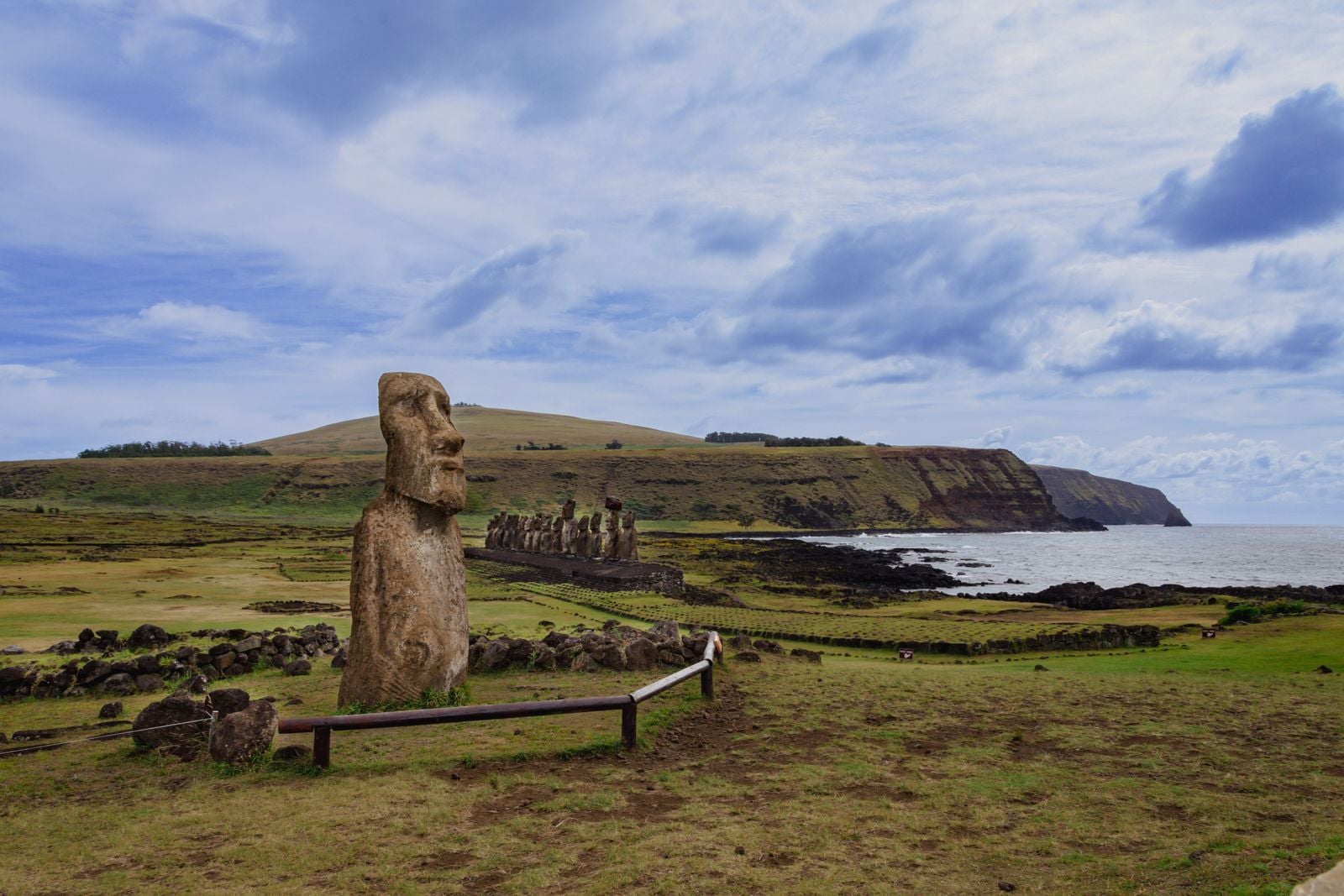
On Easter Sunday 1722, Dutch admiral Jacob Roggeveen anchored off a treeless speck of volcanic rock in the South Pacific and wrote down what he saw. Hundreds of stone giants stared inland from platforms along the coast. Some stood ten metres tall. The people who greeted his ships had, in his estimation, no cranes, no timber, no draft animals, and no obvious means of having built any of it. Roggeveen’s log became the founding document of a mystery that Europeans would spend three centuries getting wrong.
The wrongness started immediately. It compounded across generations of visitors who each arrived with a fixed idea of what the evidence should mean, and left with confirmation of what they had already believed.
What Roggeveen actually recorded
Roggeveen commanded three ships of the Dutch West India Company. He was not looking for Rapa Nui. He was looking for a mythical southern continent that did not exist. When his crew stumbled onto an island 3,700 kilometres from the nearest inhabited land, they had roughly a day of contact before violence broke out and they sailed on.
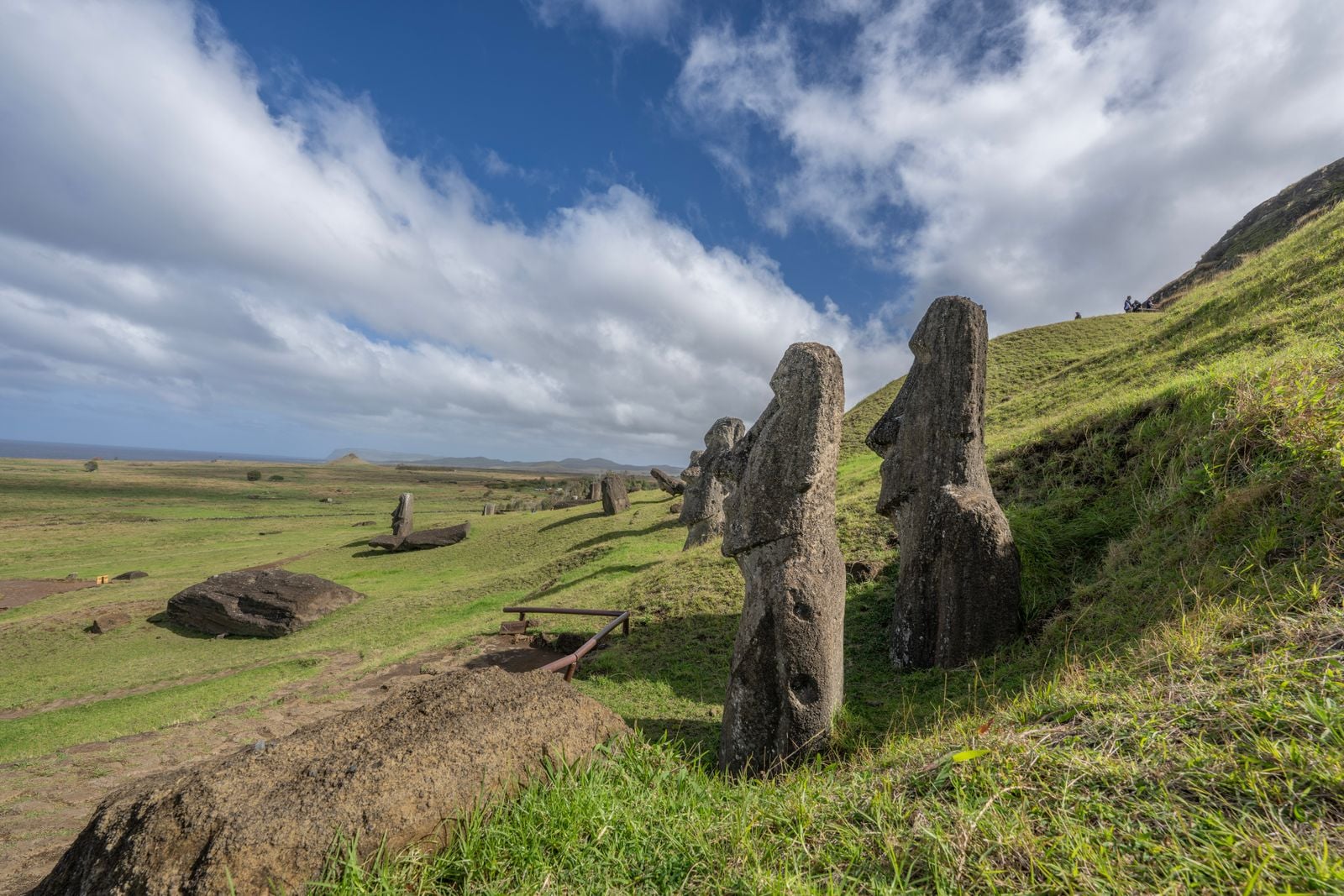
The log describes islanders paddling out in canoes to meet the ships. Strong builds. Friendly manner. White teeth. Distinctive hairstyles. And, ringing the coast, the moai — the enormous carved figures with elongated faces and heavy brows that would come to define the island in the European imagination.
Roggeveen’s men counted a population they estimated in the low thousands. They saw few trees. They saw no ropes thick enough, no timbers long enough, no engineering apparatus of any kind that could account for statues weighing several tonnes standing upright kilometres from the quarry that had produced them. The Dutch sailors concluded that something was missing from the picture. They were right about that. They were wrong about almost everything else.
The problem with a one-day expedition
The reliability of eyewitness accounts is the subject of a substantial modern scientific literature. A 2026 Nature review on eyewitness testimony catalogues the ways in which even careful, sober observers reconstruct scenes rather than record them, filling gaps with prior expectation and adjusting memory when new information arrives. The review draws on decades of work by Elizabeth Loftus, Gary Wells, John Wixted and others on how confidence and accuracy diverge under stress and time pressure.
Roggeveen’s crew had every one of the conditions that modern researchers flag as memory-degrading: unfamiliar setting, high stress, hostile interaction, cross-cultural encounter, and a debriefing process (the ship’s log) written after the fact by a small number of authoritative voices whose accounts became canonical. Nothing about the 1722 landing meets the standards that a contemporary court would apply to a witness statement, let alone to an ethnographic record.
The cross-cultural piece matters. Weber State University communications professor Sheree Josephson, working with researchers at Ball State University, published findings in the Visual Communication Quarterly on what psychologists call the cross-race recognition deficit: a phenomenon where people have more difficulty identifying individuals from ethnic groups different from their own. Her team ran the effect through an experimental study of eyewitness identification across ethnic lines. Participants asked to identify individuals from outside their own ethnicity took longer, made more errors, and produced the highest rate of outright misidentification in the study. Correct identifications sat at just 40 per cent.
Roggeveen was not identifying a suspect. He was categorising an entire civilisation on the basis of a few hours of contact, filtered through 18th-century Dutch assumptions about what technological competence looked like. The category error was baked in before the anchor dropped.
The log rope theory that lasted 300 years
Because Roggeveen saw no trees, later Europeans concluded there must once have been trees. Because moving stone giants seemed to require timber, the trees must have been felled to make rollers and sleds. Because the island now had almost no trees, the islanders must have destroyed their own forest hauling statues around. The story fit together with such satisfying neatness that it became the standard explanation, later popularised as an ecological parable of civilisational collapse.
The islanders themselves said something different. When their descendants were asked how their ancestors had moved the moai, the answer was consistent across generations of oral tradition: the statues walked.
European scholars filed this under folklore.
What the 2025 physics actually showed
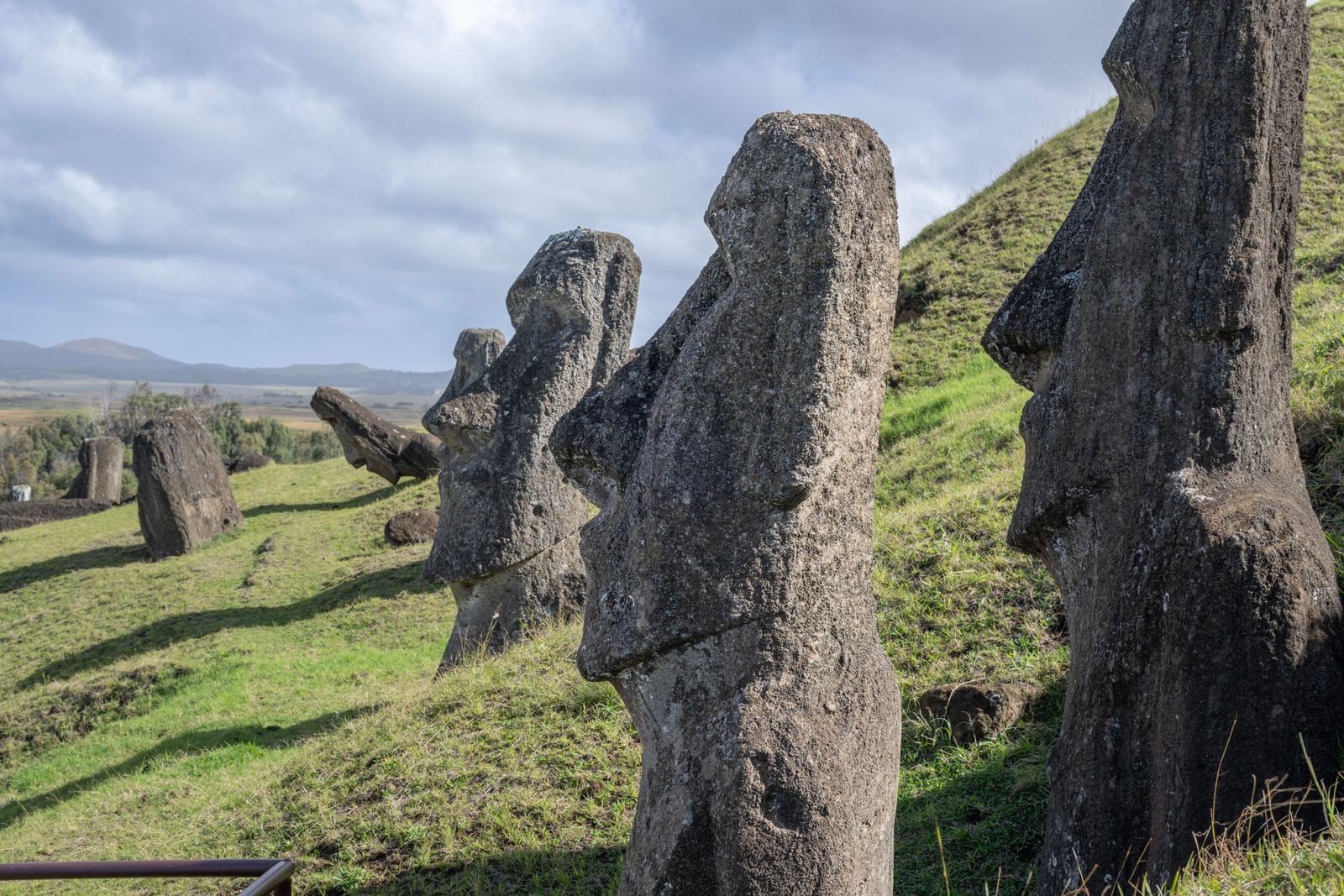
Anthropologists Carl Lipo of Binghamton University and Terry Hunt spent years arguing that the walking story deserved a physics test rather than a dismissal. Recent research published the results of that test. As Gizmodo reported on the walking moai hypothesis, Lipo and Hunt analysed 962 statues, built high-resolution 3D models of their geometry, and identified a consistent pattern: wide D-shaped bases, a forward lean, and a centre of mass that made the statues almost purpose-built for an upright rocking motion.
Then they built a 4.35-tonne replica and tested it. Eighteen people, using only ropes, walked the statue roughly 100 metres in 40 minutes.
The Artnet News summary of the study noted that the roads of Rapa Nui themselves support the theory. In the researchers’ own analysis, the transport roads run about 4.5 metres wide with concave cross-sections that would stabilise a rocking statue in transit — features they argue point to routes deliberately engineered for moving the moai rather than to accidents of terrain. Every walking moai deepened the groove for the next one.
According to the research, the experimental results demonstrated that the walking method was physically viable. The experimental evidence supported the hypothesis that the statues could have been moved using the walking method described in oral tradition.
Rapa Nui oral tradition had described exactly this — statues progressing along prepared pathways in a rocking, waddling motion — for centuries. The songs of the ancient engineers were, it turned out, a technical specification.
The cognitive machinery of getting it wrong
How did Europeans miss this for 300 years? Not because the evidence was hidden. Because the evidence conflicted with a framework they had already committed to.
Research on cognitive biases in social perception describes the pattern well: people interpret ambiguous information about unfamiliar groups through the heuristics they arrive with. Roggeveen’s crew arrived with a specific heuristic. Non-European people whose material culture appeared limited could not, by definition, have engineered the objects around them. So the objects required a different explanation. Lost civilisations. Vanished forests. Aliens, eventually.
The Rapa Nui explanation — the one supplied by the people who actually built the things — was ruled inadmissible on grounds that were never quite articulated because they never quite needed to be.
This is the same failure mode that shows up in Josephson’s mock-crime research and in the wider eyewitness literature. Confident testimony from a limited-contact observer, filtered through prior belief, produces a narrative that feels solid and is often wrong. In a courtroom, the consequence is a wrongful conviction. In archaeology, the consequence was a three-century detour through a mystery that only existed because the obvious answer had been discarded.
The last uninhabited place
The Rapa Nui arrived on the island around 1200 AD, Polynesian sailors completing the last leg of a migration that had taken humanity out of Africa, across Asia, and across the Pacific to the final piece of habitable land in the ocean. They found a forested island with abundant fish. They built one of the most distinctive visual cultures in human history — nearly 900 moai carved from a single volcanic quarry on the island’s eastern edge, some worked on for over a year by teams of specialised carvers.
They moved these figures by walking them, on roads engineered for the purpose, using a technique encoded in songs that survived the arrival of Europeans, the collapse of the population under introduced disease and slave raids, and the wholesale reframing of their history as a cautionary tale by outsiders who never asked.
Now the coast where Roggeveen anchored is under threat again. A 2025 study covered by UPI on rising sea levels around Rapa Nui projects that more than 50 archaeological sites on the island — including Ahu Tongariki, one of the largest moai platforms — could be submerged by 2080. The physical record that Lipo and Hunt spent a decade decoding has a working timer on it.
What the memory of the encounter is worth
The 1722 landing is a small case study in a larger pattern that shows up whenever an outsider arrives at a scene with limited time, strong priors, and the authority to write it down. The people on the receiving end of that authority spent three hundred years being told what their own ancestors had done and how, on the basis of an afternoon’s observation by sailors who were looking for a different continent entirely.
Recent Silicon Canals editorials on how the brain organises events around boundaries, and on how memory judges an experience by its worst moment and its ending, point at the same underlying problem. Human recall is a compression algorithm with strong opinions. It keeps the vivid parts. It discards what did not fit. And when the recall is written into a ship’s log by the captain, the compression becomes the archive.
The moai were walking the whole time. It just took the science 303 years to hear what the songs had always been saying.
