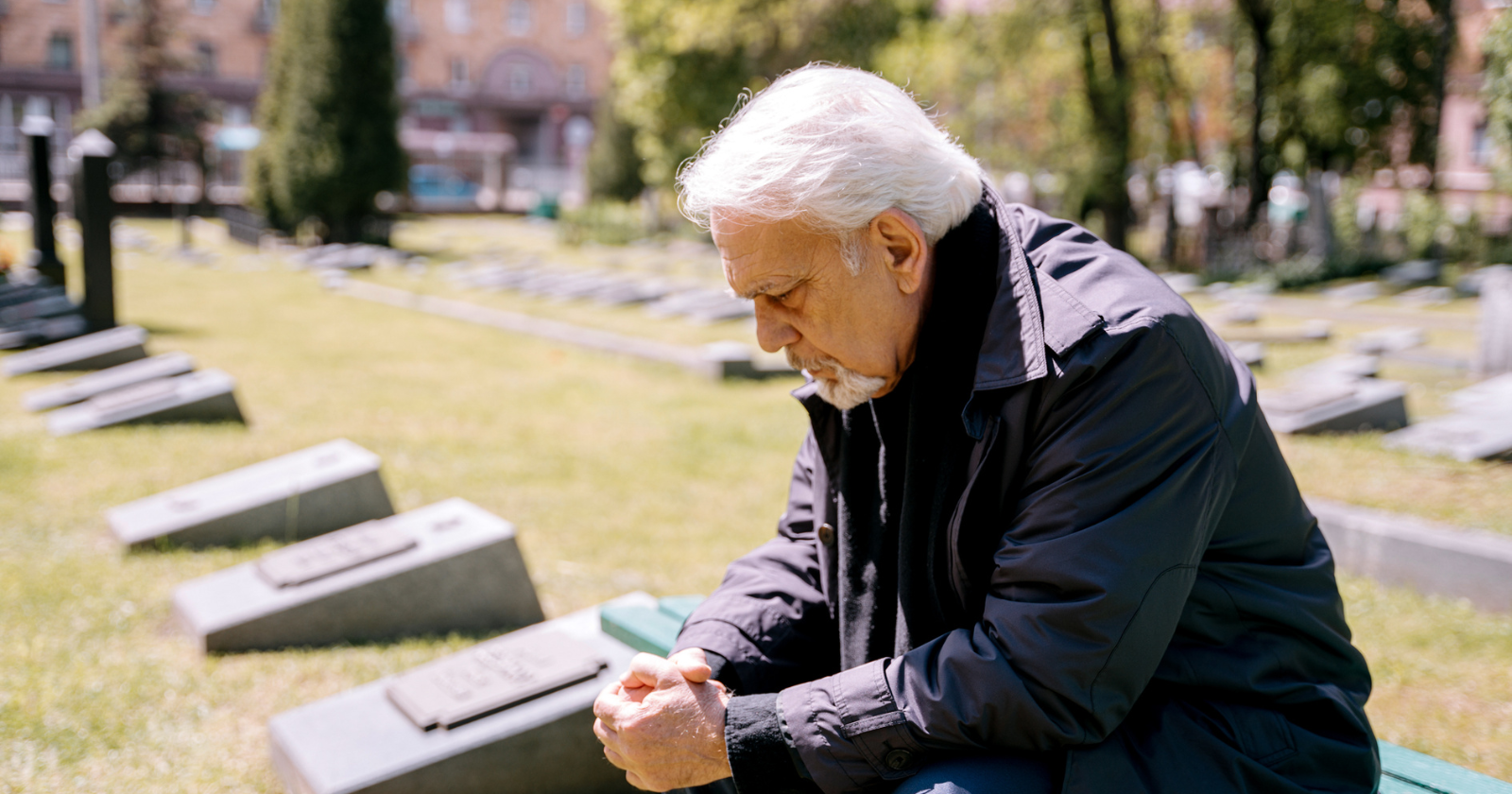
Popular culture has a specific view of what grief is supposed to look like. There is a wave of terrible sadness at the beginning, then a long period of falling apart, then a slow gradual reassembling of a life around the space where the person used to be. Anyone who cries a lot is assumed to be doing the work. Anyone who appears composed at the funeral is assumed to be in some kind of denial that will catch up with them later, in a delayed reckoning the popular literature has warned about for the better part of a century. The two figures, the one falling apart and the one holding it together, are treated as opposite responses to the same event, and one of them is treated as healthy and the other as suspect.
What thirty years of careful longitudinal bereavement research has quietly established is that neither figure is really what most bereaved people look like, and neither of the two intuitions about them turns out to be correct.
The person who transformed our understanding of this is a clinical psychologist at Columbia University’s Teachers College named George Bonanno. Beginning in the late 1990s, Bonanno and a group of collaborators noticed that almost everything psychology thought it knew about grief was drawn from studies of people who had already sought treatment, meaning people who were struggling. If you build a theory of what normal grief looks like from a sample of people whose grief has led them to a therapist, the theory will necessarily emphasise the pattern seen among people struggling to cope. And this, Bonanno argued, is what psychology had been doing for most of the twentieth century, from Freud onward. The theory said that grief required intensive emotional work, that failing to do that work would produce delayed pathology, and that the absence of visible distress was a warning sign rather than a healthy outcome.
Before we continue, I’d like to share this video I came across. It breaks down the psychology of what happens to a person who has gone through too much in life:
What Bonanno and his colleagues did differently was track people before their loss. They followed hundreds of older married adults for years, measuring their psychological state through routine assessments, and then compared those pre-loss measurements against the same people’s psychological state at six months and eighteen months after the death of their spouse. Because they had baseline data, they could distinguish between what had genuinely changed as a result of the loss and what had been present all along. That distinction, on the primary-source record, changed the whole picture.
The findings appeared in a 2002 paper published in the Journal of Personality and Social Psychology, authored by Bonanno with Camille Wortman of Stony Brook, colleagues at the University of British Columbia, and researchers at the University of Michigan, titled “Resilience to Loss and Chronic Grief: A Prospective Study From Preloss to 18-Months Postloss”. What they found was that bereaved people did not fall into two categories. They fell into five. Some experienced what the researchers called common grief, meaning a spike of distress that gradually resolved over months. Some experienced chronic grief, meaning distress that persisted at high levels for a year and a half or longer. Some had been depressed before the loss and remained depressed afterward. Some had been depressed before the loss and actually improved after it, particularly when the marriage they were losing had been unhappy or when the caregiving burden had been severe. And some, quietly, showed a pattern of steady functioning throughout, with low levels of depression before the loss and low levels of depression after it.
That last group turned out to be the largest one.
Approximately half of the sample fell into the pattern the researchers named resilience. Not the absence of feeling, on Bonanno’s careful analysis. Not repression, denial, or emotional avoidance. A trajectory characterised by transient waves of distress that did not turn into extended dysfunction, alongside a preserved capacity for positive emotion, ordinary social engagement, and the continuation of the person’s core life activities. These people missed their dead spouses. They cried. They felt the specific weight of the absence. What they did not do was fall apart in the sustained way the popular narrative predicted they were meant to.
What Bonanno articulated in a follow-up 2004 paper in American Psychologist, titled “Loss, Trauma, and Human Resilience: Have We Underestimated the Human Capacity to Thrive After Extremely Aversive Events?”, was that the resilient trajectory was not merely one of several possibilities but the most common outcome after major loss and trauma. Not rare. Not the mark of exceptional psychological strength. Ordinary. A version of coping that has been available to the majority of humans across the whole recorded history of bereavement, but that clinical psychology had largely missed because it was looking at the wrong sample.
The finding was, and remains, controversial in some clinical circles. It challenges the assumption that everyone needs to do intensive grief work. It challenges the concept of delayed grief, which Bonanno’s data has struggled to find empirical support for. And it raises the difficult possibility that some of the interventions the bereavement industry has been offering, for people who did not really need them, may have prolonged distress rather than shortened it.
What the research does not say is that falling apart is unhealthy. Common grief is a normal response and resolves in most cases within twelve months. Chronic grief, which persists beyond that, is a genuine clinical condition that benefits from treatment. What the research does say is that appearing composed is not, on the accumulated longitudinal evidence, evidence of denial. It is often just evidence of resilience, which is the majority experience, and which does not look dramatic from the outside because dramatic is not what it does. The person quietly getting on with their life six months after a devastating loss, going to work, taking care of the dog, occasionally weeping at unexpected reminders and then continuing with their day, is not repressing anything. They are simply, on the primary-source evidence, coping in the way most humans cope, which is to say functionally and without needing to make a public performance of the fact.
According to a 2021 profile of Bonanno’s decades of work published in the Association for Psychological Science’s Observer magazine, a subsequent meta-analysis of fifty-four studies covering bereavement, injury, natural disaster, and combat exposure found the same basic pattern. Roughly sixty-five per cent of people exposed to a potentially traumatic event showed a trajectory of few or no lasting symptoms. Resilience, once again, was not the exception. It was the majority outcome.
Which brings us back to the two figures at the beginning of this piece. The person falling apart is not, on the evidence, doing something psychologically wiser or healthier than the person appearing composed. They may be experiencing common grief that will resolve within a year, or chronic grief that will not, and only time will show which. The person appearing composed is not, on the evidence, in denial. They may be resilient, in the technical sense the research has spent thirty years defining, or they may be avoiding, and again only the trajectory over months and years will tell. The truly resilient person, in Bonanno’s careful sense of the word, is not the one weeping most visibly and not the one holding it together most completely. They are simply the one whose life, when you look at it several months after the loss, has quietly resumed being a life. That is the majority pattern. It is not the one popular culture has taught us to expect, and it is not the one that generates the most sympathetic attention when it happens. It is just, on the accumulated longitudinal evidence of three decades of prospective bereavement research, what most people actually do.
Kiran Athar is not a psychologist or a bereavement researcher. She writes about psychology, mental health, and the ordinary corners of life where the two intersect, drawing on peer-reviewed research and primary-source scholarship. If you or someone you love is struggling with grief, help is available in most countries through national mental health services and bereavement support organisations.