Correction, 15 September 2026: The original headline and conclusion reduced the EU’s restriction on intentionally added microplastics to ‘microbeads and glitter’ and implied that no comparable regulation existed elsewhere. Regulation (EU) 2023/2055 has a broader product scope and phased transition periods; other jurisdictions also regulate microbeads. The legal summary has been corrected.
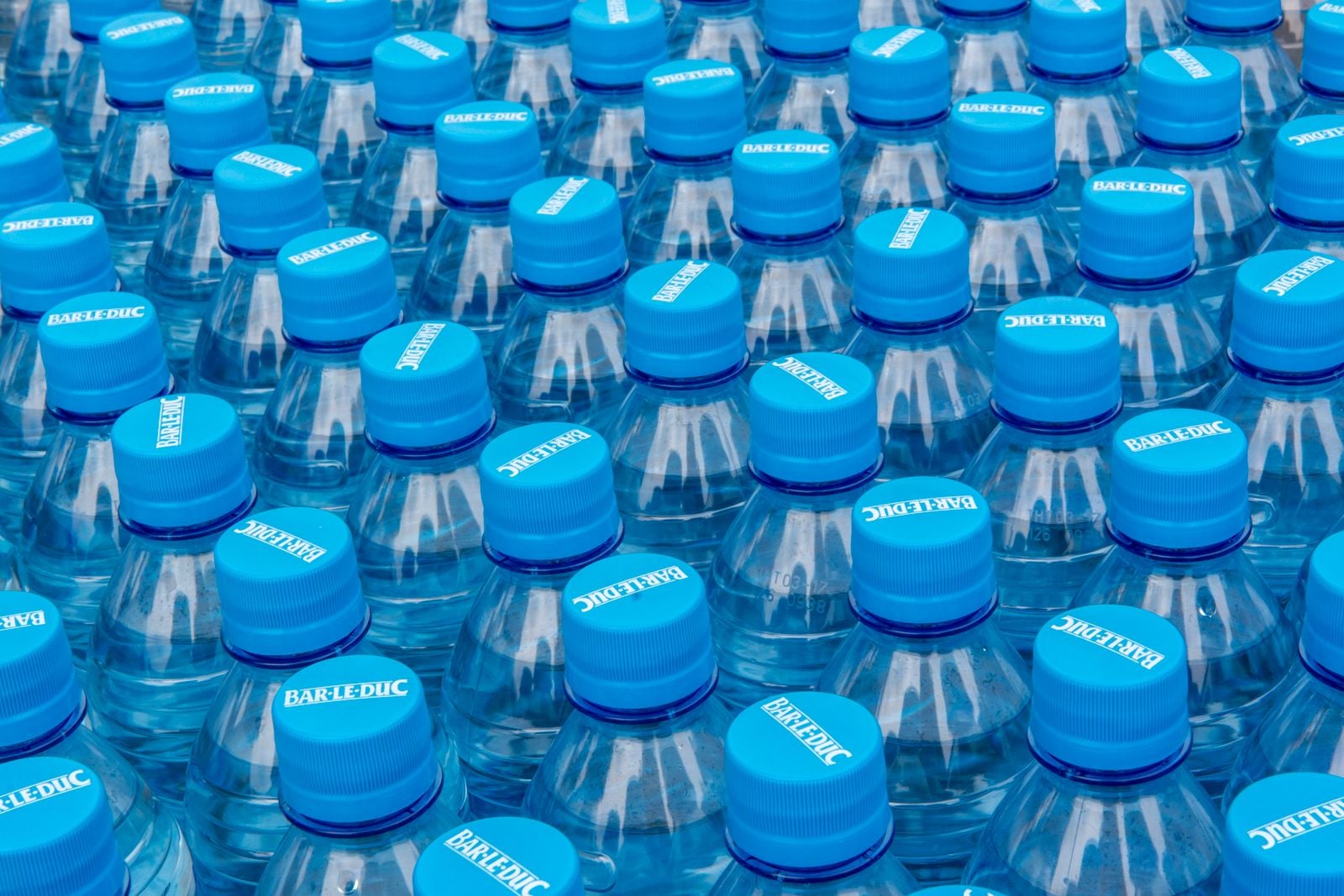
In January 2024 a team at Columbia and Rutgers published a new way of counting plastic in water, and used it on three brands of bottled water bought from a single large retailer. They found roughly 240,000 particles per litre, about 90 per cent of them nanoplastics small enough to have been invisible to every previous method.
The same paper contains the number that almost never travels with it. All 240,000 particles together weigh about 10 nanograms.
Those two figures are both correct, and holding them at once is most of what it takes to think clearly about this subject.
What the counting can and cannot do
The study, by Naixin Qian and colleagues, was published in the Proceedings of the National Academy of Sciences and was primarily a demonstration of a technique, stimulated Raman scattering microscopy, rather than a survey of the bottled water market. Three brands, two bottles each.
The authors are candid about the limits. Their reference library covered seven polymers, and by their own account that library “can only account for roughly about 10% of the total particles/dots imaged.” The rest went unidentified and were left out of the count, which cuts in an uncomfortable direction: the authors note that if every organic particle they saw were assumed to be plastic, the figure would run to a million per litre.
The figure has also been challenged in the same journal. Dušan Materić published a letter arguing that the measured concentrations were below those of the procedural blank, which if correct would undermine the quantification. The Columbia team replied that the ultrapure water used for the blank was itself plastic-contaminated and therefore unsuitable as a baseline. That exchange is unresolved.
None of this means the particles are not there. It means the headline number is a first estimate from a new method, and should be carried with the uncertainty attached.
What is in food
The food data are older and in some ways firmer.
A 2018 study in Environmental Science and Technology examined 39 commercial salt brands, among them 28 sea salts from 16 countries across six continents, and found microplastics in all but three. Sea salts ranged from zero to 1,674 particles per kilogram, excluding one outlier of 13,629, with the highest levels tracking regional seawater pollution.
For protein, the most methodologically transparent recent work is a 2024 paper in Environmental Pollution covering sixteen products from seafood to tofu to plant-based meat. Microplastics turned up in all sixteen. Mean contamination was 74 particles per serving, ranging from 2 in chicken breast to 370 in breaded shrimp, and highly processed products carried significantly more than minimally processed ones. Extrapolated to American consumption, the authors estimate mean annual exposure at 11,000 particles.
The standard deviation on that figure is 29,000, which is worth more attention than the mean. This is not a population where the average describes a typical person.
The most defensible intake estimate comes from a Wageningen group modelling accumulation rather than consumption, which put median adult intake at 883 particles a day, amounting to 583 nanograms. That is the counterweight to the widely quoted claim that people swallow a credit card’s worth of plastic every week, a figure that has not survived scrutiny.
No regulator has concluded that any of this harms you
This is the part that sits uneasily with the coverage, and it is unanimous across the agencies.
The European Food Safety Authority’s position, last reviewed in April 2026, is that it “has not yet completed a full risk assessment of microplastics and nanoplastics in food. This means that, at present, EFSA cannot conclude on potential health effects.” The European Parliament formally requested an opinion in December 2025; it is due at the end of 2027.
Germany’s Federal Institute for Risk Assessment is blunter. In the BfR’s words, “according to the current state of knowledge, there is no reliable toxicological evidence of health risks from the intake of microplastics via food.”
The World Health Organization reached a similar place in 2019, noting that the health impacts of microplastics following ingestion “are not well studied, with no human studies on ingested microplastics,” and declining to recommend routine monitoring of drinking water. The European Environment Agency’s current assessment is that “knowledge on the health impacts of microplastics is currently lacking.”
Even the study that did most to change the conversation says so in its own second sentence. The New England Journal of Medicine paper linking plastic in carotid plaque to later heart attacks and strokes, which this publication examined in July, opens by stating that direct evidence the risk extends to humans “is lacking.” Its authors were describing what their work was about to test, not what it had proved.
The EU’s Group of Chief Scientific Advisors put the honest position in 2019 and it has not really moved: current evidence suggests microplastic pollution “does not pose widespread risk to humans or the environment,” while there are “significant grounds for concern and for precautionary measures to be taken.” Their supporting review adds that on a business-as-usual path, thresholds for widespread risk could be crossed within a century.
What is actually regulated
Given all that, the regulatory position is thinner than most readers would guess, and precision here matters.
Regulation (EU) 2023/2055 restricts synthetic polymer microparticles intentionally added to products under REACH. It began applying in October 2023, with some uses restricted immediately—including microbeads in certain cosmetics and detergents and loose plastic glitter in specified products—and other uses subject to transition periods that can run to 2035. It is therefore broader than a ban on just two named materials, although its practical reach is phased.
More importantly, it covers only microplastics that are deliberately added to products. Tyre wear, synthetic textile fibres and the breakdown of ordinary plastic litter, which between them dominate the total, are untouched by it.
One unintentional source has since been addressed. Regulation 2025/2365, in force since December 2025, targets losses of plastic pellets in handling and transport, which the Council describes as the third-largest source of unintentional microplastic release after paints and tyres, at somewhere between 52,000 and 184,000 tonnes a year. Most of its obligations do not apply until December 2027.
On drinking water, the European Commission adopted a harmonised method for measuring microplastics in March 2024. But microplastics have not been added to the Drinking Water Directive’s watch list, which still contains two substances, neither of them plastic. So there is a method and no obligation to use it. The Commission is required to report on the question by January 2029.
In the United States the Environmental Protection Agency announced in April 2026 that microplastics would appear on its draft Contaminant Candidate List for the first time. That is a research and priority-setting instrument rather than a standard. It remains a draft, the comment period closed in June, a final list is expected in November, and the agency itself describes the exercise as “the first step in the SDWA regulatory process.” No American drinking water standard for microplastics exists or has been proposed.
And the treaty that was supposed to sit above all of this has stalled. Governments agreed in March 2022 to negotiate a legally binding instrument on plastic pollution. Talks in Geneva in August 2025 ended without agreement on whether the treaty should cap production or concentrate on waste. The chair resigned that October. The session held in February 2026 was, in the United Nations Environment Programme’s own words, convened for organisational purposes, and “no substantive negotiations were held.” A new chair was elected, informal meetings are scheduled into 2027, and there is no agreed text and no date for resuming formal negotiations.
Where that leaves it
Four and a half years after governments committed to negotiating a global treaty, there is still no agreed treaty text. Existing measures are fragmented: the EU restriction covers intentionally added synthetic polymer microparticles on a phased schedule, several jurisdictions regulate microbeads, and EU pellet-handling obligations are due to apply from 2027. Drinking-water measurement and standard-setting remain incomplete.
What we find striking is not that regulators have been slow, though they have. It is that the scientific and regulatory positions are not actually in conflict. The agencies are saying that exposure is universal, that the measurement methods are immature, that no harm from ingestion has been demonstrated in humans, and that this is a reason to act carefully rather than a reason to relax. All four of those can be true together, and mostly are.
The gap is between that position and a policy process that has produced, in four and a half years, a change of chairman.