The romantic version of creativity begins with surrender. Stop controlling the mind, let it wander and wait for the strange idea to arrive.
The managerial version begins at the opposite end. Define the problem, evaluate every option and impose enough discipline to turn a vague possibility into something useful.
A large brain-imaging study suggests that neither state carries the process alone. Across 2,433 people, divergent-thinking ability was associated with how frequently two large brain networks moved between relative separation and cooperation. The relationship did not appear for general intelligence.
The appealing summary is that a creative mind changes gears well. The evidence is more interesting, and more limited, than that slogan. Most of the brain scans were taken while participants rested, the overall association was small and “creativity” meant performance on a particular family of idea-generation tasks.
Ten samples produced the total of 2,433
Qunlin Chen, Yoed Kenett, Roger Beaty and their colleagues published the open-access study in Communications Biology in January 2025. They did not recruit one new group of 2,433 people under identical conditions. They reanalysed raw data from ten existing samples collected at centres in Austria, Canada, China, Japan and the United States.
The source datasets initially included 3,533 healthy participants with MRI scans. Of those, 2,772 also had a creativity assessment. The final analysis retained 2,433 after excluding incomplete or invalid behavioural records, unusable imaging and excessive movement in the scanner.
Participants ranged from 16 to 58 years old, but the average age was 21.12. There were 1,113 men. Calling the sample large and international is fair. Calling it representative of the whole adult population would not be.
The multi-centre design brought diversity and statistical power. It also brought different scanners, locations and scoring procedures. Those variations later mattered to the size of the result.
Creativity meant unusual uses for ordinary objects
Creative ability was assessed with versions of the Alternate Uses Task. A participant might see a brick, box or other familiar object and be asked to generate as many interesting, novel and uncommon uses as possible within a time limit.
In most datasets, two to four trained raters judged the responses. One Japanese sample used a single trained rater. Some centres scored originality alone, while others combined originality with fluency, meaning the number of ideas produced.
This kind of divergent-thinking task has a long history in creativity research. It creates responses that can be compared across many people without pretending that a painting, patent and scientific theory share one obvious unit of quality.
It still captures only a slice of creativity. The task rewards producing uncommon possibilities quickly. It does not measure whether a person can sustain a project, recognise a valuable idea years before others do, master a craft or persuade a community that an unfamiliar solution is worth adopting.
That boundary resembles one Silicon Canals found in its comparison of language models with 100,000 people. A strong result on a divergent-thinking measure is meaningful evidence. It is not ownership of the entire human idea of creativity.
The networks were measured while people did nothing in particular
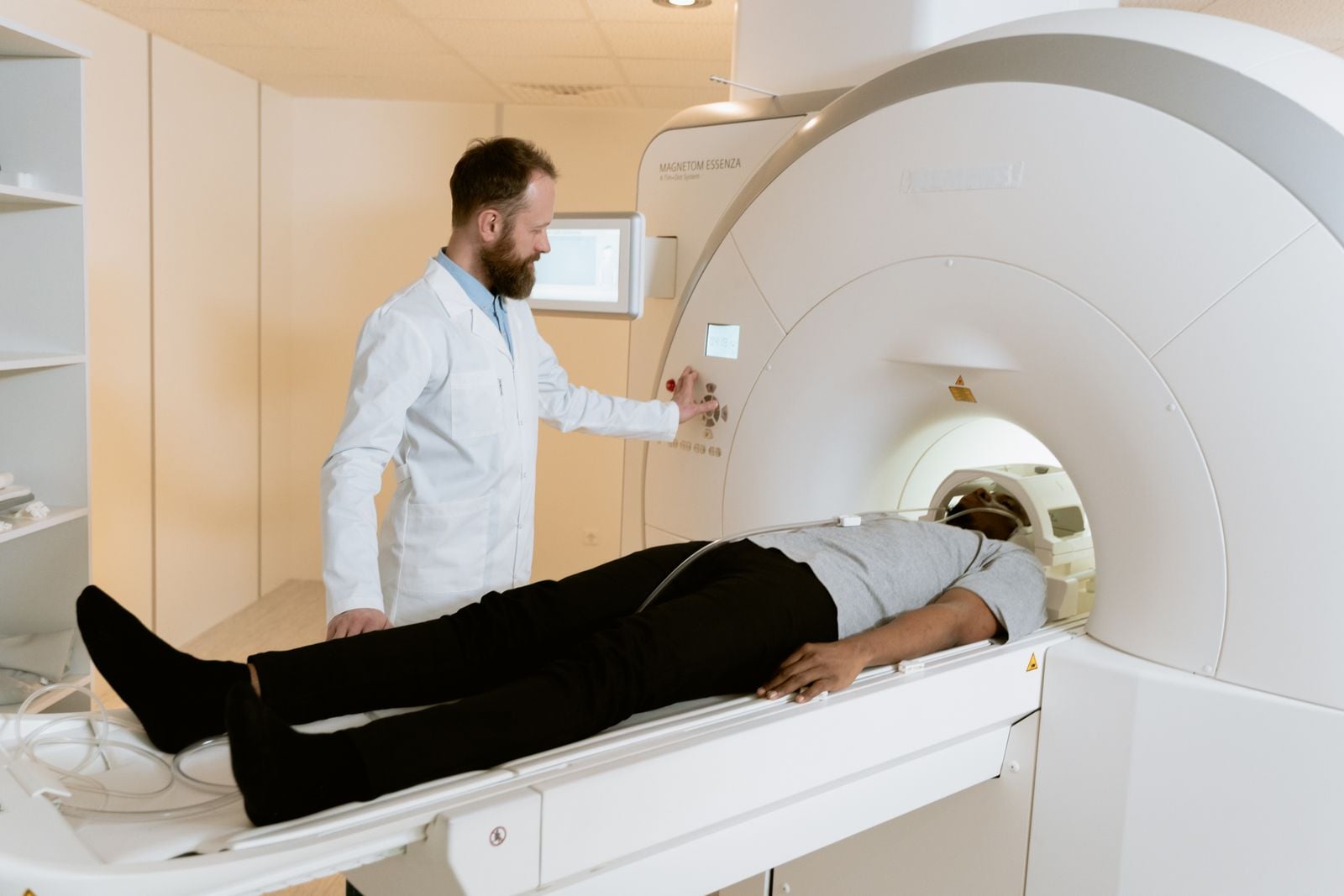
The central analysis used resting-state functional magnetic resonance imaging. Participants lay in a scanner without performing the creativity task. The researchers measured slow changes in blood-oxygen signals and examined how activity across brain regions varied together over time.
They focused on two broad systems. The default mode network includes regions associated with internally directed thought, spontaneous memory, mental simulation and mind wandering. The executive control network includes frontal and parietal regions involved in monitoring, deliberate retrieval, attention and selection.
These labels are useful shorthand, not descriptions of two isolated organs. Neither network performs only one psychological job, and creativity also involves memory, perception, attention, personality, knowledge and other neural systems.
The researchers divided the changing fMRI signal into short windows. In some windows, the default and executive networks occupied a relatively segregated state. In others, their activity was more integrated. Switching frequency counted transitions between those two configurations.
This is the technical basis of the headline’s rhythm. The study did not watch a thought change from daydream to editorial verdict. It detected changes in the statistical relationship between two distributed networks and related those changes to creativity scores obtained outside the scanner.
More switching predicted creativity, but the effect was modest
Switching frequency was significantly associated with creative performance in seven of the ten datasets. A random-effects meta-analysis produced an overall effect size of g = 0.174, with a 95 per cent confidence interval from 0.08 to 0.27.
That is a small relationship. It is strong enough to be unlikely to reflect chance under the model, but nowhere near strong enough to sort individuals neatly into creative and uncreative brains.
The effects also varied. Statistical heterogeneity was moderate, with I2 = 56.45 per cent. Location, scanner type and the method used to score creativity jointly moderated the result, but those factors were so entangled that the researchers could not cleanly identify which one drove the differences.
A second analysis pooled participant-level data rather than study-level effects. It reached the same general conclusion: people with more frequent transitions tended to produce more original ideas. Repeating the analysis with another brain atlas also preserved a smaller positive association.
The result therefore survived several analytical approaches. Surviving is not the same as becoming large.
The most creative pattern was neither permanent separation nor permanent union
Switching frequency was only one part of the theory. The researchers also calculated whether the two networks spent most of their time segregated, most of it integrated or closer to a balance between the states.
The proposed relationship was an inverted U. Creativity should be lower at both extremes and higher nearer the middle, where neither separation nor integration dominates.
Across all datasets, the meta-analysed nonlinear effect was significant but very small, g = -0.07. At the level of individual datasets, a quadratic model fitted significantly better than a straight line in three of the ten. The participant-level mega-analysis again supported the curve.
This balance is easy to turn into a tidy story. Separation lets associations roam; integration lets control shape and test them. Yet the 2,433-person analysis did not directly label moments as generation or evaluation. The authors themselves described that connection as indirect.
The safest conclusion is about network dynamics. Higher divergent-thinking scores appeared near a more flexible, balanced pattern of interaction. The study did not prove that each observed switch corresponded to a person alternating consciously between imagination and criticism.
General intelligence was a smaller comparison
Six of the ten datasets, containing 908 participants, included measures of general intelligence as well as creativity. In this subset, switching frequency was not associated with intelligence: the pooled effect was g = 0.023, with a confidence interval crossing zero.
Among the same six datasets, switching remained associated with creative performance. The difference between the creativity and intelligence models was statistically significant.
This is what the finding that intelligence “did not predict” the rhythm means. The particular default-executive switching measure carried information about divergent thinking that it did not carry about the intelligence scores.
It does not mean intelligence and creativity are opposites or completely independent. Creativity and intelligence scores were significantly correlated in three of the six datasets, with correlations from 0.32 to 0.39. Other samples showed weaker or absent relationships.
Silicon Canals has also reported that creativity measures can add information beyond conventional academic predictors. “Beyond” is not the same as “instead of”. Distinct measures can overlap while still capturing different parts of performance.
A 31-person task study supplied the direct test
To move closer to active creative thought, the researchers analysed a separate task-fMRI sample of 31 adults. Inside the scanner, participants completed an unusual-uses task and a control task that asked for ordinary characteristics of objects.
The creative condition produced more frequent default-executive switching than the control condition, a small difference with Cohen’s d = 0.28. The nonlinear balance measure was related to originality during the creative task but not during the ordinary-characteristics task.
One result resists oversimplification. Within the creative task, raw switching frequency itself was not linearly related to originality. The validation supported greater switching during creative thinking and the balanced, nonlinear pattern, not a rule that every additional switch produced a better idea.
The smaller experiment makes the resting-state interpretation more plausible. Its size also makes replication important. Thirty-one participants cannot carry the evidential weight of 2,433, and the 2,433 were not generating ideas during their scans.
The study found an association, not a training method
Because most of the evidence is cross-sectional, direction remains unresolved. Flexible default-executive dynamics might support original thinking. Practising creative work might alter the way those networks interact. A third set of traits or experiences could influence both.
The researchers acknowledged that their “true” effect was small and that personality, curiosity, attention, perception and creative self-beliefs also matter. They also noted that different brain atlases can alter measured associations.
Nothing in the experiment assigned people to brainstorm freely for ten minutes and evaluate for ten minutes. It therefore does not prove that alternating those activities will reproduce the fMRI pattern or improve creative work.
Separating generation from evaluation may still be a sensible technique. It protects fragile possibilities from immediate rejection and later restores standards. The present evidence supplies a neural analogy, not a tested productivity prescription.
Creativity may live in coordination more than dominance
The study’s contribution is not a new “creativity centre” in the brain. It is evidence that timing and coordination can reveal something that average connectivity misses.
A system devoted only to spontaneous association may produce novelty without relevance. A system dominated by control may reject unusual connections before they can develop. Creative output needs ideas that are both new and suited to a purpose.
The 2,433-person result places that familiar tension into a measurable network framework. More original thinkers were not identified by one network simply overpowering the other. They tended to have brains whose two systems changed their relationship more often and, on average, occupied neither extreme.
That is a rhythm, not a rank. The creative mind in this study was not permanently wild or permanently disciplined. It was unusually practised at refusing to remain only one of those things.