

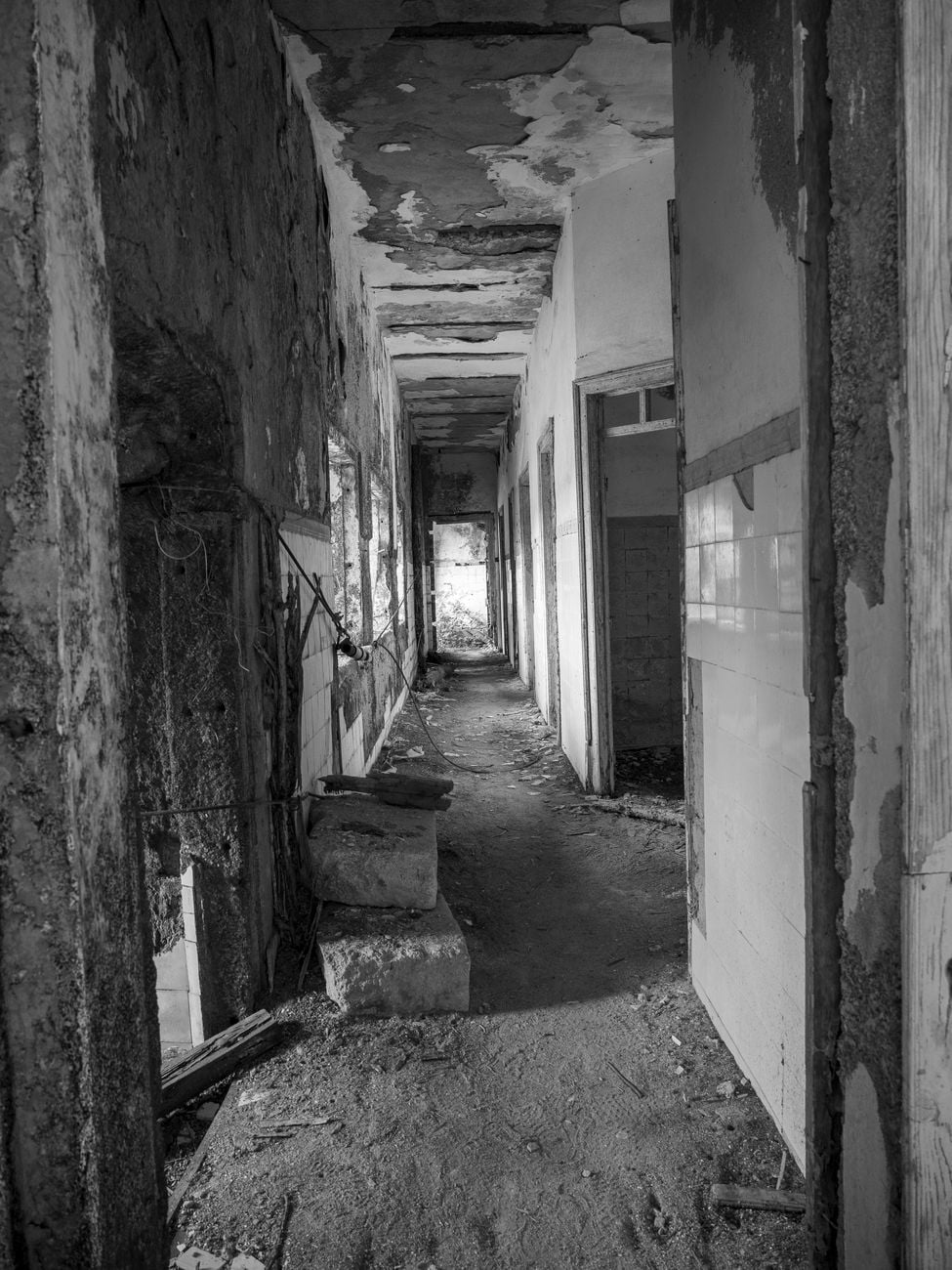
A building gets a reputation. People report a cold patch in one corner, a sense of being watched, a shape at the edge of vision that disappears when they turn to look. Paranormal investigators show up with recording equipment. None of this requires anything supernatural to be true. It requires a specific, measurable set of conditions, several of which engineers and psychologists have identified with reasonable precision.
The lab technician whose fencing sword started shaking
The clearest documented case comes from a Coventry engineering lab in the 1990s. According to the account later published by the researcher Vic Tandy, staff in the lab had been reporting an unpleasant sense of presence and unexplained cold for some time, and Tandy himself saw a grey shape at the periphery of his vision that vanished when he turned toward it. The following day, Tandy noticed his fencing foil vibrating in its clamp with no obvious cause.
Tracing the vibration led to a newly installed extractor fan producing a standing sound wave that Tandy and his co-author, writing in a 1998 paper in the Journal of the Society for Psychical Research, calculated at close to 19 hertz, a frequency below the range of normal human hearing known as infrasound. That specific frequency happens to sit near the resonant frequency of the human eyeball. Tandy’s proposed explanation was that the standing wave was vibrating people’s eyes very slightly, distorting vision at the edge of the visual field in a way that could plausibly produce the fleeting, shapeless figures people associate with a haunting. When the fan was switched off, the reported effects stopped. Tandy went on to measure similar low-frequency sound in a separate, reportedly haunted cellar in Coventry.
This is one investigator’s account of one specific site, not a controlled experiment, and it should be read as a plausible physical explanation for a specific set of reports rather than a general law about what causes every reported haunting.
The physical case for this specific mechanism rests on ordinary building mechanics rather than anything exotic. Large fans, air handling units, and long ducts can all generate low-frequency standing waves under the right conditions, particularly in older buildings with irregular geometry, ageing equipment, or ductwork never designed with acoustics in mind. None of this requires a building to be old in a romantic sense. It requires the kind of mechanical eccentricity that shows up more often in converted, patched-together, or poorly maintained structures than in newer ones built to more consistent standards, which may be part of why reports of this kind cluster around older buildings generally.
A more controlled test found something more interesting
A better-designed test of the same basic idea came a decade later. In a 2009 study in Cortex, the psychologist Christopher French and colleagues built an experimental chamber and deliberately exposed 79 participants to infrasound, complex electromagnetic fields, both, or neither, then measured how many unusual sensations, sensed presences, dizziness, unexplained smells, participants reported during 50 minutes inside the room.
The infrasound and electromagnetic-field conditions did not reliably produce more reported anomalous sensations than the control condition. What did reliably predict how many strange sensations a person reported was how suggestible they were as measured before entering the room, regardless of which physical condition they were actually exposed to. This is one study, not the final word on every environmental theory of hauntings, but it complicates Tandy’s original mechanism considerably: expectation and personal suggestibility outperformed the specific physical variables as a predictor of who reported something strange.
What a wider review of the research says
A more recent survey of the research literature on reportedly haunted locations, examining environmental variables including temperature, air quality, electromagnetic fields, and infrasound alongside psychological factors, found a genuinely mixed picture rather than a single confirmed cause. Some studies have found weak associations between specific environmental measurements and anomalous reports at particular sites. Others, including French’s controlled chamber study, found suggestibility and prior belief carried more predictive weight than any environmental variable tested. No single mechanism identified so far accounts for every reported case, and the researchers reviewing this body of work have been explicit that the overall evidence remains inconsistent and often methodologically limited. Part of the difficulty is that most reportedly haunted sites were never measured under controlled conditions before or during the events people describe, so researchers are typically working backward from anecdote rather than forward from a planned experiment, which is a meaningfully weaker form of evidence than the kind French’s chamber study was able to produce.
What this means for an actual building’s reputation
None of this settles why any one specific building becomes known for attracting paranormal investigators, and this body of research does not claim to identify a single formula for a “haunted” reputation. What it does offer is a narrower, testable alternative to a supernatural explanation: old buildings with poor insulation, ageing mechanical equipment, unusual airflow, or ductwork capable of producing low-frequency resonance are more likely to produce the physical sensations, cold spots, subtle vibration, a felt sense of unease, that get interpreted as evidence of a presence, and once a location acquires that reputation, the suggestibility effect French documented means visitors who already expect something strange are measurably more likely to report it.
A note on the equipment paranormal investigators actually carry
Much of the commercial equipment marketed to paranormal investigators, EMF meters, digital thermometers, devices claiming to translate ambient electromagnetic noise into words, is sold with the implicit claim that it can detect a presence. French’s chamber study is a useful check on that claim specifically: it directly tested whether electromagnetic field exposure predicted anomalous experience and found suggestibility, not field strength, doing the predictive work. A meter that reliably measures a real physical quantity, an electromagnetic field, is not the same thing as a meter that reliably detects the thing it is being sold to detect. The equipment can be functioning exactly as engineered and still be measuring something other than what its marketing implies.
A building does not need a resident spirit to draw a crew of ghost hunters. It generally needs an existing reputation, at least one visitor’s suggestible expectation walking in the door, and, in some well-documented cases, an old fan or a draughty duct doing something at roughly nineteen cycles a second.
