

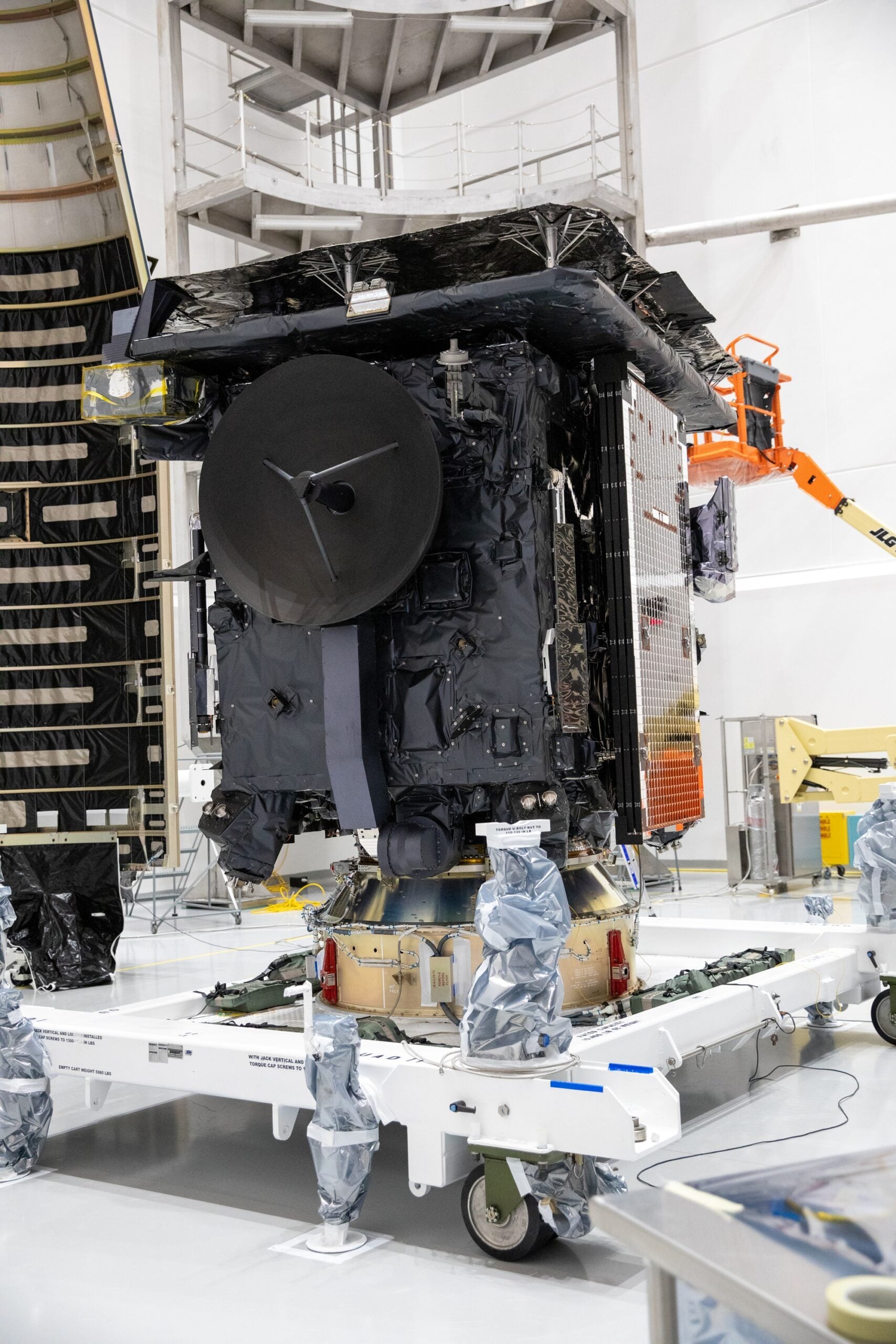
A new in-flight calibration of Solar Orbiter’s Spectrometer/Telescope for Imaging X-rays (STIX) has used solar flares themselves to measure how efficiently the instrument’s tungsten grids transmit X-rays. The study, published on 10 September 2026 in Solar Physics as In-Flight Self-Calibration of the STIX Grid Transmission, selected 91 suitable flares from an archive of approximately 25,000 events recorded between January 2021 and February 2025.
The recalibration changes STIX’s photometric scale more than its physical interpretation of solar flares. Photon spectra reconstructed with the new calibration are about 13% higher than those obtained with the old one, and fitted emission measures rise by a similar amount, while fitted flare temperatures remain unchanged.
Why STIX needed an in-flight grid calibration
STIX is an indirect hard X-ray imaging spectrometer. Its detectors cover roughly 4–150 keV, while 30 pairs of tungsten grids modulate incoming X-rays so that each detector-grid unit, or sub-collimator, samples a Fourier component of the source.
For the 24 sub-collimators with the coarsest angular resolution, the grids are made from tungsten foils 33 or 50 µm thick stacked to a nominal thickness of 400 µm. Before Solar Orbiter launched, engineers characterized the grids optically and also performed X-ray measurements, but the X-ray tests were not carried out at the small incidence angles most relevant to solar-flare observations because of time and financial constraints.
Optical measurements also cannot fully reveal what happens inside a multilayer grid. They characterize the outer layers but cannot directly measure small stacking and etching differences deeper in the structure, even though those differences can alter the effective slit width and therefore the amount of X-ray flux reaching a detector.
The new method uses the STIX Coarse Flare Locator, or CFL, as a reference. For flares at suitable positions, one or more large CFL pixels are fully illuminated and provide an estimate of the incident total flux. Comparing that measurement with the flux recorded through an imaging sub-collimator gives an empirical estimate of the sub-collimator’s effective transmission.
A self-consistency test using adjacent fully illuminated CFL pixels led the authors to estimate that the CFL total-flux measurements are accurate to about 2.3%, with statistical and systematic uncertainties both contributing.
How roughly 25,000 flares became a 91-event calibration set
The starting archive contained approximately 25,000 STIX flares recorded from 1 January 2021 through 28 February 2025. The researchers required an event to have at least one fully illuminated large CFL pixel, a sufficiently reliable flare location and enough recorded counts to keep the analysis statistically robust.
Those filters left 91 events. The calibration itself was derived from data in the 10–15 keV energy range, where the Solar Black coating covering the front entrance window transmits roughly 91% to 97% of the radiation, limiting the influence of coating inhomogeneities on the detector-to-detector comparison.
The flight measurements showed lower effective grid transmission than the model based on the pre-flight optical characterization. They also showed less internal-shadowing variation with incidence angle than expected from an idealized grid with perfectly aligned layers.
Simulations provided a plausible mechanical explanation. When random stacking and etching imperfections with a standard deviation of about 2 µm were introduced into the grid geometry, the simulated transmission fell and the predicted internal-shadowing effect became weaker. For sub-collimator 5, whose nominal slit width is 83 µm, imperfections on that scale reduce the effective on-axis slit width by roughly 6 µm.
The independent test shows what improved
The researchers then tested the calibration on 25 additional flares recorded between March and December 2025 that were not part of the 91-event calibration set. With the new transmission model, the average normalized total-flux estimates from individual sub-collimators ranged from 0.98 to 1.02, placing their mean measurements within about 2% of the cross-detector average.
The event-to-event spread is a separate quantity. With the new calibration, the standard deviation of normalized total flux was below 3.3% for every detector except sub-collimator 1b, which had a standard deviation of 6.7%.
The old calibration behaved differently. Its average normalized total-flux values ranged from 0.93 to 1.20 for the 24 coarse-resolution sub-collimators and from 0.48 to 0.86 for the six finest-resolution sub-collimators. Separately, comparing the fluxes calculated with the new and old transmission values showed differences of 3% to 39% for the coarse sub-collimators and 48% to 175% for the finest ones.
A spectral test using the X2.2-class flare of 8 December 2024 provided another measure of the improvement. Three coarse sub-collimators, 3a, 5a and 5b, were excluded because they displayed an energy-dependent discrepancy the authors consider more likely to arise from detector calibration than grid calibration.
For the remaining coarse sub-collimators, the standard deviation of the fitted photon spectra between 10 and 15 keV fell from 6.9% with the old calibration to 1.6% with the new one. Across the broader 8–20 keV interval, spectra obtained using the new calibration had a standard deviation of 2.3%.
The absolute spectral scale also moves. Photon spectra produced with the old calibration were on average 13.2% lower than those produced with the new calibration, while the fitted emission measure increased by 13.7%. Fitted flare temperatures did not change, and the authors say conclusions from earlier STIX spectral studies remain unaffected.
The calibration has clear limits
The new model applies mainly below about 20 keV and within offset angles of approximately −0.5 to +0.5 degrees. At higher energies, grid transparency changes the effective slit width while the available CFL data contain too few counts for the same calibration technique to remain reliable.
Below about 8 keV, the spectra show increased scatter that the researchers suspect is connected to inhomogeneities in the Solar Black coating. The paper identifies calibration of that low-energy effect as a possible subject for future work.
High-energy grid calibration also remains unfinished. That work matters for attempts to determine whether non-thermal hard X-ray emission from solar flares is anisotropic, a question that requires comparisons between instruments observing the same flare from different viewing directions. The authors note that cross-calibration more accurate than 10% is needed for such comparisons to produce meaningful results.
The paper also points toward a practical instrument-design lesson. Future indirect X-ray imagers would benefit from a dedicated total-flux monitor with enough collecting area to provide a calibration reference for every flare and potentially extend the same method to higher energies. The Hard X-ray Imager aboard ASO-S already includes total-flux monitors used for calibration.
For STIX itself, the authors say the visibility-amplitude calibration based on these results will be released in an upcoming version of the analysis software. The larger result is narrower but useful: the low-energy measurements from different sub-collimators are now substantially more internally consistent, while the physical conclusions drawn from the mission’s earlier flare spectra remain intact.
