

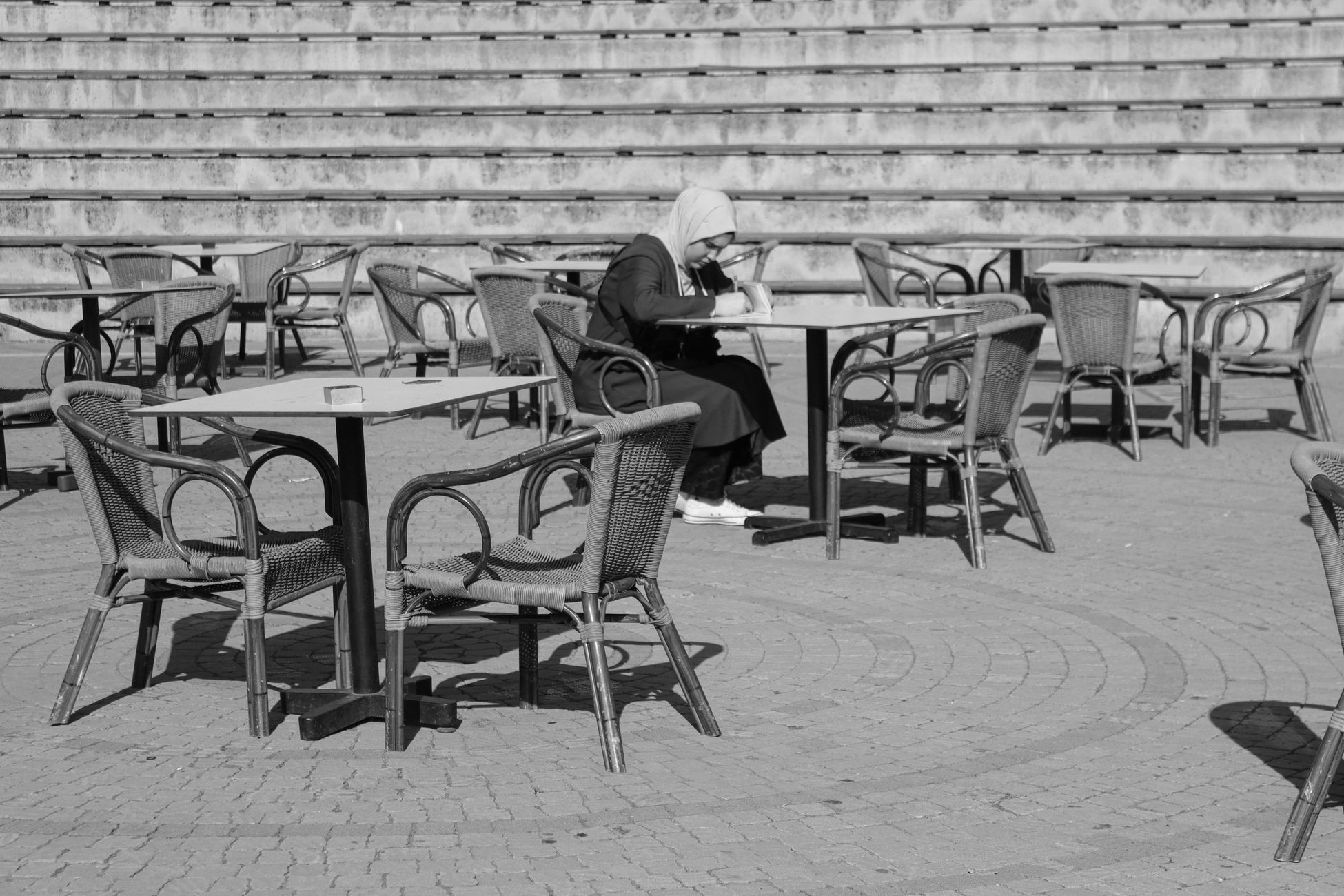
The loneliness that catches people off guard in their thirties and forties is not the loneliness of being abandoned. It is the loneliness of outgrowing the conversations the people around them are still willing to have. The friendships are intact. The calendar is full. And still, something keeps quietly closing inside the person at the centre of it, every time they sit down across from someone who has known them for a decade.
Consider the woman in her late thirties sitting across from her oldest friend at a wine bar she has been coming to for fifteen years. The friend is telling a story she has told before, about a coworker who is still doing the same passive-aggressive thing she was doing in 2019. The woman nods at the right places. She asks the follow-up questions she is supposed to ask. She laughs when the punchline lands. And somewhere underneath the performance, a small, quiet panel slides closed inside her chest, because she has realised, again, that she cannot say the thing she actually came here to say.
This is the loneliness nobody warns you about. It does not arrive through a door slamming. It arrives through a door that stays politely open, in a room where the conversation has not changed in a decade. The cultural script for adult loneliness still assumes a rupture. Someone died. Someone left. A marriage ended, a friend group fractured, a city was traded for another city. The condition is understood as a subtraction problem. You used to have people, now you have fewer, and the math explains the ache. But there is a second, quieter form of loneliness that has almost no script at all, and it tends to surface in the middle of intact lives. The people are still there. The texts still come. The birthdays are still remembered. And still, the person at the centre of it feels increasingly unreachable, as though they are waving from a shoreline the others cannot see.
The conversations stop scaling with the interior life
What is actually happening, in most cases, is a mismatch in developmental pace. One person in a relationship has been quietly reorganising their interior life. Through therapy, through grief, through reading, through a job that broke them open, through a health scare, through the slow erosion of a belief they used to hold without question. The other has not. Neither is wrong. But the conversations the relationship was built on begin to feel like clothes that no longer fit. The seams strain. The collar chokes. The person keeps wearing the outfit because they love who gave it to them.
The temptation is to frame this in clinical language, to call it an attachment issue or a trauma response or a sign of avoidant patterning. That framing flatters the discomfort but misses what is actually going on. Most of the time, the person is not unwell. They are arriving at a clarity that has not yet arrived for the people they love, and there is no graceful social protocol for that gap. You cannot announce it. You cannot speed the others up. You cannot reasonably ask the friend at the wine bar to stop telling the coworker story, because the coworker story is how she keeps the friendship alive in the only register she still has access to.

What existential psychology has long called this
The discipline that has sat with this kind of loneliness most honestly is not mainstream cognitive psychology but the existential tradition, which has spent decades distinguishing between social isolation and existential aloneness, the recognition that no one else fully inhabits the world you are perceiving. Writers in existential psychotherapy have argued for years that a meaningful share of adult suffering is not pathology but the consequence of confronting freedom, meaning, and the irreducible separateness of conscious experience. The framework is older than the wellness industry’s borrowed vocabulary and considerably less consoling, which may be why it never went viral.
The clinicians working in this tradition tend to make a distinction that matters here. Being alone in a room is one kind of solitude. Being alone in a conversation is another. The second is harder to name because the room looks full. The voices are real. The affection is real. And yet the speaker is conducting a private archaeology that the listeners are not equipped, or not willing, to join. The existential tradition treats this as a confrontation with what its practitioners describe as the inescapable limits of being understood by another mind.
The myth of the loyal inner circle
Most people are taught, implicitly, that the friendships forged before twenty-five are the ones that will carry them through the rest of life. There is a romance to the idea: the college roommates, the childhood best friend, the cousin who knew you before you had language for anything. The romance is mostly wrong. Those relationships often do survive, but survival is the lowest bar a friendship can clear, and the cultural pressure to treat longevity as the measure of a friendship’s value obscures something more uncomfortable. Some of the people who have known you the longest are the people most invested in the version of you that no longer exists.
They are not malicious about this. They are simply doing what humans do, which is recognising the person they remember and addressing that person warmly. The problem is that the person they are addressing has been gone for years. Every time you sit down with them, you are asked, gently, to put the old self back on for the duration of the meal. After enough meals, the old self starts to feel like a costume kept in a closet you visit only for these occasions, and you begin to wonder whether anyone in your life actually knows the person who walks back out into the parking lot afterwards.
Why the body registers this before the mind admits it
The first signal is rarely a thought. It is a tiredness that arrives after seeing certain people, even when nothing went wrong. It is the small relief of cancelled plans. It is the way the phone, face down on the counter, becomes an object of low-grade dread rather than connection. The mind, which has been trained to value loyalty and continuity, will mount a defence. These are good people. I love them. I am being ungrateful. I am being a snob. The body, which is not interested in narrative, just keeps reporting that something is being spent in those rooms that is not being replenished.
There is emerging epidemiological work suggesting that the felt experience of loneliness, the subjective sense of being unmet, tracks more closely with downstream health effects than the objective fact of being alone. A recent longitudinal study tracking more than 10,000 older adults across Europe found that loneliness was associated with poorer memory function, even when participants were not socially isolated by any measurable count. Separate analyses of perceived loneliness have made a similar distinction, finding that the internal sense of being unreached is the variable that matters most, not the calendar count of how many people you saw last week.
The data is one piece of evidence, not settled consensus, and it concerns older adults, not the thirty-something at the wine bar. But the underlying mechanism is suggestive. The feeling of not being met is doing its own work on the nervous system regardless of whether the room is full.

The grief that cannot be mourned in public
There is no language for the kind of loss that happens when a friendship does not end but stops being able to hold what you bring to it. You cannot post about it. You cannot tell your other friends, because some of them are the friends in question, and the rest will assume you are being uncharitable. You cannot tell the friend directly without sounding like you are accusing them of failing a test they never agreed to take. So the grief sits in a category that has no ritual. No funeral, no breakup, no severance.
The same principle applies here, in a quieter register: two people can be in the same room and experience two completely different events. The friend at the wine bar is having a lovely night. She is genuinely glad to see you. She would be wounded to learn that you left feeling more alone than when you arrived. Both things are true at the same time, and there is no version of the conversation that makes them less true.
What people actually do about it
The people who navigate this stretch without burning their lives down tend to do a few specific things, none of them dramatic. They stop expecting any single relationship to meet every register of who they are. They start having different conversations in different rooms. The old friend gets the old register, and a newer relationship, often unexpected, gets the harder material. They give up the fantasy that one person, or one circle, will know all of them. The accounting becomes distributed.
They also stop treating their own developmental drift as a problem to be hidden. The reflex, when you notice yourself outgrowing a conversation, is to perform the old self more convincingly so that no one feels rejected. That reflex is generous and exhausting and ultimately the thing that produces the loneliness. The alternative is not to announce your growth, which is insufferable, but to stop actively concealing it: to let the silences sit when there is nothing to say, to ask a question you actually want the answer to, to let a friend notice, without comment, that you are different now.
Sometimes the friendship rises to meet that. Sometimes it doesn’t. The data point that matters is what the friend does when given the chance, not what you suspect they would do if asked.
The part nobody says out loud
The hardest piece of this is the suspicion that the problem is you. That you have become difficult. That you read too much, think too much, expect too much. That ordinary people, in ordinary friendships, do not sit around interrogating their interior lives and you are being precious by wanting that. The suspicion is partly true and entirely unhelpful. Of course the wanting is high-maintenance. Of course it would be easier to want less. There is a whole genre of advice quietly suggesting that adulthood means learning to put up with the life you already have, including the conversations.
But the people who try that route tend to report, eventually, a particular kind of dimming. Not a crisis. Just a slow lowering of the ceiling. The wine bar gets smaller. The stories get shorter. The interior archaeology is conducted entirely in private, on long walks and in the margins of books, and the friendships continue, smoothly, around it.
So ask the question honestly. What is the smoothness costing you, and would you pay it again if the bill were presented up front?
The loneliness is not a sign that the people around you have failed you. It is a sign that you have continued to change in a world that mostly rewards staying the same, and some of the rooms you keep returning to are not going to hold the person you have become. They were not built for that person. They will not be retrofitted. The kindest thing you can do, for yourself and eventually for them, is to stop pretending the fit is still there. The loneliness does not get resolved. It gets relocated, into rooms that can finally take its weight, or it stays exactly where it is.
