

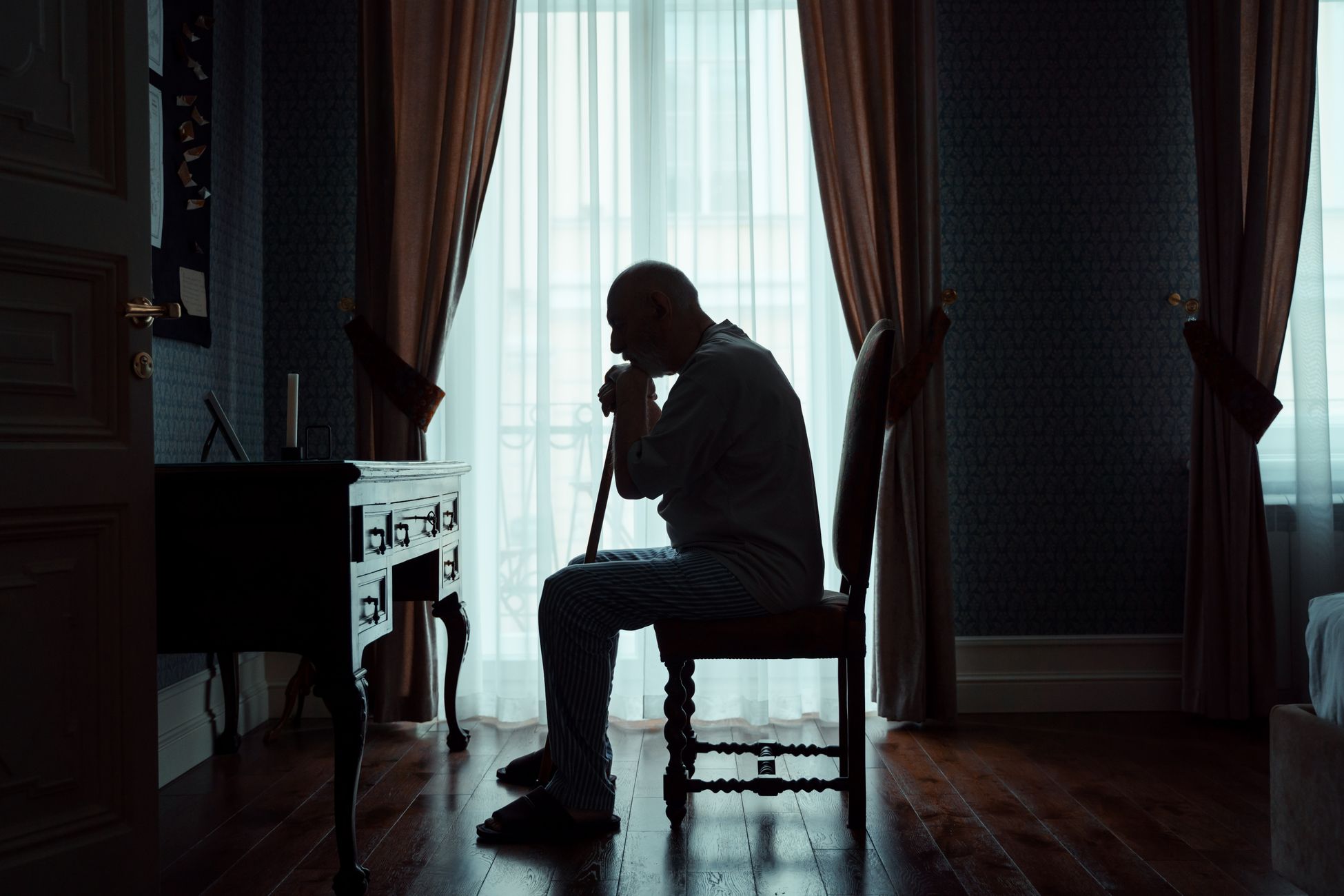
The dinner is loud, the way dinners are when adult children come home with their own children in tow. Somewhere between the second course and the dessert, the talk turns to a decision someone has to make about a job in another city. The father at the head of the table lifts his hand an inch off the wood, the small unconscious gesture of a man about to say something, and then sets it back down. No one was looking at him. The conversation has already moved on.
He eats the rest of the meal in a kind of attentive quiet that the family, later, will describe as withdrawn. His wife will call it moodiness. His daughter, driving home, will tell her husband that her dad seemed off again. Almost no one in the car will name the thing that actually happened at the table, which is that a man with a fully formed opinion about the job in the other city sat through the entire discussion of it without being asked.
The conventional reading is that older men go quiet because they have run out of things to say, or because some inward door has closed, or because masculinity itself trains men to retreat as their utility narrows. There is a small truth in each of those, and a larger one they all miss. Quietness in older men is usually not a private failure of expression. It is a response to a social environment that stopped soliciting their thinking and waited, with diminishing patience, for them to catch up.
The quiet can look like vacancy from the outside. More often, it is calculation. He is measuring when he last got asked a real question, and whether offering an answer now would sound like an imposition.
The slow withdrawal of the question
Through most of a working life, a man is asked things constantly. A colleague asks how to handle a client. A junior asks how the contract should be structured. A spouse asks what he thinks about the school, the move, the offer. Children ask, in the literal sense, what he believes about everything, because they have not yet developed their own framework for the world. Being asked is the connective tissue of mattering. It is the daily proof that one’s interior life has weight outside the skull.
Then, by degrees that no one announces, the asking thins. The colleagues leave or retire. The juniors are now running their own departments. The spouse, often having spent decades deferring, has built a parallel decision-making life and no longer routes choices through him. The children, now in their thirties or forties, have their own marriages, their own therapists, their own podcasts, and a quiet sense that their father’s frame of reference is dated. They love him. They simply do not ask him much anymore.
None of this is cruelty. Most of it is the ordinary churn of life rearranging itself around new centres of gravity. But the cumulative effect, for the man who used to be at the centre of that gravity, is a strange and steady silence.
He is still in the room. He is no longer in the conversation.

What the silence is actually doing
It would be convenient to call this loneliness and move on, but loneliness is a felt state, and what is being described here is structural. The man is not alone. He is often surrounded, by a wife, by grandchildren on weekends, by a golf group, by a neighbour who waves. The structure of inquiry around him has changed, even though the structure of company has not. He is included in events. He is not included in deliberation.
This distinction matters, because the research on isolation in older adults has begun to separate the two with increasing care. A large US study using causal modeling, summarised by News-Medical, found that social isolation operates as a key, independent risk factor for cognitive decline, distinct from loneliness as a feeling. A separate analysis covered by Neuroscience News found that perceived loneliness, the subjective sense of not being reached, predicted cognitive decline more strongly than objective isolation did. Both can be true. The man with the busy household and the quiet interior is, on paper, well-connected. On the metric that matters, being asked, he is not.
Why men in particular
Women in this generation tend to have built, often by necessity, a more distributed network of inquiry. A sister calls. A friend from the book club asks for an opinion on her son-in-law. The hairdresser asks about the holiday. The fabric of being consulted is woven through smaller, more ordinary exchanges that survive retirement and widowhood and relocation.
Men of this generation, particularly those who routed most of their identity through work, tend to have outsourced their being-asked to a single environment. When that environment ends, the retirement party, the buyout, the handover email, the asking ends with it. The phone does not ring on Monday morning. No one needs his read on the situation, because there is no situation he is attached to anymore. The structural collapse is sudden in a way that almost no one prepares him for.
The hardest part of changing your life isn’t always failure; sometimes it’s letting go of the identity everyone expects you to keep. For the older man, the identity being shed is not chosen. It is being quietly removed from the inboxes and conversations of everyone he knows.
The household recalibration
Inside the marriage, a quieter version of the same shift is happening. After decades, most long partnerships have settled into a division of decision-making that does not require fresh consultation. She handles the family logistics, the social calendar, the grandchildren’s birthdays, the relationships with the adult children. He handles the car, the taxes, the things that have not yet broken. The areas where his opinion is genuinely required have narrowed to a band so thin that most days no question crosses it.
This is not a complaint about wives. It is an observation about how thirty or forty years of competent partnership eventually eliminates the need to check in about most things. The man who used to be asked, what do you think we should do about the kids, is no longer asked, because the kids are fifty and the question has been answered for years.

The adult children and the unasked question
The grown children are often the place where the silence becomes most legible, and most painful. They love their father. They call on Sundays. They visit at holidays. They report on the grandchildren. What they almost never do, after a certain age, is ask him a real question, about his view on their career, their marriage, their politics, their grief. There is a tacit feeling, often unspoken, that his generation is the wrong frame of reference for the problems they are actually navigating. So they tell him things. They do not ask him things. And telling, without asking, is a form of inclusion that produces the exact silence we are describing. He nods. He says that’s great. He has nothing to add, because nothing was solicited. The conversation closes without him having been in it. Many of these children are also correcting, consciously, for fathers who once dominated conversations and made every gathering revolve around their opinion. Pulling back from asking can feel, to the adult child, like a healthy boundary. To the father, who has by now also learned not to dominate, the boundary lands as a closed door.
What the quietness is actually a signal of
The behaviour the household reads as withdrawal is usually a man calibrating to the new rules. He has noticed, over months and years, that his unsolicited opinion is received politely and not engaged with. So he stops offering it. The household reads the stopping as proof that he had nothing to offer in the first place, which deepens the not-asking, which deepens the quiet. It is a feedback loop with no clear villain, and it terminates in a man who looks, from the outside, like he has emotionally retired.
There is some evidence that this pattern is not benign. Loneliness in older adults, the felt sense of not being reached, has been linked to measurable changes in memory and cognition in recent research and further coverage by Fox News notes that the effect on memory appears real even when overall cognitive decline does not visibly accelerate. The mind that is not being asked anything starts, slowly, to lose some of the muscle that answering requires.
The repair is smaller than it looks
The fix here is not a grand reconciliation. It is the restoration of one small habit: asking the man a real question and waiting for the answer. Not a logistical question, did you take the bin out, but a question that assumes he still has a working interior life. What did you make of that election result. What do you think we should do about your brother. What was your father like at this age. Do you think we got it right with the kids.
The first few attempts will land oddly, because the muscle has atrophied on both sides. He will give a short answer. The asker will feel the awkwardness and may not try again. But the men who come back into themselves in their seventies are almost always the ones whose households, often led by a single grandchild or a daughter-in-law who noticed, started asking them things again. The recovery is not psychological. It is conversational.
The quiet, reread
So here is the part that is harder to sit with. If there is an older man in your life who has gone quiet, the temptation is to wish he would speak up, to wonder why he doesn’t just say what he thinks, to read his silence as some failure of nerve or warmth on his part. That framing is comfortable because it leaves you outside the problem. It is also, in most cases, wrong.
Think back honestly through the last few times he was in the room with you. Count the questions you actually directed at him. Not the pleasantries, not the logistics, the questions that assumed his answer mattered to what you were going to do next. If the number is low, and it almost always is, then the silence at the table is not his to break. It is yours. He has been reading the room correctly for years. The question is whether you are willing to change what the room has been telling him.
