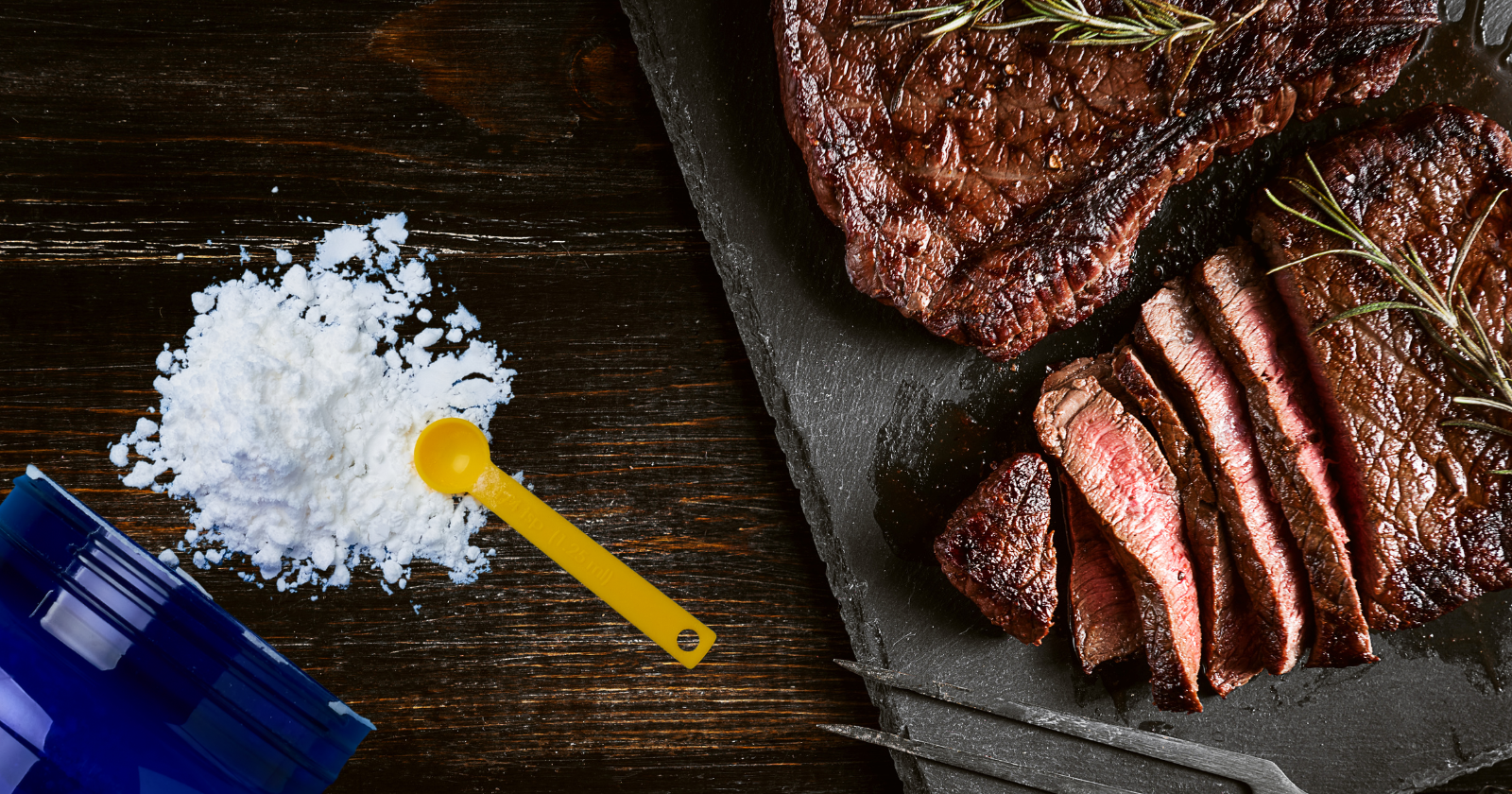
A 5-gram serving of creatine monohydrate contains roughly as much creatine as about 1 to 1.5 kilograms of raw beef, depending on the meat’s creatine content. That comparison describes a supplemental dose; it does not show that a normal diet is deficient.
The body synthesises creatine from amino acids, food supplies additional creatine, and endogenous production can adapt to dietary intake. Supplements can raise muscle creatine stores above typical baseline levels, but full storage saturation is not a nutritional requirement for health.
Roger Harris and colleagues’ early loading study used repeated 5-gram doses to study how supplementation changed muscle creatine. Its protocol should not be read as evidence that everyone needs 5 grams from food each day.
The 1.5-kilogram steak problem
The exact creatine content of meat depends on the cut and how it has been handled. Raw beef sits at roughly 3.5 to 5 grams of creatine per kilogram. Pork is similar. Herring, oddly, is the richest common source, at around 6.5 to 10 grams per kilogram, which is why fish-heavy diets in coastal Japan and Scandinavia historically delivered more dietary creatine than inland European ones. Chicken is lower. Plants contain essentially none, which is why vegetarians enter every creatine study with measurably lower baseline muscle stores than omnivores.
Cooking destroys some of what is there. Long braises, high-heat grilling and slow roasts all convert a fraction of the creatine into creatinine, the same inert breakdown product the kidneys filter out of the bloodstream. A well-done steak can lose a substantial portion of its starting creatine to heat. So the 1.5-kilogram figure to hit a 5-gram dose is the raw-weight estimate. To hit it from a plate of cooked sirloin, the realistic number creeps closer to 2 kilograms.
Nobody eats like that.
Indian household consumption surveys put average per-capita meat intake at a few tens of grams a day, and even in heavy-meat-eating populations like the United States and Argentina, daily intake typically sits in the 200 to 400 gram range. A single supplement scoop delivers what four or five days of carnivorous eating would, condensed into a teaspoon of white powder.

What the body makes on its own
The human body holds roughly 120 to 140 grams of creatine at any given time, about 95 percent of it stored in skeletal muscle as phosphocreatine, the molecule that recycles ATP during the first ten seconds of any explosive movement: a sprint, a jump, a heavy lift, the first stair after a fire alarm. Every day, a small percentage of that pool degrades into creatinine and washes out in urine. For a 70-kilogram adult, that is about 2 grams of creatine lost per day that has to be replaced from somewhere.
The liver, kidneys and pancreas synthesise creatine internally, while food can supply additional creatine. The balance varies with body size, diet and intake; it is not a fixed daily shortfall that food must fill. In a vegan or strict vegetarian, the food half is essentially zero, and endogenous synthesis quietly ramps up to compensate, though never quite to the level of an omnivore. In a heavy meat-eater, dietary intake might cover three quarters of the daily loss. In a supplement-taker swallowing 5 grams a day, the surplus saturates muscle storage and the kidneys excrete the rest.
This is why the loading-dose protocol Harris pioneered, 20 grams a day for five to seven days, then 3 to 5 grams maintenance, works the way it does. Muscles have a ceiling. Once phosphocreatine stores are full, additional intake produces no further benefit and simply ends up in urine as creatinine. The ceiling sits at a level most untrained adults fall short of. Supplementation can raise muscle stores above typical dietary baseline levels.
Why baseline muscle stores differ
The mismatch between dietary supply and muscular demand becomes obvious when researchers measure baseline creatine in populations that eat very differently. Vegetarians enter studies with the lowest muscle creatine, omnivores sit in the middle, and only people already supplementing reach the saturation ceiling. As reporting in USA Today noted earlier this year, the body produces only a fraction of what muscle can hold, and food typically does not close the gap unless intake is extreme.
Part of the reason is biological. Muscle is greedy and replacement is slow. Part is behavioural. People who lift heavy or sprint repeatedly deplete phosphocreatine faster than people who sit. Older adults synthesise less internally. Women, on average, carry lower muscle creatine concentrations than men of the same training status, which is one of the reasons the recent surge in creatine use among women has produced unusually large effect sizes in muscle and bone studies. They started further from the ceiling.
The herring exception
Among whole foods, only one common source even approaches supplement-scoop density: raw herring, at roughly 6.5 to 10 grams per kilogram. A 200-gram fillet of raw herring delivers about 1.3 to 2 grams of creatine, which is closer to a maintenance dose than any practical portion of beef. This is one of the quiet biochemical reasons fish-heavy diets show up favourably in long-term cognitive and muscular-aging studies, and it is part of why the modern functional beverage industry has spent the past two years trying to crack the stability problem of putting creatine into ready-to-drink formats. The powder-in-water approach reaches a much smaller audience than a can on a shelf.
Cooked herring loses some creatine to heat, as beef does. Pickled herring, the Scandinavian staple, loses more, because the acid and salt brine slowly converts creatine to creatinine over weeks of storage. Sushi-grade raw tuna and salmon land in a similar range to beef. The herring advantage is real but narrow.
Why the supplement won the argument
Creatine monohydrate, the white crystalline powder sold in every gym, was first identified in meat extract by the French chemist Michel-Eugène Chevreul in 1832. He named it after the Greek kreas, for flesh. For most of the next 160 years it was a laboratory curiosity. The early 1990s human loading studies, and the athletes who used the protocol to compete at the 1992 Barcelona Olympics, changed that. Within a decade it became one of the most extensively studied ergogenic supplements, with hundreds of peer-reviewed trials.
What the trials kept finding, and what is now driving the supplement’s expansion well beyond athletics into cognition, mood and healthy aging (themes covered in recent features by GQ and Women’s Health), is that the benefits scale with how far below saturation a person starts. Vegetarians show the largest cognitive responses. Older adults show the largest muscle responses. People who already eat a kilogram of beef a week show smaller, though still measurable, effects. The supplement is essentially closing a dietary gap that the modern plate cannot.
The arithmetic that nobody talks about
A kilogram of creatine monohydrate contains 200 doses of 5 grams each. The equivalent in raw beef, 200 doses times 1.5 kilograms per dose, comes to 300 kilograms of meat. At supermarket prices, that is somewhere between $3,000 and $9,000 of steak, before cooking losses, before the practical impossibility of chewing through it, before the saturated fat and the cholesterol load and the freezer space.
This is the trade the body has been making, unnoticed, for the entire history of the species. Hominid muscles needed phosphocreatine for the sprint after the antelope and the climb away from the leopard. The liver and kidneys learned to manufacture enough to keep the system running on a diet that was, by modern standards, surprisingly low in meat. Hunter-gatherer intake estimates put daily creatine consumption at perhaps 1 to 2 grams, the same order of magnitude as endogenous synthesis. Saturation was never the default. It was always something the body settled for being slightly short of.
That is the uncomfortable part. The baseline most people call natural is in fact a permanent shortfall, a state our ancestors evolved to tolerate because tolerating it was cheaper than chasing down another antelope. The body’s internal factory was never built to fill muscle to the brim. It was built to keep the lights on between meals that never came in the quantities the tissue actually wanted. A 5-gram scoop, dissolved in a glass of water at 7 a.m., tips the balance for the first time in evolutionary history. The kilogram and a half of beef sits, uneaten, on the other side of the equation, the meal nobody was ever going to manage anyway. Whether that counts as cheating or simply as finishing the job evolution started is a question the supplement aisle does not answer, and probably cannot.
Health note: Creatine is not appropriate for everyone. People with kidney disease, people who are pregnant or breastfeeding, and anyone taking medicines or managing a medical condition should seek individual clinical advice before using a supplement. This article does not provide treatment advice.