Cecil Rhodes was a young Englishman sent to South Africa for his lungs when he arrived at the Kimberley diggings in 1871, and within two decades he had bought, bullied, or bankrupted nearly every other claim-holder on the field. By 1888 he had merged his holdings with those of his last serious rival, Barney Barnato, into a new company called De Beers Consolidated Mines. By the following year that single company controlled an estimated 90 percent of the world’s rough diamond production, a near-monopoly that would shape the price of an engagement ring for the next 130 years.
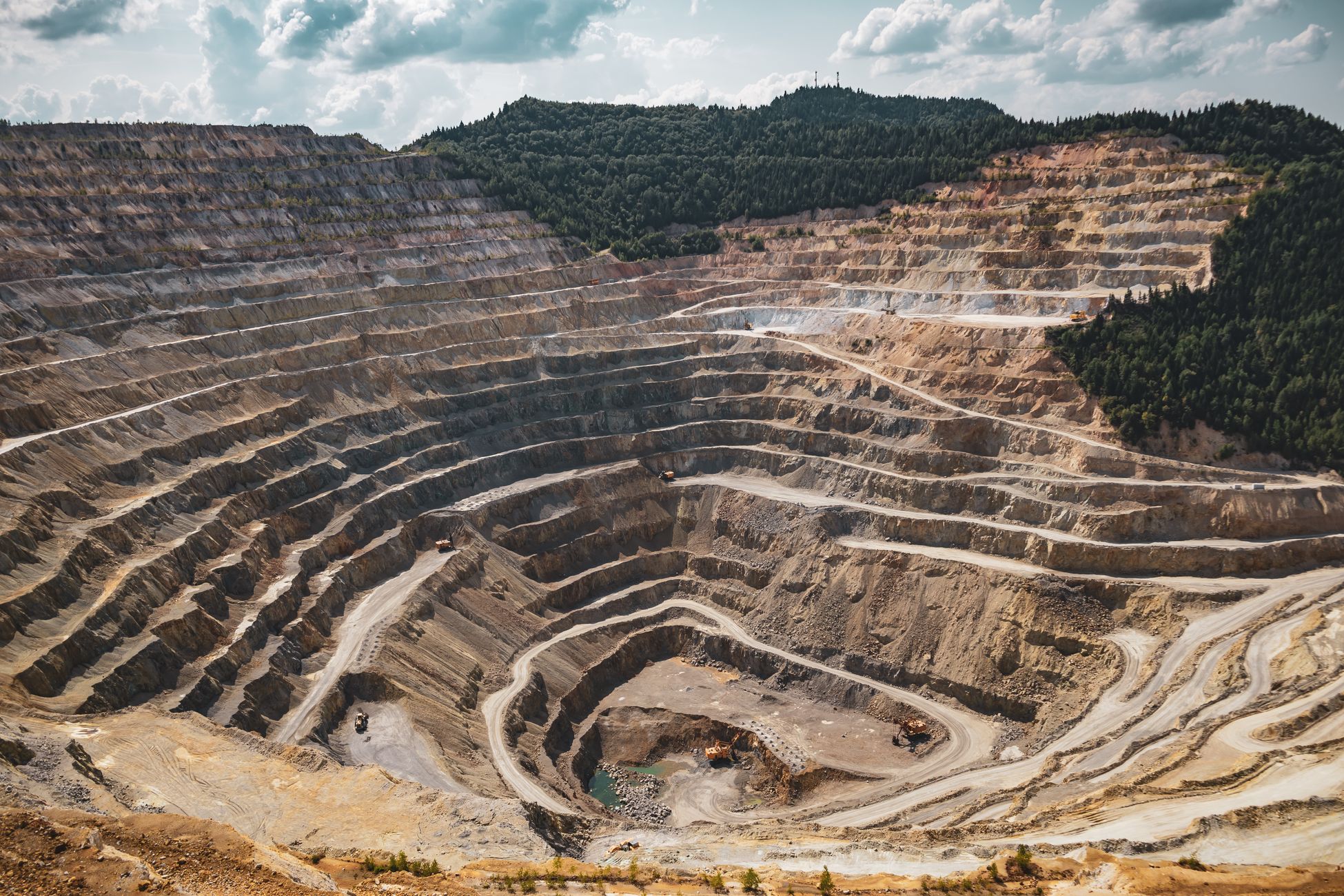
The Kimberley field had been chaos before Rhodes arrived. Diamonds were first found in the area in the late 1860s on a farm owned by two Boer brothers named de Beer, who sold the land in the early 1870s without ever digging a stone themselves. Within months, thousands of prospectors had swarmed onto their old farm and the neighbouring Colesberg Kopje, hacking at the yellow earth with picks and buckets. The hole they opened became the Big Hole of Kimberley, eventually one of the largest hand-dug excavations in human history.
A field divided into 3,600 squares
The colonial authorities had carved the Kimberley mine into thousands of small claims, and the rule was that no single miner could hold more than two. The intention was egalitarian. The effect was a nightmare. As diggers went deeper, the walls between adjacent claims collapsed, flooding was constant, and the cost of hauling earth out of an ever-deeper pit ate any profit a small operator could make. Diamonds themselves were becoming a problem too: the more that came out of the ground, the less each one was worth.
Rhodes understood this earlier than most. He had arrived with almost no capital, started by renting out a steam-powered water pump to drowning miners, and parlayed that into claims of his own. By 1880 he had founded the original De Beers Mining Company with his partner Charles Rudd, named after the long-departed Boer brothers whose farm sat over the richest pipe of kimberlite rock anyone had yet found.
The Rothschild loan that ended the war
Rhodes’ chief competitor was Barney Barnato, a London-born former music-hall performer who had built up the rival Kimberley Central Diamond Mining Company. Through most of the 1880s the two men fought a slow war of attrition, each buying out smaller claims, each undercutting the other on price whenever the London diamond market sagged.
The decisive move came in 1887. Rhodes secured a substantial loan from the Rothschild banking house in London and used it to buy up shares in Barnato’s company on the open market and through private deals. By 1888 Barnato had agreed to merge. The trust deed of the new De Beers Consolidated Mines was extraordinary in its scope: it gave the company power not only to mine and trade diamonds but to annex territory, raise armies, and govern populations. Rhodes was already thinking past Kimberley.
A dominant share of rough diamond production
By the end of 1889, De Beers Consolidated controlled the four main Kimberley pipes. De Beers, Kimberley, Dutoitspan and Bultfontein together produced the overwhelming majority of the world’s diamonds. Estimates of the company’s share of global rough production at that moment cluster around 90 percent. There were diamonds being pulled from alluvial gravels in Brazil and a trickle from India, but the volumes were negligible against the South African output. An estimate of annual production is not a measure of all diamonds already owned, traded or still underground.
Rhodes did not stop at production. He signed an agreement with a syndicate of London diamond merchants, the so-called Diamond Syndicate, who agreed to buy De Beers’ entire output at a fixed price and resell it through a controlled pipeline. Supply was throttled to keep prices high. When new finds threatened the system, De Beers either bought the new mine or bought its output. The company would refine and tighten this model for the next century under the Oppenheimer family, who took control in 1927.
What the monopoly was actually for
Rhodes was never coy about why he wanted the monopoly. Diamonds, unlike gold, have no industrial floor price set by central banks. Their value is entirely a function of scarcity, and natural scarcity in Kimberley had collapsed the moment the Big Hole opened. The only way to keep the stones expensive was to make them artificially rare. Dig them up, sort them, and release them onto the market at a pace the market could absorb without the price falling.
Without that control, a one-carat stone might have sold for the price of a decent dinner. With it, the same stone became a symbol of marriage, status, and inheritance for the better part of the twentieth century. The famous slogan “A Diamond is Forever” was the cultural finishing touch on an economic structure Rhodes had built in the 1880s.
The Cape-to-Cairo profits
The Kimberley monopoly funded Rhodes’ political career and his imperial ambitions. He became Prime Minister of the Cape Colony in 1890, the year after De Beers consolidated its grip. He used diamond money to charter the British South Africa Company in 1889, which annexed the territory that would become Rhodesia, named after him, and Zambia. The De Beers trust deed had explicitly allowed for this kind of expansion. The diamonds paid for the railways, the telegraph lines, the rifles, and the bribes that pushed British rule north from the Cape toward the Zambezi.
Rhodes died in 1902 at the age of 48 in Muizenberg on the Cape coast. He left most of his fortune to fund the Rhodes Scholarships at Oxford, which still exist. He also left De Beers in a position so dominant that even a century of new discoveries in Namibia, Botswana, Russia, Canada and Australia could be absorbed into the cartel rather than break it.
The slow unwinding
The monopoly held until surprisingly recently. Through the 1980s De Beers still controlled a large majority of the world’s rough diamond trade through its London-based Central Selling Organisation. The cracks came from Russia, which began selling outside the cartel after the Soviet Union collapsed, and from Canada, where new mines opened in the late 1990s and early 2000s and refused to sell through De Beers. By the mid-2000s the company’s market share had fallen significantly. Today it sits closer to a third.
The numbers at the end of the cartel
The final blow has been the rise of laboratory-grown diamonds, chemically identical to mined stones and a fraction of the price. Anglo American, which has owned De Beers since 2012, announced in 2024 that it was looking to sell or spin off the diamond business entirely. Reporting by Forbes in December 2024 revealed that De Beers was sitting on roughly $2 billion in unsold rough diamonds, the largest stockpile in fifteen years, as the lab-grown market continued to eat into demand.
The arithmetic of the unwinding is stark. From a peak share of roughly 90 percent of world rough production in 1889, De Beers held around 80 percent of the global trade through its Central Selling Organisation as late as the 1980s. By the mid-2000s that figure had fallen to roughly 40 percent. Today the company’s share sits closer to a third. The Big Hole at Kimberley, which produced thousands of kilograms of diamonds across more than four decades, closed in 1914. The original De Beers Mining Company was founded in 1880, the merged Consolidated trust deed signed in 1888, the cartel pricing structure functional from 1890 to roughly 2000. That is 110 years of price-setting from a single office on Charterhouse Street in London, now reduced to a $2 billion stockpile that nobody is in a hurry to buy.
Correction, 3 October 2026: The earlier headline and section heading confused a share of diamond production with control of every diamond on Earth. Those claims and the related universal assertion about purchases have been corrected.