

In 1941, the psychiatrist Abram Kardiner published The Traumatic Neuroses of War, a clinical study of American soldiers returning from the First World War who could not stop scanning rooms for threats. Kardiner described men who flinched at car backfires two decades after the Armistice, slept with their backs to walls, and read hostile intent into a stranger’s glance across a diner. He called the pattern a physioneurosis — a body stuck in a defensive posture the mind could no longer switch off. The word we use for it now is hypervigilance, and it entered the diagnostic manual in 1980 alongside the first official definition of post-traumatic stress disorder.
Kardiner’s veterans were the template. The children came later.
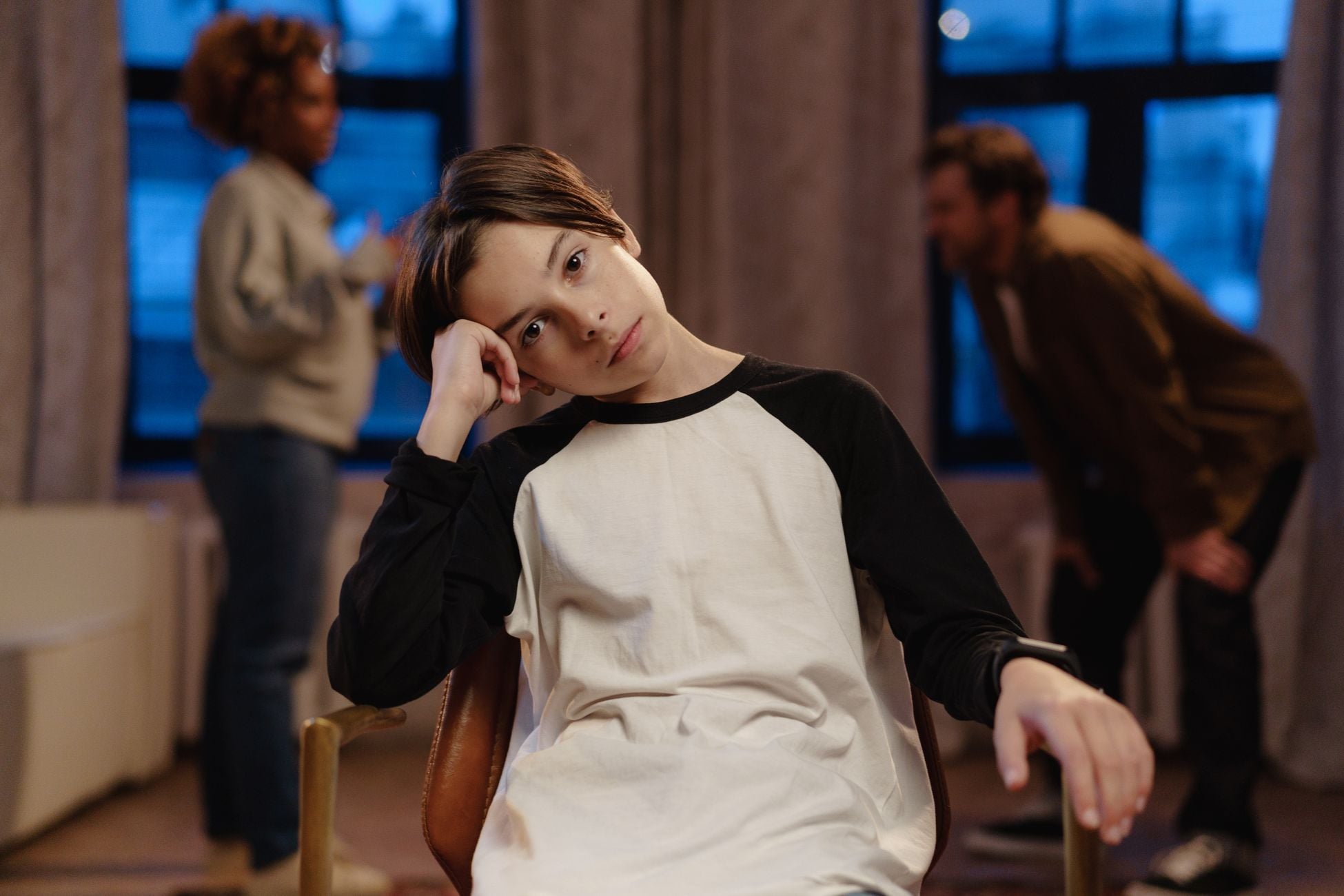
By the 1990s, developmental psychologists watching kids raised in homes with volatile parents were seeing the same reflex — the same overactive threat-scanning, the same startle response, the same exhausted alertness — in eight-year-olds who had never been near a battlefield. The scanning wasn’t a personality quirk. It was a nervous system that had learned, correctly, that the room was dangerous.
What Kardiner actually saw
Kardiner had trained under Freud in Vienna in 1921, then spent the next two decades treating veterans at the U.S. Veterans Bureau in New York. What struck him was how physical the condition was. His patients had elevated resting heart rates. They sweated at rest. Their pupils dilated at ambiguous sounds. Their sleep architecture was broken — they woke at 3 a.m. with the covers thrown off, listening.
The Vietnam era gave the pattern its modern name. Psychiatrists working with returning combat veterans in the 1970s catalogued the same cluster Kardiner had described and pushed for its inclusion in the DSM-III. Hypervigilance became one of the hallmark symptoms of PTSD, listed under the “hyperarousal” criterion alongside exaggerated startle response and difficulty concentrating. Decades later, clinicians would still be arguing about how combat veterans with PTSD are treated by the systems meant to help them.
The important thing about Kardiner’s framing is that he refused to call it weakness. He called it learning. The soldier who spent eighteen months in a trench had been taught, at gunpoint, that unpredictable loud noises meant death. His nervous system was doing exactly what evolution designed it to do. The problem was that the trench was in France and the diner was in Queens.
The reflex, mechanically
Hypervigilance runs on a specific piece of neural hardware: the amygdala, a pair of almond-shaped clusters buried deep in the temporal lobes. The amygdala is the brain’s threat-detection system. It receives sensory input on a fast track — before the conscious cortex has processed what the sound was — and can trigger a full-body stress cascade in milliseconds.
In a calibrated nervous system, the amygdala fires and then a network of prefrontal regions calms it back down. In a hypervigilant one, the brake is worn thin. A 2026 study published in Nature Neuroscience mapped a three-node circuit connecting the reward center to the amygdala’s alarm system, showing how the brain decides which threats deserve attention — and how that decision-making goes wrong in both PTSD and addiction.
The result, in daily life, is a person who reads five signals where a calmer nervous system reads one. A door slams and the heart rate spikes before the conscious mind has identified the sound. A partner sighs and the muscles across the shoulders lock.
The pediatric discovery
The move from veterans to children happened gradually, and it started with attachment researchers. In the 1970s and 80s, Mary Ainsworth’s students were running the Strange Situation protocol — a lab test in which a toddler is briefly separated from a parent — and noticing that a subset of children responded neither with the secure calm of a well-attached child nor the clear distress of an anxious one. These kids froze. They watched the parent with a strange, tracking gaze. They seemed to be assessing.
The pattern traced to homes where the parent’s emotional state was unpredictable — where a smile at 9 a.m. might become a shout at 9:15 for reasons the child could not identify. The children weren’t traumatized by a single event. They were trained by ten thousand small ones.
A body of research on parent-child emotional dynamics has since shown that the reciprocal exchanges between caregiver and infant — of facial expression, tone, physiology — are what teach a developing brain what to expect. When those exchanges are inconsistent, the developing brain builds a wider net.
What the child learns
A five-year-old with a volatile parent learns to read micro-expressions the way a sommelier reads a wine label. They notice the way the car keys are set down on the counter. They know which brand of silence means the evening will be fine and which means it won’t. They know that asking about dinner at the wrong moment can rearrange the mood of the entire house.
This is not intuition. It is data collection under conditions of high stakes. The child cannot leave the room and cannot control the adult, so the only variable available is prediction. If they can predict the mood, they can pre-empt it.
Clinicians who work with adults raised in these households describe patients who apologize before entering a conversation, who scan a partner’s face for signs of displeasure at the beginning of every phone call, who cannot fully relax in their own kitchens. Recent writing on how parents’ unresolved distress spills onto children has drawn on the same clinical observations that go back to the attachment labs of the 1980s.
The same reflex, different origins
What the combat and developmental literatures converged on, by the early 2000s, was that hypervigilance is the same physiological pattern regardless of what taught it. A Vietnam veteran hearing a helicopter and a 34-year-old on a Zoom call with a sighing manager are running the same subcortical program. Elevated cortisol. Faster breathing. Peripheral vision widened. Digestive system throttled back.
The difference is the trigger. The veteran’s amygdala learned in a jungle. The adult’s learned at a kitchen table.
Children who grow up watching a parental relationship collapse in unpredictable stages often carry the scanning reflex into their own adult partnerships. Recent clinical writing on parental divorce as a developmental trauma describes adults who monitor their spouse’s tone the way their eight-year-old self monitored a parent’s.

Why it looks like a personality
The reason hypervigilance gets mistaken for a personality trait is that by the time anyone notices it, the pattern is 20 or 30 years old. It has been running longer than any other feature of the person’s inner life. It feels like who they are.
The adult describes themselves as sensitive, or as a good reader of people, or as anxious in relationships. They are, on the face of it, all three. But underneath those descriptions is a nervous system doing exactly what Kardiner’s veterans’ nervous systems were doing in 1941 — running a threat-assessment loop that was calibrated for a room the person no longer lives in.
Health writers now emphasise that PTSD and its related hyperarousal patterns show up in populations well beyond returning soldiers — in survivors of car accidents, in first responders, in people who lived through violent childhoods. Coverage of PTSD symptoms across non-military populations increasingly stresses that the condition is defined by the physiology, not the biography.
What quiets it
The treatments that work on hypervigilance are, almost without exception, treatments that give the amygdala new data. Exposure therapy walks the nervous system through a feared cue in a safe context, repeatedly, until the fast-track threat association weakens. EMDR asks the patient to hold a distressing memory in mind while doing bilateral eye movements, which appears to reduce the emotional charge attached to the memory. Somatic therapies work bottom-up, using breath and posture to persuade the body that it is currently, in this room, safe.
What none of them do is talk the person out of their scanning. You cannot argue an amygdala into standing down. You can only give it enough repetitions of the safe outcome that its threshold for firing gradually resets.
Kardiner understood this in 1941. His notes describe veterans who improved not when they were told the war was over — they knew the war was over — but when they had accumulated enough uneventful nights in a Brooklyn apartment for their bodies to begin to believe it.
The room the person is actually in
Hypervigilance is what happens when a nervous system does its job too well. It is a solved problem from an earlier chapter of a life, still running in the background, still scanning a room that is no longer the room the person is in.
For a Vietnam veteran, the earlier room was a jungle. For a 40-year-old whose father drank, it was a hallway outside a closed bedroom door. For a Ukrainian child in 2022, it was a basement in Kharkiv. The rooms differ. The circuitry doesn’t.
Kardiner’s insight, restated for a longer century of evidence, is that the body remembers what it was taught, and that undoing the lesson takes as long as the lesson took to learn. The scanning is not a flaw in the person. It is a receipt.
