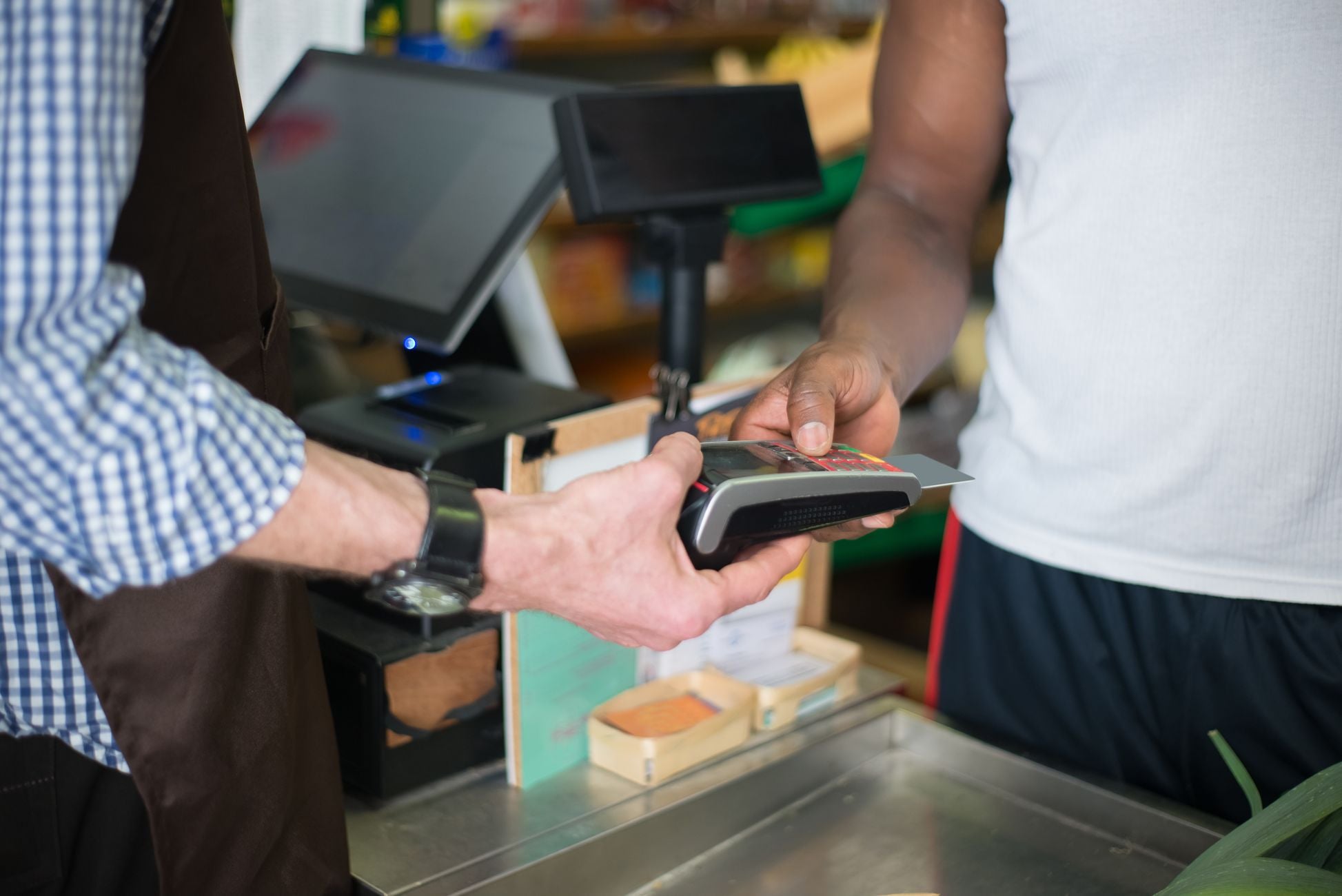
Every time a shopper taps a Visa or Mastercard at a checkout counter in the United States, a small percentage of that swipe peels off before the merchant ever sees the money. It is called interchange, and in 2024 it drained roughly $111 billion from U.S. merchants — about four times what it cost them in 2009, according to figures the National Retail Federation drew from Nilson Report data.
The fee is invisible to the customer. It shows up nowhere on the receipt. But it sits behind the price of almost everything sold in America with a piece of plastic.
What interchange actually is
Interchange is the cut that a shopper’s bank — the card issuer, like Chase or Capital One — takes from every transaction on a Visa or Mastercard network. The merchant’s bank collects the payment, subtracts the interchange, and passes it to the issuer. Visa and Mastercard don’t keep interchange themselves. They set the rates, and the issuing banks pocket the money.
On a typical U.S. credit card purchase, interchange runs somewhere between 1.5% and 3.5% of the sale, depending on the card type, the merchant category, and how the card is presented. Premium rewards cards cost merchants the most. A platinum travel card with lounge access and 3x points is subsidised, in large part, by the coffee shop that swiped it.
The most recent industry tally from The Motley Fool’s research team puts total U.S. card processing fees — interchange plus network and acquirer markups — at a record $198.25 billion in 2025. Interchange is the largest slice of that pile.
Why the number quadrupled in 15 years
Three things happened at once between 2009 and 2024.
First, Americans stopped using cash. Card share of retail payments climbed steadily through the 2010s and then jumped during the pandemic, when contactless became the default. Every dollar that shifted from cash to card became a dollar with an interchange fee attached.
Second, the rewards arms race pushed more consumers onto premium cards. A basic Visa runs the merchant one rate. A Chase Sapphire Reserve or an Amex Gold, with their airline credits and points multipliers, runs the merchant a much higher one. The richer the rewards, the fatter the swipe fee funding them.
Third, the raw volume of card spending exploded. More transactions, on higher-fee cards, from a population that no longer carries twenties.
The result is a fee stream that has grown far faster than inflation, faster than retail sales, and faster than almost any other line item on a small business’s cost sheet.
The merchant sees a number they can’t predict
One of the odder features of interchange is that a merchant often cannot tell, at the moment of sale, what a given transaction will cost them. The fee depends on which specific card was tapped — a detail the merchant learns only after the fact, buried in a monthly statement.
American Banker has reported that merchants describe the system as functionally impossible to price against in real time. The interchange schedule published by Visa runs to hundreds of rate categories. Mastercard’s is similar. A grocery store, a gas station, a hotel, and an online subscription service all pay different rates for the same physical piece of plastic.
That opacity is part of why the fees have compounded so quietly. A restaurant owner watching food costs and labour rarely has the tools to model interchange as a controllable expense. It just arrives.
A 21-year lawsuit that still hasn’t ended
U.S. merchants first sued Visa and Mastercard over interchange in 2005. The case, formally known as the Payment Card Interchange Fee and Merchant Discount Antitrust Litigation, has been grinding through federal court in Brooklyn ever since.
In 2024, a proposed settlement would have lowered interchange rates modestly and given merchants more flexibility to steer customers toward cheaper payment methods. A judge rejected it as too favourable to the networks. A revised deal, unveiled in late 2025, won preliminary approval this year, more than two decades into the litigation — though large merchant groups have objected and analysts expect years of appeals before anything takes effect.
The core complaint has never really changed: Visa and Mastercard, which together handle the overwhelming majority of U.S. card volume, set interchange rates that their member banks all charge in parallel. Merchants argue that looks a lot like coordinated pricing. The networks argue interchange is what makes the whole system — fraud protection, instant authorisation, guaranteed payment — economically viable.

The Durbin amendment and the debit-card experiment
Interchange has been capped once in American history, and only on debit cards. The Durbin amendment, tucked into the 2010 Dodd-Frank Act, limited debit interchange for large banks to roughly 21 cents plus 0.05% of the transaction, starting in 2011.
The effect on debit fees was immediate. The effect on consumer prices was heavily disputed. Some studies found retailers pocketed most of the savings; others found gradual pass-through over several years. Banks, for their part, killed off most free checking accounts and raised other fees to recoup the lost interchange revenue.
Credit card interchange was left untouched. It is the credit side of the ledger — with its rewards programs and premium tiers — where the fees have grown most sharply since.
States are now trying to intervene
Illinois passed the Interchange Fee Prohibition Act in 2024, aiming to bar banks and card networks from charging interchange on the tax and tip portions of a transaction. The banking industry sued immediately. A federal court struck down the law’s data-usage restriction in February 2026 but initially let the fee limitation stand. After the Office of the Comptroller of the Currency issued a preemption order that spring, an appeals court sent the case back, and on 1 June 2026 the district court barred Illinois from enforcing the fee limitation against national banks, out-of-state banks and the card networks — leaving only Illinois-chartered institutions subject to it. The same day, state lawmakers pushed the law’s effective date to July 2027. Other states are watching closely.
Critics of state-by-state regulation argue it would fracture a national payments system that depends on uniform rules. A recent analysis in Reason warned that capping card fees tends to push costs elsewhere — onto annual fees, onto interest rates, onto the loss of rewards that lower-income cardholders rely on for effective discounts.
Supporters counter that $111 billion a year is a tax on commerce collected by two private networks with no meaningful competition, and that the cost is ultimately baked into the sticker price every consumer pays, whether they use a card or not.
What a swipe actually pays for
The interchange fee funds a real infrastructure. Authorisation networks that clear a transaction in under two seconds. Fraud detection systems that flag stolen card numbers in real time. Chargeback protections that refund a customer whose flight was cancelled. The 24-hour call centres. The rewards points. The float on the 25-day grace period before a cardholder has to pay their bill.
All of it costs money. The dispute is not whether cards should have fees. The dispute is whether $111 billion a year, growing at roughly 10% annually, is the right price for a service that in most other developed economies costs a fraction as much. Interchange in the European Union is capped at 0.3% on credit and 0.2% on debit. Australia caps credit interchange around 0.5%. U.S. rates are, by an order of magnitude, the highest in the developed world.
The fee that shows up in the sticker price
Merchants pass interchange on. They have to. A corner store operating on a 2% margin cannot absorb a 2.5% swipe fee, so it lifts the price of the sandwich by a few cents. Multiply that across every card-accepting business in America, and interchange functions as a small, invisible surcharge layered on top of almost every retail price in the country.
Cash customers pay it too. Unless a store explicitly offers a cash discount — which most do not, in part because network rules long discouraged it — the person paying with a $20 bill is subsidising the person paying with the platinum rewards card behind them in line.
That inversion, where the cash-paying customer effectively funds the airline miles of the credit-card customer, is one of the quieter redistributions in the American economy. It moves roughly $111 billion a year. And unlike a tax, no one voted for it.
Fifteen years from now, if the current growth rate holds, the number will be somewhere north of $300 billion. It will still not appear on any receipt.