

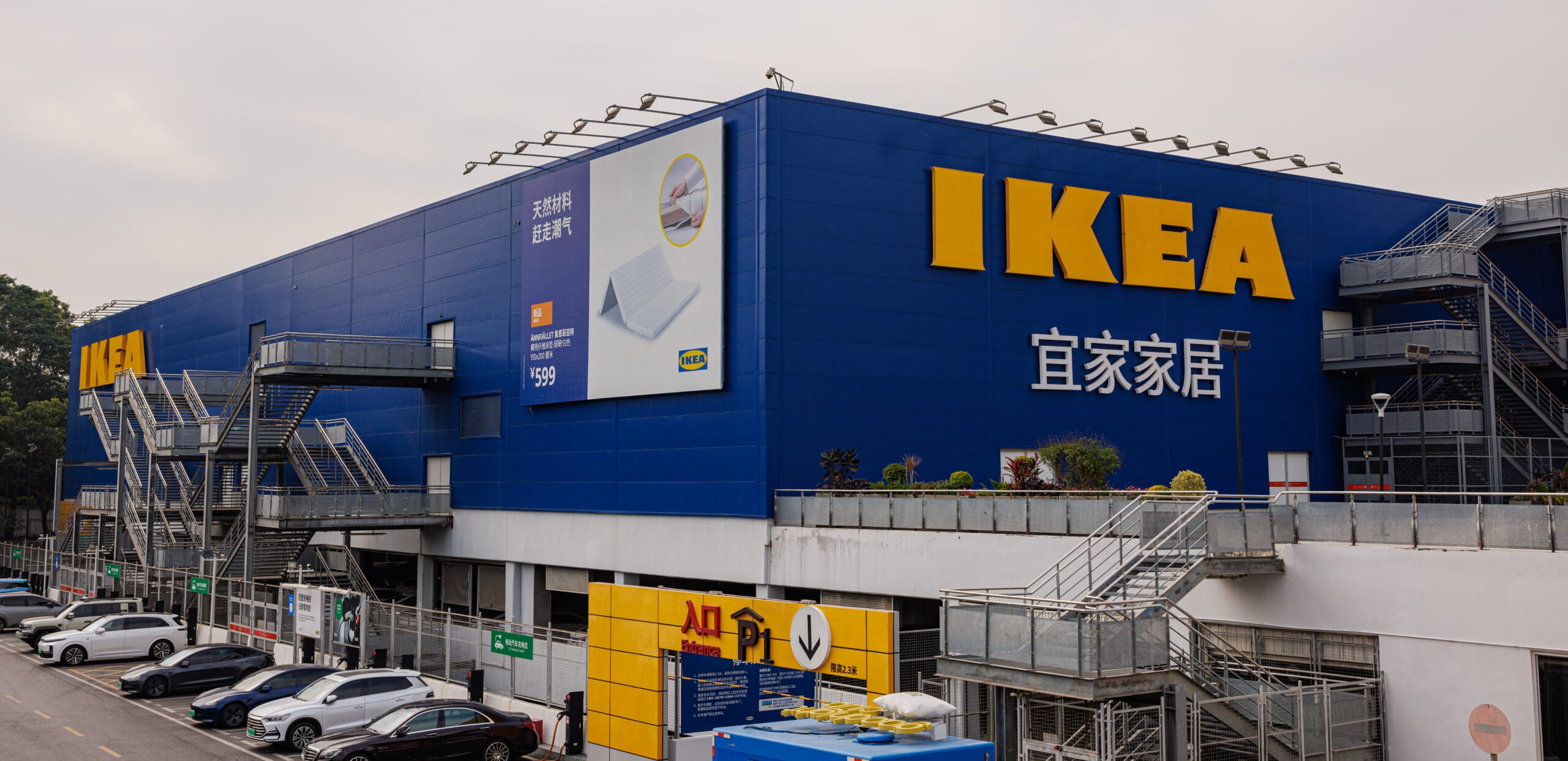
Ask who owns IKEA and the honest answer is that almost nobody does, by design. The Swedish furniture retailer, founded by Ingvar Kamprad in 1943, is not listed on any stock exchange, is not controlled by the Kamprad family in any straightforward sense, and has a foundation-based ownership structure rather than publicly traded shares. Most of it belongs to a Dutch foundation that, in legal terms, owns itself. The rest of the structure is built around the same idea. It is one of the more deliberate pieces of corporate engineering in Europe, and the word doing the heavy lifting in it is “foundation,” which carries a sense of giving that the arrangement only partly earns.
The basic shape is two foundations sitting over two separate businesses. The shops are run by Ingka Group, the operating company that runs the large majority of IKEA stores worldwide and is the brand’s biggest franchisee. Ingka Group sits under Ingka Holding B.V., registered in the Netherlands, which in turn is owned entirely by the Stichting INGKA Foundation, a Dutch foundation Kamprad set up in 1982 and transferred his ownership of IKEA into. The name is a contraction of his own, and the structure has no external shareholders. The foundation itself has no shareholders or beneficial owners; it is the shareholder of Ingka Group. Its purpose is long-term ownership and support for philanthropy.
The second business is the brand itself. The IKEA name, the store concept, the product range and the franchise system are owned by Inter IKEA, whose Dutch subsidiary, Inter IKEA Systems B.V., is the worldwide franchisor. Every IKEA store on earth, including all the ones operated by Ingka Group, pays Inter IKEA Systems a franchise fee of three per cent of turnover for the right to trade under the name. Inter IKEA Group is ultimately owned by the Inter IKEA Foundation in Liechtenstein, following a demerger from Interogo Foundation in September 2023. The historical Interogo structure should not be presented as the current ownership chain.
So money runs in a particular direction. Customers pay the stores; the stores hand three per cent of their takings to the brand owner in the Netherlands; and from there a route led, for years, on toward Luxembourg and then Liechtenstein. The retail profits that stay with Ingka flow up to the Dutch foundation, which funds a separate philanthropic body, the IKEA Foundation. The effect of all this is the part worth slowing down on, because each piece does a job.
The first job is permanence. Foundation ownership is intended to protect long-term independence and make an ordinary takeover through buying publicly traded shares unavailable. It is not a guarantee of corporate immortality or protection from every conceivable restructuring. Ingka Group identifies Stichting INGKA Foundation as its owner. The second job is tax and disclosure. Dutch foundations have historically faced light oversight and modest reporting obligations, which means a great deal about how the money moves has stayed out of public view. Kamprad never treated this as embarrassing. In a Swedish documentary he called tax efficiency “a natural part of the company’s low-cost culture”.
RELATED YOUTUBE VIDEO BY SILICON CANALS: Nobody Owns IKEA and Almost Nobody Knows Why
The charitable element is real, but for a long time it was small against the scale of the wealth it sat on. The case was laid out in 2006 by The Economist, in a piece that remains the clearest account of the arrangement. At that point the Stichting INGKA Foundation’s official purpose was narrow, the promotion of innovation in architectural and interior design, and its actual giving was slight: by The Economist’s reckoning the foundation directed a little over a million euros a year toward a Swedish institute while sitting on an endowment it valued at around 36 billion dollars, which made it, on paper, the wealthiest charitable foundation in the world. The magazine’s own summary was blunt: the set-up created a charity, dedicated to a fairly banal cause, that was not only the world’s richest foundation but at that moment one of its least generous, an arrangement that minimised tax and disclosure, rewarded the founding family handsomely, and made IKEA immune to takeover. The foundation, it noted, had collected around 1.6 billion euros in dividends between 1998 and 2003, and what became of most of it was not visible from outside.
That is the historical charge, and it is worth being precise that it has shifted. After the 2006 reporting, the philanthropic arm expanded its mandate in 2009 toward vulnerable children and has since grown into a serious giver. The IKEA Foundation now grants more than €200 million a year and has paid out more than €2 billion in total since it began, with its work now concentrated on child poverty, refugee livelihoods and climate change; an independent analysis put its 2024 grantmaking at €260.3 million. A foundation giving away a quarter of a billion euros a year is not meaningfully described as ungenerous. The accurate version of the story is not that IKEA fakes its philanthropy, but that the philanthropy was, for decades, the smaller and later purpose of a structure whose primary functions were control and tax.
Those functions are now under formal scrutiny, and not over a side issue but over the central flow of money. In December 2017 the European Commission opened an in-depth state aid investigation into two tax rulings the Netherlands had granted to Inter IKEA Systems, in 2006 and 2011. The Commission’s concern, set out in its opening decision, is that the rulings let franchise profits be routed out of the Netherlands and taxed lightly: first via a low-tax Luxembourg company, and then, after that Luxembourg scheme was itself ruled unlawful, via the purchase of the IKEA intellectual property funded by an internal loan from the Liechtenstein parent, the interest on which was deductible against Dutch profits. In April 2020 the Commission widened the investigation to cover later annual tax assessments as well. Reporting at the time put the potential tax recovery, if the arrangements were found to be illegal aid, at as much as a billion euros. A separate figure points the same way: the 2016 report for the Greens/EFA group in the European Parliament that prompted the EU’s interest estimated the structure had cost member states at least a billion euros in foregone tax between 2009 and 2014.
The investigation has not concluded. As of early 2026, according to the Chambers tax-controversy guide for the Netherlands, the Commission has still not taken a final position on the IKEA case. That caution is not surprising. The Commission’s broader campaign against sweetheart tax rulings has had an uneven record in the European courts: its Starbucks ruling was annulled and then dropped, while it eventually won the much larger Apple case at the Court of Justice in September 2024. Where IKEA falls is genuinely undecided, and nothing has been proven against the company.
And that is the uncomfortable part. Nothing here required hidden accounts or anything illegal on its face. It was assembled out of ordinary, individually legitimate parts: a Dutch foundation, a Liechtenstein foundation, a franchise fee, a transfer of intellectual property, an internal loan. Each piece is legal. Stacked together, they produce a structure designed for enduring foundation control, a tax footprint that regulators have spent the better part of a decade trying to map, and a charitable face that for most of its life gave away a rounding error of what it held. If a structure this carefully built can sit, year after year, inside the rules of the Netherlands, Luxembourg and Liechtenstein without ever crossing a line a court will enforce, the honest question is not what IKEA did wrong. It is what the rules were for. Brussels can take another decade to decide whether a billion euros in foregone tax was illegal aid or merely the lawful reward of clever drafting; either answer leaves the same problem on the table, which is that the gap between what the law permits and what the public would recognise as fair has been wide enough, for long enough, to park the world’s largest furniture company inside it.
For a deeper exploration of who owns IKEA and why there’s such secrecy around it, check out our recent YouTube video: Nobody Owns IKEA and Almost Nobody Knows Why.
Correction, 3 October 2026: The earlier headline conflated a foundation having no shareholders with its subsidiary having no owner or shareholders. Ingka Group is foundation-owned; Inter IKEA Group has a separate owner, Inter IKEA Foundation since September 2023. Absolute claims of immunity to every takeover have also been qualified.
