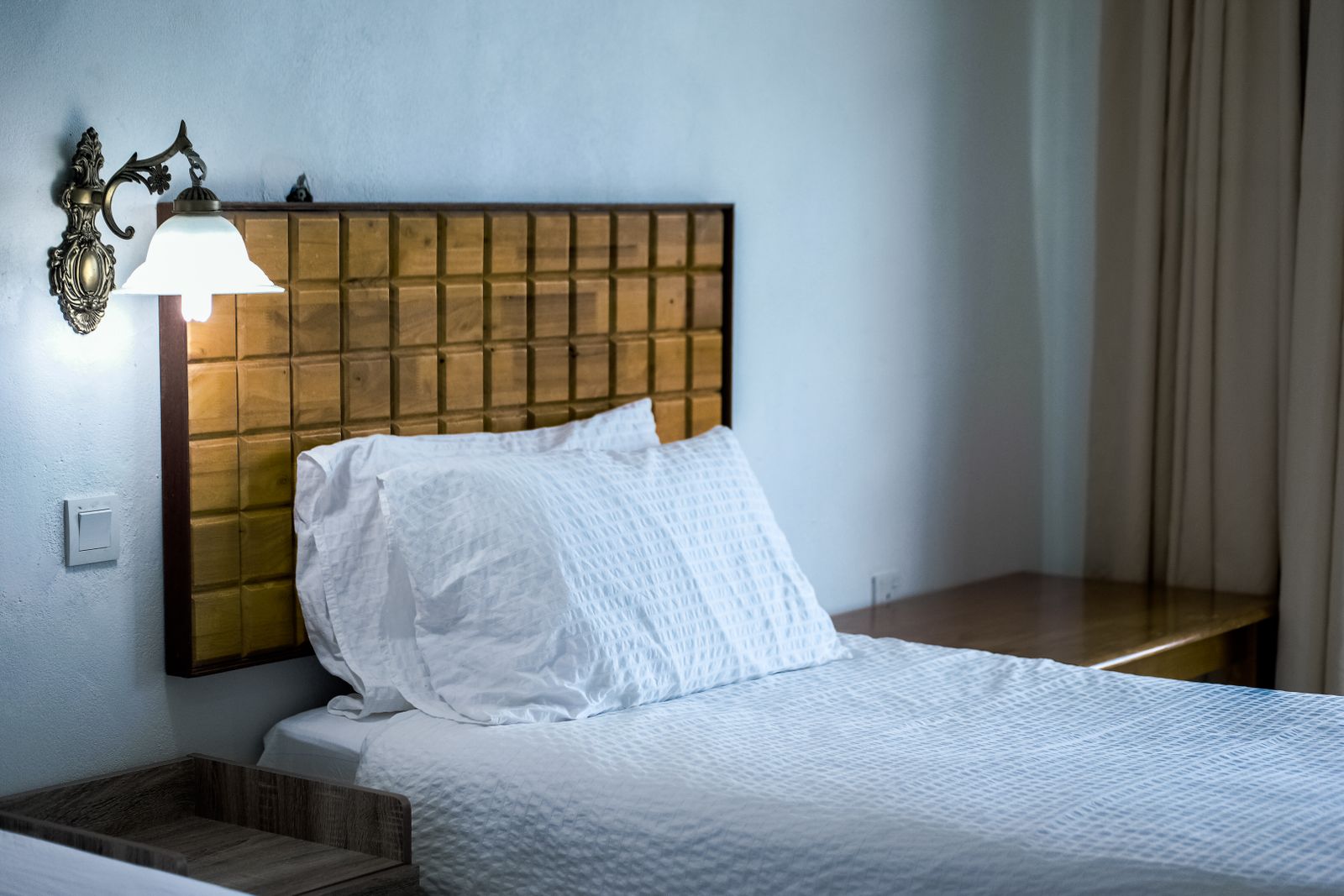
It is 2:17 a.m. in a hotel room on the fourteenth floor of a building you have never been in before. The air conditioning hums at a frequency that is almost musical. You have been awake for maybe four minutes, the way middle-aged people wake up now, briefly, for no clear reason, and you are waiting for the familiar tightening in the chest that usually accompanies these wakings at home. It does not come. You lie there and try to figure out why.
What you notice, eventually, is what is not in the room. There is no half-finished tax folder on a dining table. There is no laundry basket in the corner that has been there since Sunday. There is no stack of mail with at least two envelopes you have been avoiding for a month. The room contains a bed, a kettle, a window, and a stranger’s idea of art. Nothing in it is waiting for you to do something about it. You roll over and you are asleep again before you can finish the thought.
Most explanations for why people sleep better away from home point to the mattress, the thread count, the temperature of the room, or the heavy blackout curtains. Those things help. They are not the mechanism. The mechanism is cognitive, and it has a name in psychology that almost nobody connects to a Marriott on a Tuesday night.
The conventional wisdom misses the actual variable
The hotel industry has spent decades selling the idea that better sleep is an engineering problem. Memory foam, weighted duvets, sound machines, lavender turndown service. Sleep researchers have spent decades testing those variables and finding that environmental factors matter, but they explain only a fraction of the variance in how well a middle-aged adult sleeps in an unfamiliar room.
What explains more of it is what the brain is not doing. A 2025 systematic review in Scientific Reports looking at behavioural sleep programs for middle-aged adults found that the most effective interventions were not about changing the bedroom at all. They were about changing what the mind was carrying when the head hit the pillow. Goal setting, regulation of antecedents, shaping knowledge. The active ingredients were cognitive, not material.
Hotels accidentally do this work for you. You cannot see the dishwasher you forgot to run. You cannot see the email you have been drafting since March. You cannot see the corner of the garage that has needed sorting since your father died. The room is, in the most literal sense, mentally quiet.
The Zeigarnik effect, and why it gets louder around 47
The mind holds open loops with a strange persistence. Tasks that have been started but not finished get tagged for recall and continue to surface, unprompted, until they are either completed or formally closed.
Modern psychology has refined this into what is now widely called the Zeigarnik effect: unfinished tasks keep running in the background of conscious awareness, the way browser tabs keep draining a laptop’s memory. Each open loop costs attention. Each loop, fired off by an environmental cue, briefly reactivates the entire problem it represents.
By the late forties, the number of open loops a person is carrying tends to be at its lifetime peak.
Aging parents. Teenagers or adult children navigating launching. A mortgage. A career that is either climbing or plateauing and either possibility generates its own kind of work. A body that has started sending small unfamiliar signals. Friends getting divorced or sick. A house that has accumulated fifteen or twenty years of deferred decisions. The home is, by this point, a museum of unresolved items, and every surface is a cue.
What the bedroom is actually doing to a tired brain
Cognitive scientists describe sleep onset as a competition between two states. The brain is either busy thinking about something important, worry or problem solving, which is a signal to stay awake, or it is in a dreamlike state with drifting imagery, which is a signal that it is safe to descend. Luc Beaudoin, the Simon Fraser University cognitive scientist who developed cognitive shuffling as a sleep technique, has described this as two processes running in parallel: one keeps you up if the brain is engaged with something it deems important, the other lets you go if the mind looks more like a child’s daydream.
At home, the bedroom of a 47-year-old is not neutral terrain. The dresser has a drawer that does not close properly. The bedside table holds a book that has been bookmarked at page 84 since last September. The phone on the charger contains seventeen unread messages from a group chat about a parent who is declining. None of these things are emergencies. All of them are cues. The brain reads cues whether you ask it to or not.
This is the part nobody talks about. The bedroom is supposed to be the place where the mind powers down. For many middle-aged adults, it has become, instead, the densest concentration of unfinished business in the house.
Why this hits differently in middle age
Sleep architecture changes with age. Deep slow-wave sleep, the kind that does the heaviest physical and cognitive repair, tends to decline progressively from early adulthood onward, and REM sleep, which handles emotional processing and memory consolidation, becomes more fragile and easier to interrupt. A psychologist writing in Psychology Today on cognitive performance and sleep noted that even one night of restricted sleep, under six hours, measurably degrades sustained attention the next day. The margin for error narrows.
At the same time, the cognitive load of an average week is at or near a lifetime peak. Sleep quality and cognitive function in older adults are intimately connected, and midlife is the critical window in which sleep disturbances start to predict downstream cognitive outcomes decades later. Short sleep duration in midlife appears to increase dementia risk in late adulthood. So the brain that is hardest to put to sleep is also the one that most needs the sleep.
This is the trap. The decade when sleep matters most for long-term brain health is the decade when the mental inbox is fullest.
The hotel room as accidental cognitive intervention
A hotel room performs three quiet psychological functions that the home bedroom of a middle-aged adult almost never does.
First, it strips away environmental task cues. There is no laundry, no mail, no half-assembled bookshelf, no pile of receipts. The Zeigarnik effect needs cues to fire. Without them, the open loops stay quieter.
Second, it removes responsibility for the room itself. Someone else will clean the towels. Someone else will restock the coffee. The room is not a project. Home, by contrast, is a permanently unfinished project to which you are the sole contractor.
Third, it offers a temporary, sanctioned identity: traveller. The traveller does not have to fix anything tonight. The traveller is allowed to be a passenger in their own life for a few hours. This is not a small thing for an adult who has spent twenty-five years being the person other people depend on.
Put those three together and you have, in effect, a cognitive intervention dressed up as a Hampton Inn.
Why this matters more for some people than others
Not everyone sleeps better in hotels. The people who report this most strongly tend to be people who are also, in their daily lives, carrying high responsibility loads, who score high on conscientiousness, and who grew up in homes where they had to track the emotional or logistical state of the house in order to stay safe. As we’ve explored in writing about people who unconsciously read the energy of a room before they’ve fully walked into it, this kind of background scanning never really turns off. It just changes targets.
For these adults, home is not only full of task cues. It is full of emotional task cues. The unspoken tension with a teenager. The conversation with a partner that has been postponed for two weeks. The text from a sibling that needs a careful reply. The brain, trained early to keep watch, keeps watch.
A hotel removes the watchers. There is nothing in the room that needs your vigilance. This is why some people, on the second night of a work trip, cry in the shower for no apparent reason. The nervous system has finally, briefly, been allowed to put its hands down.
What this means for sleep at home
The reflexive advice is to make the bedroom more like a hotel room. Clear the surfaces. Hide the laundry. Buy nicer sheets. This is fine but partial. It addresses the visual cues without addressing the deeper architecture of unfinished business.
Beaudoin’s technique of cognitive shuffling, where you pick a random word, spell it out, and spend five to ten seconds imagining something that starts with each letter, works precisely because it occupies the bandwidth that would otherwise be used by problem-solving. The brain interprets dreamlike, drifting imagery as evidence that nothing important is happening and lets you go. He also points to the older, well-validated technique of constructive worrying: sitting down after dinner with a notebook, writing out the concerns, and devising provisional next steps. The point is not to solve the problems. The point is to formally close the loops for the night, so the Zeigarnik effect has less to chew on at 2 a.m.
Sleep medication, by contrast, is a poor substitute. Recent research on benzodiazepines and Z-drugs in older adults has shown that while these medications help people fall asleep, they alter sleep architecture in ways that reduce deep sleep and appear to disrupt memory consolidation. The drug knocks the brain unconscious without addressing the open loops, and the loops are still there in the morning, slightly fuzzier.
The deeper reason hotels work
There is one more piece to this, and it is the quietest. People in their late forties have often, by this point, become the keeper of other people’s narratives. The aging parent’s medical appointments. The adult child’s job search. The partner’s stress about work. They hold these stories not because anyone asked them to but because someone has to, and they were the one who happened to be paying attention.
A hotel room is one of the only places where none of those stories live. The room knows nothing about you. It has no expectation, no history, no half-completed conversation waiting to resume in the morning. For a few hours, you are not the person who is supposed to remember everything. You are just a body in a bed in a city you do not live in.
This is closer to what people mean when they say they slept like the dead at the airport hotel. It is not the mattress. It is the rare, structurally enforced experience of being briefly off-duty from one’s own life.
What to actually do about it
The honest answer is that you cannot turn your bedroom into a hotel room, because you live there, and the loops will always partially follow you home. What you can do is reduce the density of cues and formally close as many loops as possible before bed.
That looks less glamorous than blackout curtains. It looks like keeping the bedroom genuinely free of mail, paperwork, and project debris. It looks like a ten-minute brain dump on paper before bed, the constructive-worrying version, where every nagging item gets written down with one provisional next action so the brain trusts that it has been logged. It looks like a consistent wind-down that signals to the nervous system that vigilance is no longer required. And it looks like protecting, fiercely, the principle that the bedroom is not a workspace, a storage unit, or a control tower.
The reason a hotel feels like such a relief in middle age is not that the bed is better. It is that, for one night, you have outsourced the entire unfinished business of being a competent adult to someone you will never meet. The trick at home is not to replicate the room. It is to replicate the permission.