

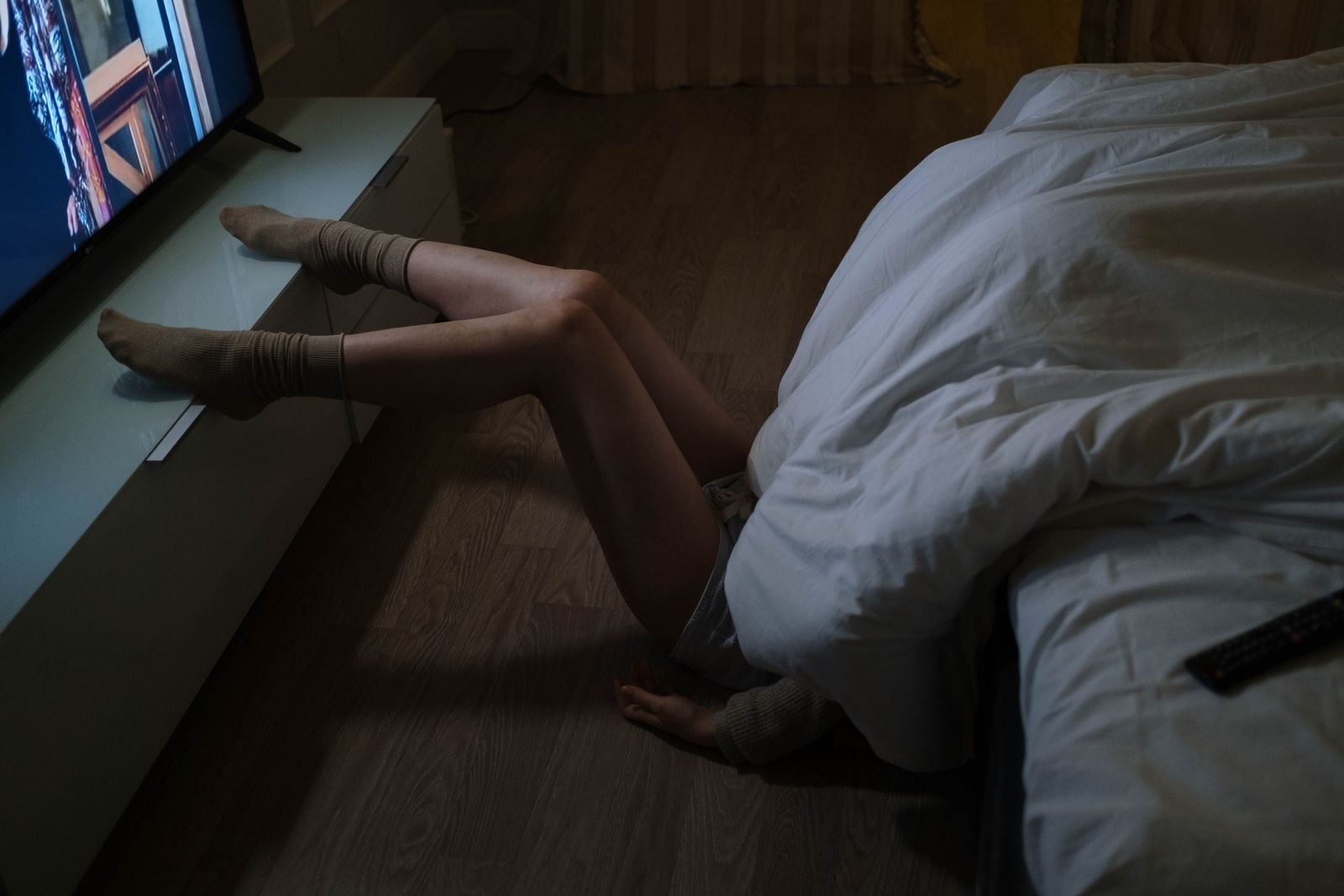
The blue glow of a late-night infomercial has put more people to sleep than melatonin ever will. In a 2022 National Sleep Foundation survey, roughly six in ten American adults said they regularly fall asleep with a screen on, and a substantial minority reported that they cannot reliably drift off without one. Sleep clinics report the same pattern in their intake forms. The behaviour cuts across age, income, and education.
What’s striking isn’t the prevalence. It’s who’s doing it. People with skincare routines, retirement accounts, blackout curtains. People who optimise everything else and still cannot fall asleep unless something is talking at them from across the room.
The habit is usually filed under bad sleep hygiene, with the standard advice to turn it off, charge your phone in another room, get a book. But the research on what background media actually does to the sleeping brain is less settled than the wellness industry pretends, and the habit itself is more interesting than the dismissal allows.
The habit is more common than people admit
Sleep clinicians have been writing about it for years. Writing in Psychology Today, Dennis Rosen, a pediatric pulmonologist and sleep specialist at Boston Children’s Hospital, noted that he has met many people who say they are unable to fall asleep unless there is a TV on in their bedroom.
The pattern isn’t confined to teenagers. It shows up in adults in their forties, fifties, sixties. Often professionally accomplished, often anxious, often unwilling to give the habit up.
The wellness orthodoxy treats this as a problem to be corrected. Light from the screen suppresses melatonin. The content is stimulating. The brain stays half-alert tracking dialogue. All true. And yet the people who do it keep doing it, and they report sleeping better with the TV on than without it. They’re not all wrong about themselves.
What the television is actually doing
Three things are happening simultaneously, and they don’t all pull in the same direction.
The first is sensory masking. A continuous low-level audio stream covers up the small unpredictable noises (a creaking floorboard, a neighbour’s door, a distant siren) that would otherwise jolt a light sleeper into alertness. The brain stops scanning for threats because there is already something familiar filling the auditory field.
The second is cognitive distraction. People who lie down in silence often find that the silence is immediately occupied by their own thinking. A familiar sitcom rerun gives the prefrontal cortex something low-stakes to chew on until it gives up and lets sleep happen.
The third is the part the habit’s defenders rarely acknowledge: once you’re actually asleep, the television is no longer helping. It is still flickering. It is still talking. And the sleeping brain is still processing it.

The pink noise problem
A study from the University of Pennsylvania Perelman School of Medicine, published in the journal Sleep, examined what continuous background sound actually does once a sleeper is unconscious. The research focused on pink noise, the broadband category that includes the soft static of rain machines, fan apps, and, functionally, the low ambient hum of a muted-but-running television. Lead author Mathias Basner and his team monitored 25 healthy adults across seven consecutive nights in a controlled sleep laboratory. They tested pink noise alone, aircraft noise alone, pink noise plus aircraft noise, and aircraft noise with earplugs. Pink noise at 50 decibels, about the volume of moderate rainfall, or a television playing softly in the next room, was associated with a nearly 19-minute decrease in REM sleep compared to nights with no noise at all. That’s not nothing. REM sleep is the stage where the brain consolidates memory, processes emotion, and regulates mood. Nineteen minutes a night, accumulated over years, is a significant deficit in the part of sleep that does the heaviest psychological work.
According to the study’s press release, Basner warned that pink noise and other broadband noise during sleep may be harmful because REM sleep plays a crucial role in memory consolidation, emotional regulation, and brain development. Especially for children whose brains are still developing and who spend more time in REM than adults do.
Why the habit forms in the first place
The pattern often traces back further than the bedroom. Many adults who sleep with the television on grew up in households where a television was always on somewhere. In the living room during dinner, in a parent’s bedroom at night, in the kitchen during homework. The sound of voices coming from another room was the sound of a household that was occupied, awake, watching out.
This is similar to what drives the habit of keeping the radio on in an empty house. The sound itself isn’t the point. The associations attached to the sound are the point.
For a child, silence at night could mean a parent was out, or asleep, or angry. Sound meant someone was up, available, and that the night was still safe. Decades later the nervous system still reads the equation the same way.
This is why the standard advice (just turn it off) fails so often. The behaviour isn’t about laziness. It’s a self-soothing strategy with deep roots.
The compounding cost
What makes the habit worth examining now is the slow accumulation. A single night with disrupted REM sleep is not a health crisis. A decade of nights is a different matter.
A 2025 paper in Nature Communications examined what the authors called the Unfavorable Sleep Profile, a combined accelerometer-derived metric capturing sleep timing, efficiency, duration, rhythmicity, and regularity, across 85,233 UK Biobank participants. The sleep profile was significantly associated with incident health outcomes spanning circulatory, metabolic, respiratory, mental, and neurological categories.
The American Heart Association has incorporated sleep health into its Life’s Essential 8 framework, a recognition that sleep is no longer optional infrastructure for cardiovascular health.
Here the comforting story about background noise breaks down. The masking function is real, and the childhood roots are real, but neither cancels the architecture cost. The nightly choice to fall asleep to background media is not neutral. It is a vote, repeated 365 times a year, for a sleep architecture that’s measurably less restorative. The nervous system may have learned to associate sound with safety, but the sleeping brain pays the bill regardless of what the conscious mind believes is happening.

What separates the habit from a sleep disorder
There is a meaningful difference between someone who occasionally drifts off during a documentary and someone who genuinely cannot fall asleep without external input. The second person is describing a form of conditioned dependency that sleep medicine takes seriously.
The brain learns that sleep onset requires a specific stimulus. Remove the stimulus, and the conditioned response fails. This is the same mechanism that makes some people unable to sleep in unfamiliar hotel rooms, except in this case the unfamiliar environment is silence.
The pattern is worth noticing in yourself. Falling asleep to the TV three nights a week as a wind-down ritual is one thing. Lying awake for an hour in panic when the cable goes out is another.
The contrast with readers
People who read before bed every night tend to show measurably different patterns of cognitive winding-down: slower heart rate, lower cortisol, fewer mid-sleep awakenings.
This isn’t a moral judgment about readers versus watchers. It’s a mechanical observation. A book has no backlight, no soundtrack, and crucially, it stops when you stop. A television keeps going whether you’re conscious or not.
The fundamental difference is that one medium ends when sleep begins, and the other doesn’t.
What actually helps, if you want to change it
The mistake most people make when trying to break the habit is going cold turkey. They turn the TV off, lie in the dark, panic at the silence, and reach for the remote within twenty minutes. The conditioning wins.
The more effective approach is to gradually decouple the stimulus from the sleep onset. A sleep timer set to 30 minutes is a reasonable starting point, long enough for sleep to happen, short enough that the TV isn’t running for eight hours. Over weeks, the timer shrinks.
Some people find that switching from television to an audio-only equivalent, a familiar podcast, an audiobook played at low volume, preserves the masking function without the light. It’s not perfect, but it removes one of the three problems.
And for a meaningful number of people, the answer is to address the underlying anxiety the habit is medicating, not the habit itself. If silence at night feels intolerable, the silence is doing something the television was covering up.
The honest version
The honest version is harder than the wellness version. Falling asleep with the television on is not a moral failure, but it is a cost, and the cost is not paid by the conscious self that finds the sound soothing. It is paid by the sleeping brain that loses nineteen minutes of REM a night, by the memory consolidation that doesn’t quite finish, by the emotional processing that gets clipped at the edges.
The habit found a real problem and produced a partial solution that quietly creates a second problem. That second problem compounds for as long as the habit lasts. Defending it as a legitimate nervous-system response is true, and beside the point. The nervous system is wrong about what keeps it safe at three in the morning, and the evidence for that is now hard to argue with.
The silence at midnight is loud because something in the day hasn’t let go. The television covers the sound of that without resolving it. Turning it off won’t be comfortable, and it shouldn’t be. The discomfort is information.
