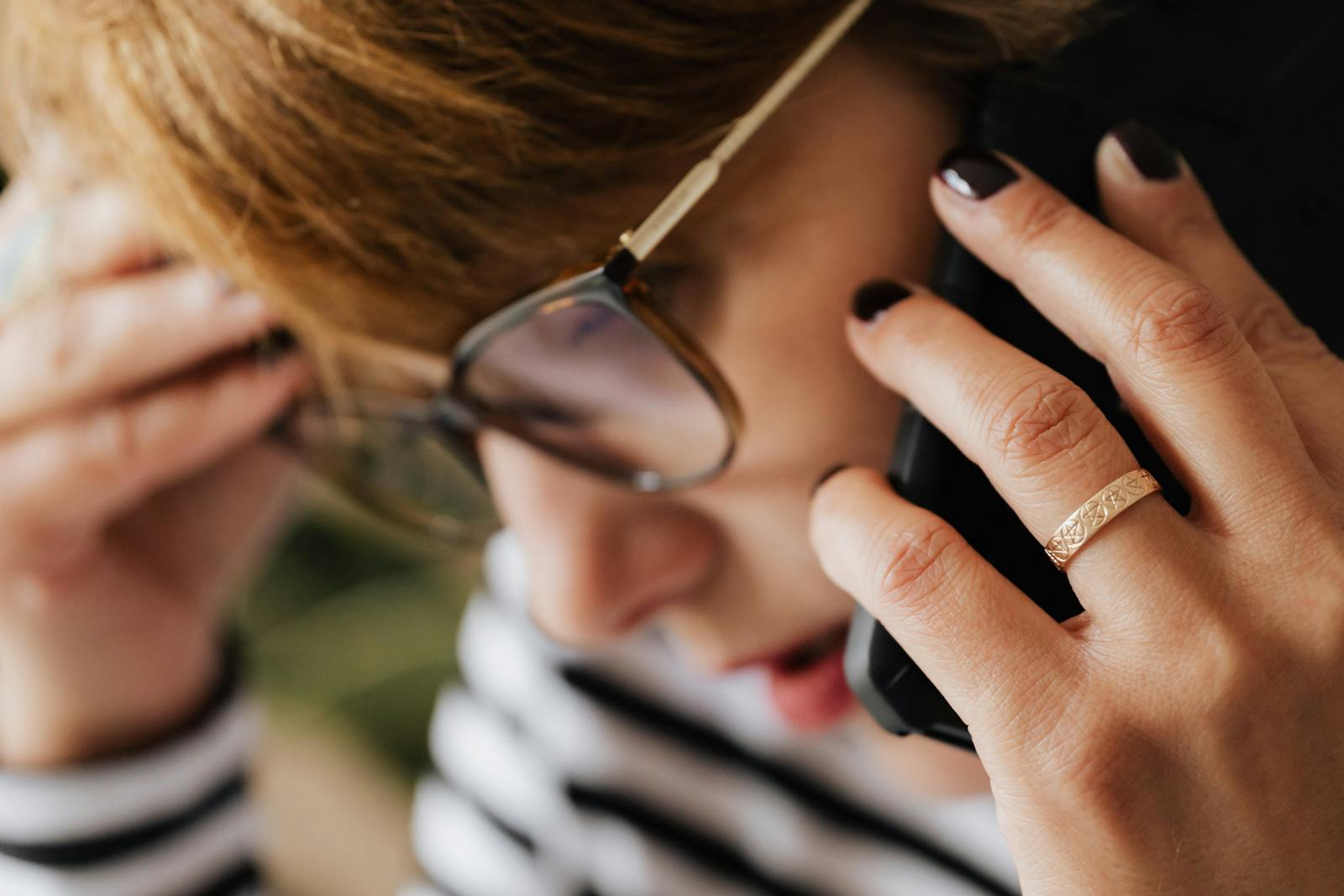
I noticed it in myself first. A friend was halfway through a story about her sister when my phone buzzed against the wood, and before I’d even registered the sound, my hand was already turning the screen down. Not silencing it. Not putting it away. Just flipping it, like closing a small door.

She kept talking. I kept listening, more easily than I had a minute earlier. And I remember thinking, briefly, that the gesture had nothing to do with her at all.

The face-down phone on a restaurant table is one of the most common small gestures of the smartphone era, and it tends to get read in only one way: as good manners. The person across from you is signalling that the screen will not pull focus, that the meal is sacred, that you have their attention. That reading is generous, and it is not wrong. But for a meaningful number of people, it is incomplete.

The polite story is the surface story

For some people, flipping the phone over is genuinely about etiquette. They learned somewhere along the way that screens at the table are rude, and they adjust accordingly. Nothing complicated.

For others, the gesture is doing more work than that. The face-down phone is a small barricade. It is the only way they can stop being on call for an evening without having to explain to anyone, including themselves, that they were ever on call to begin with.

The conventional wisdom says smartphones make people anxious because they are addictive. The deeper version is that smartphones make some people anxious because they were already conditioned, long before the device existed, to feel responsible for whoever happened to be reaching for them.

What being on call actually looks like

The pattern shows up early. It tends to be built in childhood, often in homes where an adult’s emotional state was unpredictable enough that children learned to monitor it, anticipate it, and respond to it before being asked. The instinct doesn’t go away when those children grow up. It just finds a new place to live.

By the time these children become adults with smartphones, the conditioning has somewhere convenient to land. The screen lights up. A name appears. The body tightens before the brain has decided whether the message is urgent. The reflex is already running.

Why the screen feels like an obligation

Writing in Psychology Today, the evolutionary psychologist Nigel Barber points out that animal research established something useful decades ago: unpleasant events become more upsetting when they are unpredictable or uncontrollable. Smartphones are engineered to deliver both qualities. You cannot predict when the next message arrives. You cannot control what it will say.

For a person without on-call conditioning, this is annoying but tolerable. For a person with it, the unpredictability hits an old groove. Each notification is a small test of whether they will rise to meet someone else’s need fast enough.

The face-up phone keeps that test live. The face-down phone, even briefly, switches it off.

The boundary that doesn’t have to be announced

What makes the gesture so quietly powerful is that it requires no negotiation. The person does not have to declare their unavailability for the next hour or defend the choice. They do not have to apologise for it. The phone is simply, physically, not looking at them.

For people raised to feel that needing space was a kind of selfishness, the face-down phone is one of the few small boundaries they can enforce without conflict. It looks like manners. It functions like a fence.

phone face down restaurant
Photo by Gera Cejas on Pexels

How the body learns to respond to a screen

The on-call response isn’t only psychological. It tends to show up physically too: shoulders rising, breath shortening, attention staying half-cocked toward the device even when the conversation is interesting. People who have lived with this for decades describe it as a feeling of never being fully off duty.

Flipping the phone over is the cheap, instant version of stepping off duty for a while. It tells the body, in a small physical signal, that nobody can summon them for the next forty minutes. Stand down.

What the research on phones at the table actually says

A 2025 study from the University of Portsmouth and the University of Surrey, published in PLOS One, surveyed 407 young adults aged 18 to 25 and found that loneliness and anxiety, rather than screen time itself, were the strongest mediating factors behind problematic smartphone and social media use. The lead researcher, Dr Anna-Stiina Wallinheimo, described a vicious cycle in which young people turn to phones to soothe emotional discomfort and the phones deepen the distress instead.

The point that often gets missed in coverage of that study: the people most prone to compulsive checking are not the ones with the most thrilling notifications. They are often the ones whose internal weather is already heavy, and who have learned to read the screen as a possible source of either rescue or threat.

The face-down phone interrupts both expectations at once. No rescue is coming. No threat is coming. The dinner is the dinner.

The phubbing research and the boundary reading

Most existing research on phones at the table looks at “phubbing”, the rudeness of phone-snubbing the person across from you. A Psychology Today analysis of the behaviour by Kyle D. Killian frames it primarily as a relational problem: phones at the table erode connection, intimacy, and the felt sense that the other person is fully present. Killian notes that simply setting the phone down face-up or face-down sends a clear signal: you’re important, and you have my attention.

That framing assumes the phone-down move is mostly about the other person at the table. The on-call lens flips it. The phone-down move can also be about the person doing it. It can be them giving themselves permission to not be reachable for the duration of one meal. The other person at the table benefits, but they are not always the only reason.

Who tends to do this

The face-down phone is often the move of someone who used to be the family fixer. The eldest daughter who took the calls when something went wrong. The friend who became the unpaid emotional support line in their twenties. The employee whose manager texts after 9pm and gets a reply within minutes.

It tends to be the same instinct, redirected. Being available feels safer than being needy. Being reachable feels safer than being absent.

For these people, the act of physically turning the phone over is small but quietly heretical. It says, briefly, that someone else’s need is not their job tonight.

dinner table conversation
Photo by Anna Shvets on Pexels

The difference between avoidance and a boundary

Not every face-down phone is a boundary. Some people flip the phone because they are avoiding a specific message they do not want to deal with. Some people do it out of social performance. Some people genuinely just don’t want a screen in their face during dinner. The boundary version has a tell. It is often accompanied by a small, often unconscious exhale, a lowering of the shoulders, a noticeable shift in how present the person can actually become once the screen is no longer demanding peripheral attention. That exhale is the body recognising it is briefly off duty. The person may not even know that’s what is happening. They will only know they feel a bit lighter, and the conversation is easier than it was a minute ago. It is a tiny piece of evidence, gathered in real time, that stepping out of the rotation does not make the sky fall.

Why this matters more in 2026 than it did five years ago

The cultural conversation has shifted. Gallup polling shows that nearly half of Americans, 49 percent, now report frequently experiencing stress, the highest figure in the trend to date and up sixteen points over the past two decades. Search interest in ways to step away from “always-on” living has grown alongside it.

The face-down phone is one of the smallest entry points into that shift. It does not require deleting an app, going off-grid, or buying a dumbphone. It costs nothing. It takes one second. And for someone whose nervous system was trained early to treat every incoming signal as their responsibility, that one second can be the difference between a meal they were present for and a meal they only half-attended.

The quiet politics of the gesture

What looks like etiquette is sometimes regulation. What looks like manners is sometimes a person teaching themselves, slowly, that they are allowed to step out of the on-call rotation for forty minutes without the world ending.

But there is something worth sitting with here, and it is not comfortable. Why does a boundary this small have to be smuggled in under the cover of good manners? What does it say about the people doing it, and the people they grew up around, that the only way to claim forty minutes of their own attention is to disguise it as a courtesy to someone else?

A boundary that needs camouflage is still a boundary. It is also a quiet indictment of every relationship that taught someone they could not have one out loud. The phone goes face-down. The world does not end. The question is why so many of us needed the cover story in the first place.

Feature image by Yan Krukau on Pexels