

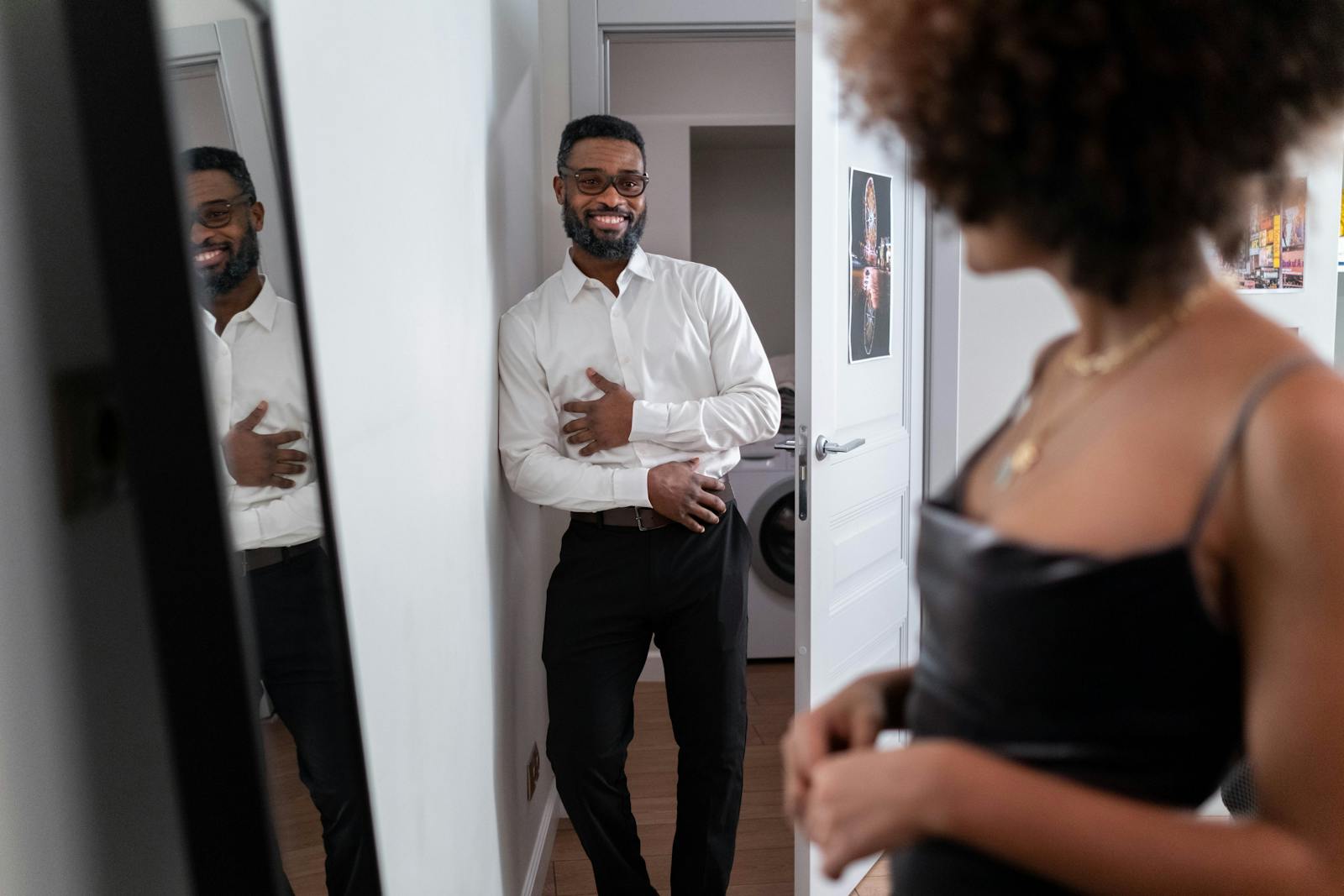
She is three steps inside the apartment, coat still on her arm, and her eyes have already done the math. The host’s husband is laughing a beat too loud at the kitchen island. One friend is standing closer to the window than usual. Someone she doesn’t recognize is checking their phone for the third time in a minute. By the time she says hello, she has decided which couch to head toward and which conversation to avoid.
She will tell you, later, that she is just observant. That is not what this is.
What she is doing is a survival skill she learned before she could spell the word survival. The room-scan. Most people assume the legacy of an unpredictable childhood is anxiety, the shaky hands, the racing thoughts, the catastrophizing. That framing misses the more common, more invisible inheritance.
The inheritance is environmental fluency. A near-instant ability to read affect, body language, and tonal shifts, refined over years of needing to know which version of a parent had just walked through the door.
The skill that gets mistaken for intuition
Adults who grew up in homes where moods rotated unpredictably often develop what looks, from the outside, like uncanny social intuition. They sense when a meeting is about to go sideways. They know which friend is upset before the friend knows. They pick up on the slight stiffness in a partner’s shoulders from across the kitchen.
Therapists call this hypervigilance, but the word can sound too clinical for what it actually feels like from the inside. From the inside, it just feels like being awake. Like everyone else is moving through the world with the volume turned down, and they have always had it turned up.
Researchers studying adverse childhood experiences have long observed that early exposure to unpredictable caregiving can leave the threat-detection system on a permanent low hum. The amygdala, which flags potential danger, becomes more reactive. The prefrontal cortex, which contextualizes that danger, takes longer to come online.
Translated: the body decides something is wrong before the mind has the words for it.
Why the room-scan starts at the door
Children in chaotic homes learn that the safest information arrives early. By the time a parent is yelling, the moment to adjust has already passed. The useful intel is in the seconds before, the slammed car door, the pause in the hallway, the particular cadence of footsteps on the stairs. So the nervous system learns to read the entry, and the threshold becomes the most important place in any room. A child who can predict the next ten minutes from the sound of a key in a lock buys themselves time, and time is what allows them to disappear into a bedroom, soften their voice, ready an excuse, or simply brace. The skill is rehearsed nightly. It is rehearsed at the dinner table when a glass is set down too hard. It is rehearsed in the car on the way home from school. It is rehearsed enough that, by adolescence, it is no longer a skill at all but a baseline mode of perception, indistinguishable from seeing.
Decades later, that same person walks into a dinner party and, without thinking, registers six small data points in the first four seconds: who made eye contact, who didn’t, whose drink is half-empty, whose phone is face-down, who is laughing slightly too loud, who is sitting slightly too still. None of this is conscious. It is the same scan, just running on different hardware.
It looks like anxiety, but often isn’t
This is where the popular framing falls apart. Anxiety, as a clinical category, involves disproportionate worry, intrusive thoughts, and physical symptoms that interfere with functioning. The room-scan, by contrast, is functional. Often alarmingly so.
A 2025 Yale study, covered by ScienceDaily, found that while childhood adversity raises the risk of anxiety disorders by roughly 40 percent, most people who experience early adversity do not develop them. What many of them develop instead is a heightened baseline sensitivity that, in the right environments, can look indistinguishable from emotional intelligence.
The same scanning that exhausts them at family gatherings makes them excellent therapists, nurses, mediators, hostage negotiators, and middle managers. They are the people who notice the new hire is drowning before HR does. They are the friend who texts you the day before you were going to text them.
This is not a pathology. It is an adaptation that outlived its original purpose.
The cost nobody talks about
The cost is that the scanner never turns off.
They cannot walk into a coffee shop without clocking the body language of the barista. They cannot have dinner with a partner without monitoring the rhythm of the partner’s breathing for a sign that something is about to shift. They cannot sit in a meeting without tracking which colleague seems coiled and which seems checked out.
Psychology Today’s analysis of how childhood trauma shapes the inner world describes this kind of pattern as a constant external focus, with the mind doing perimeter work that the body cannot recover from.
Sleep gets thinner. Headaches arrive at the back of the skull around 4 p.m. Crowded rooms become quietly draining in a way that is difficult to explain to people who do not experience them that way.
And there is a relational cost too. Reading a partner’s mood with surgical accuracy can feel like care, but it can also bypass the thing that actually builds intimacy: asking. The room-scan can become, in some ways, a defense against having to ask. A person who can decode someone before they speak never has to find out what happens when they don’t.
The scan and the social cue overload
What makes this pattern slippery to talk about is that environmental scanning is not unique to people from chaotic homes. Everyone reads rooms, to some degree. The difference is volume and cost.
People shaped by unpredictable households often describe social environments as overwhelming, not because they cannot read the cues, but because they cannot stop reading them. The bandwidth is occupied. There is no ambient mode.
Other small tells
The doorway scan is the headline behavior, but it travels with smaller companions:
The chair selection. They sit with their back to the wall and their face to the door. Always. They will rearrange themselves at a restaurant if they end up in the wrong seat. It is not preference. It is muscle memory.
The mood-matching. They calibrate their energy to the most volatile person in the room within minutes. If someone is irritable, they go quiet. If someone is performatively cheerful, they meet it. They learned that mismatched energy used to be punished.
The pre-emptive apology. They apologize before there is anything to apologize for, often as a way of taking up less space in case the room turns. The body is trying to defuse a situation that has not happened yet.
The post-event audit. Hours after a social interaction, they replay it. What did that pause mean. Why did she laugh like that. Was he annoyed. They are trying to confirm that the read they did in real time was correct.
The audit is the scan, retroactive. It rarely produces useful information. It almost always produces tiredness.
The room-scan is not the problem
Here is the part that gets missed in most discussions of early adversity: the skill itself is not broken. Reading rooms quickly is genuinely useful. It makes people kinder, more responsive, more attuned. The problem is not the perception. The problem is the inability to tell the perception to stand down when the room is, in fact, safe.
Healing, in the context of adverse early experiences, is less about deleting the scanner than about giving the scanner an off-switch. About teaching the nervous system that not every silence in a room is a precursor to something. That sometimes a partner is just tired. That sometimes a colleague is just thinking. That sometimes a parent is just chewing.
People who do this work, often with trauma-informed therapists, often describe it not as becoming less perceptive but as becoming more selective about what their perception is for. The skill stays. The cost goes down.
What this looks like in adult life
Once the pattern is visible, it shows up everywhere. The friend who reads the group’s mood and adjusts the joke before it lands wrong. The colleague who senses the boss is about to fire someone three weeks before HR knows. The partner who can tell, from the rhythm of footsteps in the hallway, whether the day was good or bad.
It also shows up in quieter places. The person who can absorb the social temperature long enough to find the real question underneath someone’s rude one is, frequently, someone who learned early that escalation costs more than absorption.
It also helps explain a related observation, that the loneliest people are sometimes the ones surrounded by family who never asked who they actually became. People who scan rooms for a living are very good at knowing what others need. They are often very bad at being asked, and being known.
What can shift
Naming it tends to come first. Most people who do the room-scan have never described it out loud. They assume everyone does it. When they realize not everyone does, something releases.
Body-based therapies, including EMDR and somatic work, are aimed precisely at recalibrating the threat-detection system. The point is not to teach the body that the world is safe. The point is to teach the body that this room, right now, can be evaluated on its own terms, not against a thirty-year-old hallway.
Whether any of that fully works is harder to say. Some people describe the scan getting quieter over years of practice. Others describe it going underground, becoming less visible to them but not less active. Others describe a kind of bargain, in which the skill stays sharp and the exhaustion stays steady, and they get better at choosing which rooms are worth entering at all.
It is tempting to call the scan a gift. It is also tempting to call it a wound. Most days, for most people who carry it, it is probably both, and probably neither, and probably something that resists being summarized at all. The door opens. The eyes move. The body decides. Whatever the work is, it happens somewhere inside that sequence, in a place that is difficult to reach and harder still to describe.
Feature image by cottonbro studio on Pexels
