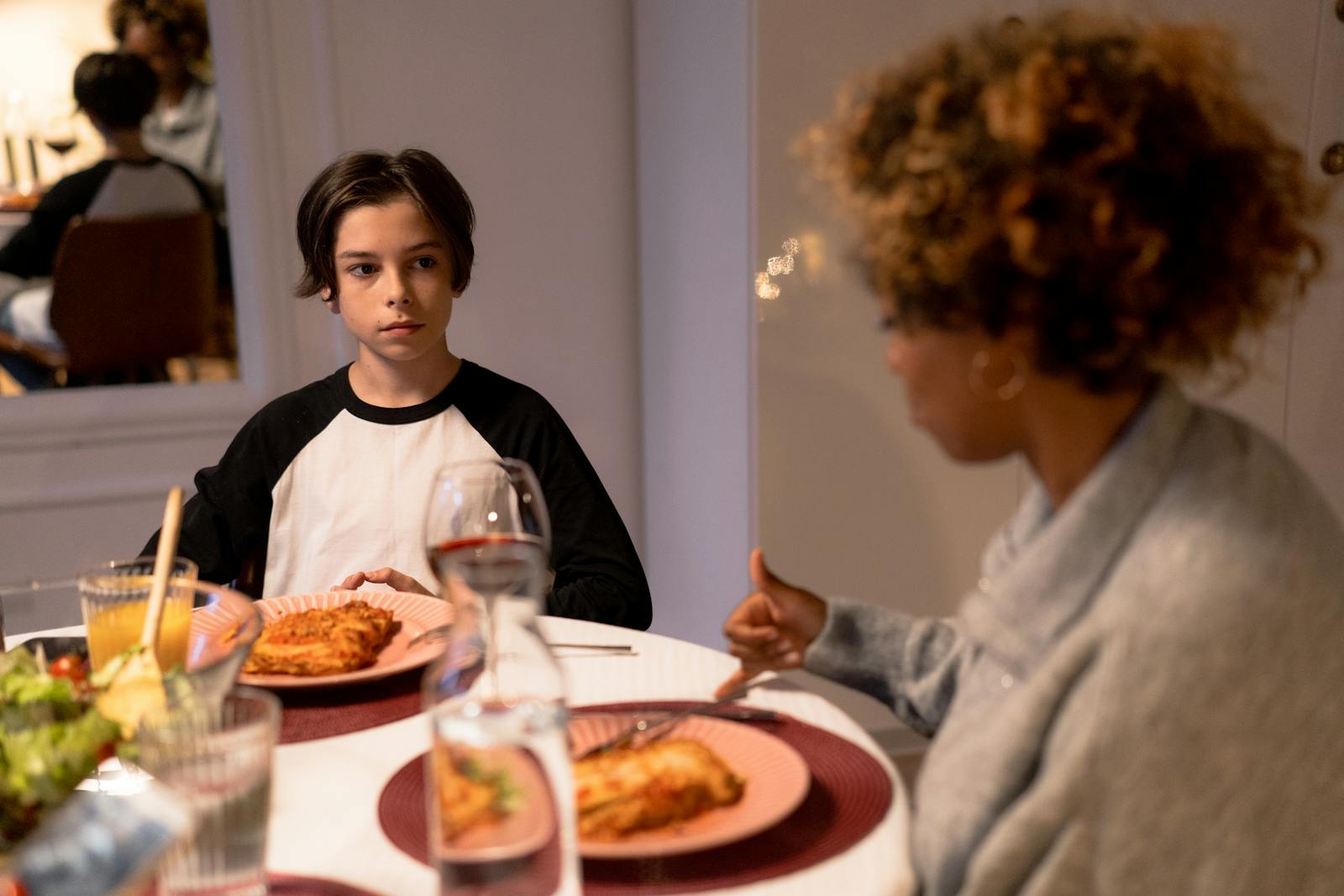
The table goes quiet at minute forty of the dinner. Someone’s joke didn’t land, someone else checked their phone, and now there are six adults staring at their wine glasses. Five of them start to fidget. One does not. Her hands stay where they were. Her shoulders don’t rise. She isn’t smiling and she isn’t frowning. She is simply there, waiting, the way a person waits for a bus that will eventually come.
Around the fifteen-second mark, someone cracks and tells a story about their commute. The pause ends. Everyone exhales. The woman who didn’t move picks up her glass and takes a sip, and across the table you decide, without quite deciding, that she is the most composed person in the room.
That reading is not always wrong. It is also not always right.
For some people, the ability to sit through a long silence without flinching was learned in a house where silences were not neutral. They were a forecast. A warning. The thirty seconds before something happened. And the child who lived through enough of those silences often figured out that filling them with chatter, questions, or apologies only ever sped up whatever was coming.
The conventional read can get it backwards
Self-help culture treats comfort with silence as a marker of high self-esteem. The confident communicator, the executive coaching cliché, the meditation-app calm. Stay quiet, hold the room, watch others reveal themselves first.
That framing is sometimes accurate. It is also sometimes a flattering mistranslation of a survival strategy.
Some people sit through silence because they have nothing to prove. Others sit through it because, very early, they learned to treat speaking during a tense pause as the riskier move. Both look identical from the outside. They are not always the same thing on the inside.
What dangerous silence can teach a child
In homes where moods rotate unpredictably, silence is rarely just an absence of words. It is a pressure system. A parent stewing at the dinner table. A stepfather staring at the television without blinking. A mother who has stopped responding to questions an hour ago and whose face has gone somewhere the child cannot follow. Children in those rooms learn fast. They learn that asking are you okay tends to make things worse. They learn that nervous laughter draws attention. They learn that the safest thing to do, often, is to become very still and very quiet and wait for the weather to pass. The strategy is not chosen so much as discovered, the way a small animal discovers which branches will hold its weight.
Researchers studying adverse childhood experiences have documented how this kind of environment can reshape the stress response itself. According to WebMD’s overview of ACEs, chronic exposure to unsafe family dynamics can change how the brain develops, with lasting effects on how a person manages emotion, reads threat, and builds relationships.
The child does not know any of this is happening. The child only knows that one strategy works and the others do not.
Watchfulness dressed up as poise
Adults who grew up reading rooms before they entered them tend to carry that scanning into every conversation. A pause is not just a pause. It is data. Whose breathing changed. Whose jaw tightened. Who looked at the floor.
A Rutgers study published in the Journal of Psychiatric Research in 2025 found that adverse childhood experiences raise adult threat sensitivity in measurable ways. Lead author Sultan Altikriti, a postdoctoral fellow at the New Jersey Gun Violence Research Center, told reporters that hypervigilance and sensitivity to threats can cause people to perceive danger where none exists, which in turn can lead to overreactions in neutral or ambiguous situations.
That research was looking at defensive gun use. The mechanism, though, generalises. The same threat-detection system that sees a weapon-relevant cue in an ambiguous encounter is also the system that turns a friendly dinner-party silence into a small interior alarm.
The person stays still. They look composed. Inside, they are running a full perimeter check.
Why filling the silence felt worse than enduring it
For a child in a tense house, the math is brutal and quick. Speaking up when an adult is simmering invites the adult’s attention. Attention is what the child is trying to avoid. Therefore: do not speak.
Psychology Today has covered the way children make sense of conflict in their homes by absorbing responsibility for it. If they made things worse by speaking, they often conclude they were the problem. The next logical step is to stop speaking. Not just in the heated moment, but as a general policy. The quiet child becomes the quiet teenager becomes the adult who is praised for their composure.
That praise is real. The composure is also real. The origin story is not always what people assume.
The body remembers what the mind has reframed
One of the strange things about this pattern is that the adult version often does not feel anxious. They have practiced the stillness so long that it feels native. They are genuinely not panicking when the table goes quiet at a work dinner. They have, by adulthood, made peace with the pause.
What they may notice instead is fatigue. A sudden flatness after social events that other people describe as energising. A reluctance to host. A preference for one-on-one conversations where the variables are smaller.
Psychology Today has also written about how childhood trauma resurfaces in adult contexts people would not predict. Parenting is the obvious one. Conversation is a quieter one. The body keeps the original training even after the mind has redecorated the meaning.
How to tell the two kinds of silence-tolerant people apart
The socially confident person who does not rush to fill silence tends to be relaxed in their posture. They might be looking around with curiosity. They will often be the first to break the silence themselves, but only when they have something they actually want to say.
The other kind looks similar at a glance. The differences are in the details. They tend to track faces more than the room. Their breathing is shallow rather than deep. They will often wait for someone else to break the silence first, and the relief on their face when that happens is brief but visible.
Ask either of them about it later. The first will shrug. The second will sometimes have a story they have never quite told anyone, because they did not know it counted.
The wider pattern this fits into
Comfort with dangerous silence is, for some, part of a larger set of behaviours that get coded as maturity but were originally adaptations. The 1990s kids whose resilience was really just the absence of anyone checking on them. The adults who keep volunteering for airport runs and holiday logistics because being useful is the only role that lets them feel they are not imposing.
These are different costumes for the same outfit. A child found one strategy that reduced harm. The strategy stuck. The adult is now praised for the strategy by people who do not know what it cost to develop.
The role of family roles
Dr Steven Szykula, writing in a column on family role patterns, describes how every family develops its own emotional ecosystem and how children take on roles within that system to help it function and to secure their place in it. The Mediator. The Caretaker. The Invisible One. The Calm One.
The Calm One is often the child who learned that silence was the safest contribution. They become the adult others describe as so easy to be around. They are easy to be around in part because they have spent twenty or thirty years training themselves not to need anything from the room.
That ease is a real gift to other people. It is also a quiet tax on the person providing it, and the tax has been collecting interest for decades.
What changes when someone realises this about themselves
The first thing that usually changes is not the silence itself. It is the meaning attached to it.
Sitting through a pause used to feel like a personality trait. Now it feels more like a learned response. That distinction sounds small. It is not small. A personality trait does not need explaining. A learned response can be examined, kept where it is useful, retired where it is not.
Some people decide they want to speak more in pauses. Not to fill them, but to test whether anything bad still happens. Usually nothing does. The room they are in now is not the room they grew up in. The adults around them are not the adults they were once afraid of. The silence they are sitting through is, increasingly, just silence.
The kindness of not commenting
If you are the friend, partner, or colleague of someone who handles silence with unusual ease, the most useful thing you can do is probably not point it out. Praising the trait can quietly reinforce the original deal: that being quiet is what makes you welcome.
What helps more is asking actual questions. Not are you okay, which is the question their childhood may have taught them to deflect, but specific, low-stakes ones that invite real answers. What did you think of that meeting. What would you have said if you’d jumped in. What’s the thing you almost mentioned.
Some people will answer immediately. Some will need a week. The week is not avoidance. It is a feature of how they were taught to process anything emotionally relevant.
Silence is not the enemy. Mistaking it for confidence sometimes is.
So here is the question worth sitting with the next time you find yourself admiring someone’s composure across a long pause. What exactly are you praising. The poise, or the fact that they are not making the moment harder for you. The confidence, or the convenience of someone who has been trained, somewhere you cannot see, not to take up space.
The person who sits calmly through silence may be at peace. They may also be a child who learned that disappearing into the quiet was the only safe move, still doing it in rooms that no longer require it, still being rewarded for it by people who never thought to ask. Comfort with silence is one of the easiest traits to compliment and one of the hardest to read correctly.
It is worth reading more carefully before reaching for the compliment.
Feature image by cottonbro studio on Pexels