

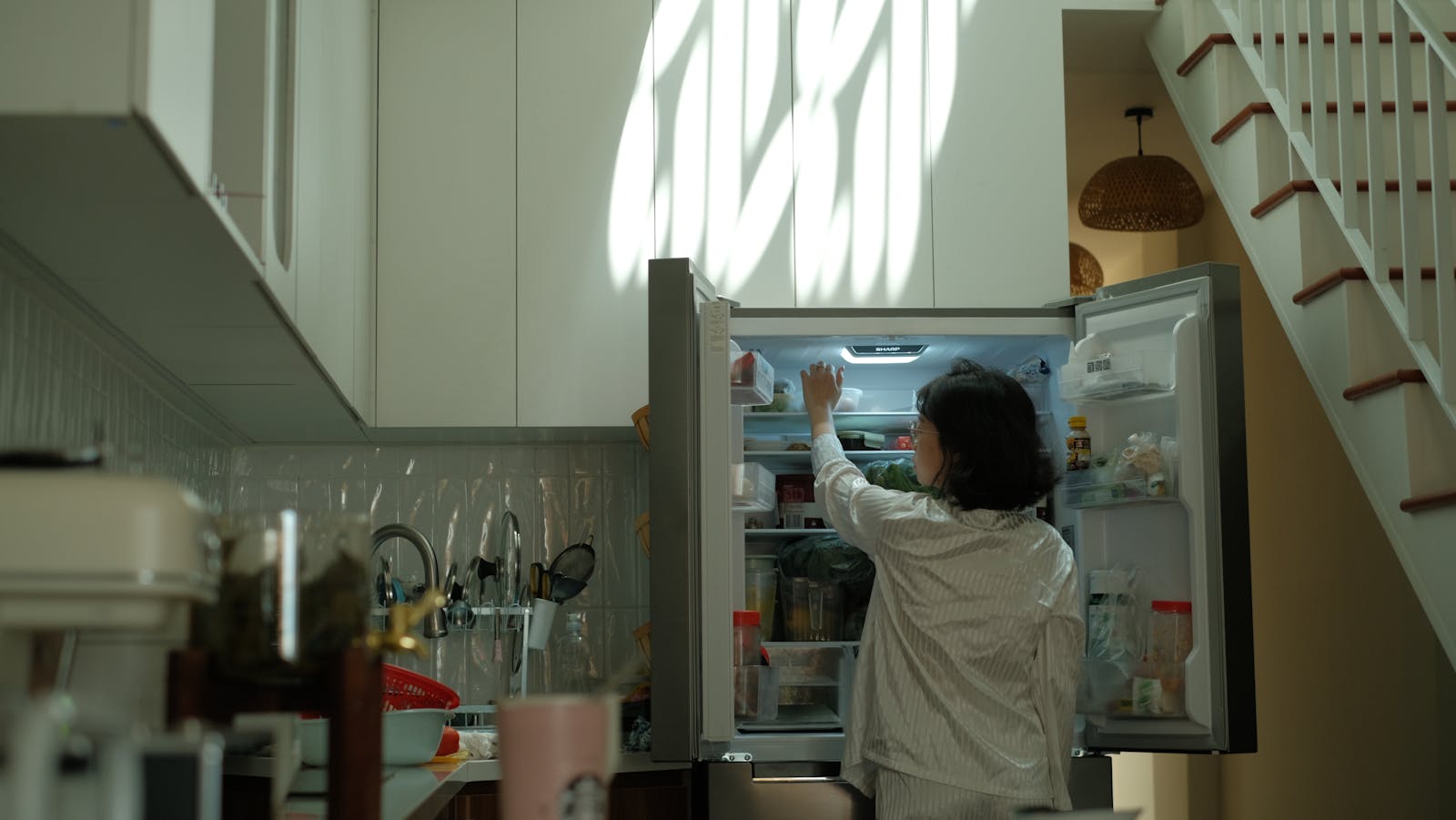
An empty fridge looks like restraint. It can also be the residue of a childhood where the contents of a fridge were never neutral.
The minimalist aesthetic gets the credit. The nervous system did the work.
The fridge as evidence
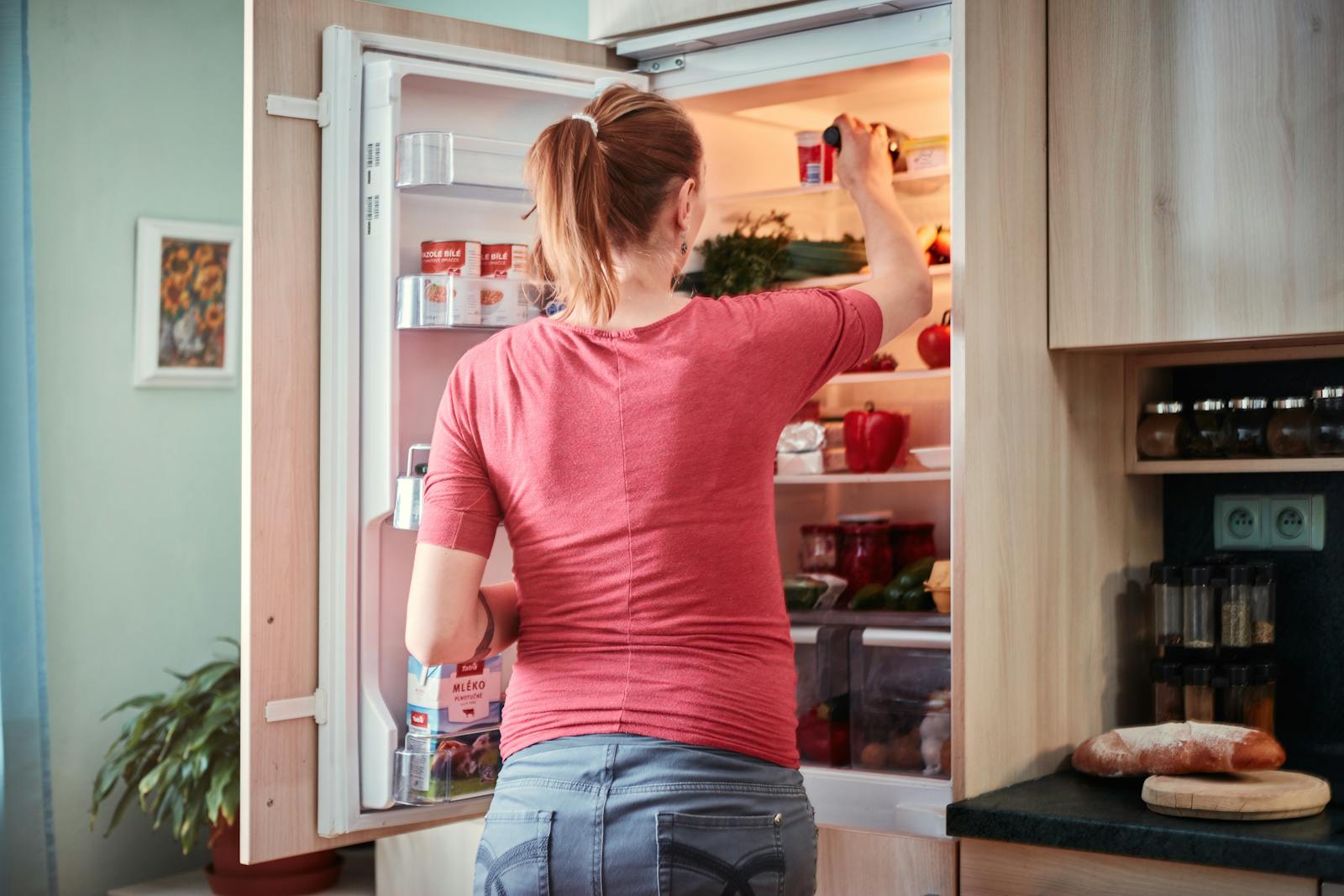
For some adults, opening a refrigerator is an ordinary act. For others, it’s a room that used to be searched.
A parent who counted the leftovers. A stepparent who asked why the milk was finished. A sibling who reported back. A household where food was rationed, hidden, or used as currency in a fight that had nothing to do with hunger.
The child in that house learned something the minimalism blogs never mention: a full fridge is a paper trail. It tells a story about who ate what, when, and whether they had permission. The behaviour that follows is not aesthetic. It is inventory control, transplanted from a household where inventory was the unit of conflict.
Years later, the adult version of that child keeps the shelves nearly bare. Two condiments. A carton of eggs. Maybe a single takeout container. They will tell you they just don’t like waste. They are not lying. They are also not telling the whole truth.
What the research actually says about food and childhood
The clinical literature on food insecurity has expanded sharply over the last decade, and it points in a direction most lifestyle writing avoids. Early scarcity, surveillance, and instability around food do not just affect what people eat. They affect how people relate to food as an object in the world — as inventory, as risk, as something that can be counted against you.
A 2025 review in Psychology Today summarising work by Lam and colleagues in JAMA Cardiology found that children who experienced food insecurity carried measurable cardiovascular and psychological signatures into young adulthood, even after their material circumstances improved. The body kept the ledger.
Research has linked household food insecurity to mental health problems in mothers and children at the same time, suggesting that the emotional climate around feeding is rarely separable from feeding itself. The kitchen is never just a kitchen.
And a 2024 paper by Smith, Kassa and Wesselbaum in Global Food Security, also referenced in the Psychology Today review, made a finding that explains a lot of adult behaviour: food insecurity erodes trust. Not just trust in institutions. Trust in the people who were supposed to provide.
Surveillance, not scarcity
Not every empty-fridge adult grew up poor. That is the part the conversation keeps missing.
Some grew up in houses where there was plenty of food and not enough privacy. A parent who policed weight. A relative who treated snacking as a moral failing. A household where the fridge door triggered a comment every single time it opened.
Building on the adverse childhood experiences framework, patterns of emotional abuse and neglect around food become visible. In some households, parents count granola bars or monitor food consumption in ways that create lasting patterns of anxiety around ordinary appetites. The mechanism is the same whether the scarcity is material or imposed: a child learns that ordinary appetites are watched, ranked, and held against them. The system that adapts is not the palate. It is the procurement instinct.
The body adapts. As an adult, the safest fridge is one with nothing in it to inspect.
The brain keeps the receipt
There is now neurological evidence that early food environments leave durable marks. A 2026 study from University College Cork’s APC Microbiome research centre, published in Nature Communications, found that early exposure to calorie-dense, nutrient-poor diets produced persistent changes in the hypothalamus, the brain region that governs appetite and energy balance. The changes outlasted the diet itself.
According to the study’s first author, Dr. Cristina Cuesta-Martí, early dietary patterns may affect feeding behavior long-term in ways not immediately visible through weight measurements alone.
The study was about mice and junk food, not about emotionally controlling parents. But the principle generalises. What happens around food in childhood is encoded in systems that have nothing to do with conscious memory. The hypothalamus does not care whether the chaos came from poverty or surveillance. It registers chaos.
Why the minimalism story is so attractive
Calling an empty fridge minimalist is a reframe, and reframes are useful. They let an adult take an old survival behaviour and present it as a deliberate aesthetic choice. The behaviour gets to stay. The shame goes away.
A 2024 Psychology Today essay on minimalism argued that voluntary simplicity, when chosen freely, can improve relationships and mental clarity. That is true. The harder question is whether the simplicity was actually chosen.
Chosen minimalism feels like spaciousness. Inherited minimalism feels like vigilance. The first one rests. The second one scans.
One way to tell them apart: ask what happens when someone fills the fridge as a gift. The voluntary minimalist feels mildly inconvenienced. The other person feels something closer to dread.
The same pattern, in different rooms
The empty fridge rarely sits alone. It usually has cousins.
There is the adult who never lets a drawer get full because a full drawer might be searched. There is the one who deletes text messages compulsively. There is the one who keeps the car immaculate because, as a child, the car was a place that got inspected.
The through-line is not minimalism. It is reduced surface area for control.
What “weaponised” actually looked like
The word weaponised does heavy lifting here, so it is worth being specific about what it tends to mean in these households.
It means a parent who used food access as a reward and a punishment. It means a fridge that was locked, or had items marked, or was unofficially divided into territory. It means the comment that followed every meal. It means the older sibling who reported on what the younger one ate. It means being told, sometimes for years, that you had eaten too much, or the wrong thing, or food that wasn’t yours.
The webMD overview of ACEs notes that chronic stress in childhood can become toxic, altering how the brain develops and how the body responds to ordinary stimuli later in life. The fridge becomes one of those stimuli. Opening it produces a small jolt the person no longer connects to its origin.
Why scarcity and surveillance produce similar adults
It might seem strange that growing up without enough food and growing up with surveilled food produce overlapping behaviours. They do, because the underlying lesson is the same: what is in this fridge is not neutral, and your relationship to it can be used against you.
Research from Northwestern University on SNAP and cardiovascular health found that food-insecure children who received nutritional support had significantly better long-term health than food-insecure children who did not. The protective factor was not just calories. It was predictability. The same logic applies in reverse to surveilled households: it was not the food that did the damage, it was the unpredictability of how the food would be used.
Adults from both backgrounds often arrive at the same coping strategy. Keep the shelves minimal. Reduce the evidence. Reduce the variables.
The cost of the empty fridge
There is a real cost to living this way, and it is not nutritional. People who keep their homes provisioned at a near-zero baseline tend to eat out more, spend more on small frequent purchases, and structure their days around small food errands that a fuller fridge would eliminate. The strategy that once protected the child taxes the adult — in money, in time, in the cognitive load of running a household on a just-in-time supply chain that was designed for a war that ended decades ago. Partners notice. Guests notice. The empty fridge sends a signal the person did not mean to send: that this is not quite a home where someone settles in. Settling in requires the assumption that the food you bought yesterday will still belong to you tomorrow. That assumption was the thing the original household refused to grant, and the adult has been operating without it ever since.
Recent work from Mass General Brigham on food insecurity and pediatric long COVID adds another wrinkle: the social conditions surrounding food appear to influence inflammatory and immune outcomes in ways researchers are still mapping. The body is keeping a finer-grained record than the conscious mind ever asked it to keep.
How the pattern actually changes
The pattern does not change by force. Filling a fridge to prove a point usually backfires, because the underlying nervous system is not in a debate. It is in a posture.
What tends to help is much smaller. Buying one extra item that is genuinely yours. Letting it sit there for a week. Noticing that nobody comments. Noticing that nobody counts it. Noticing that the shelf survived a guest.
The adult is, in effect, running an experiment the child was never allowed to run: what happens if the fridge contains evidence and no one weaponises it?
Most of the time, nothing happens. That is the finding. That is also, eventually, the relief.
A different word for the same shelf
There is a tidy version of this argument that ends by saying every preference is valid — that some people just like shopping daily, living light, keeping little on hand, and that is fine. It is not quite fine. A preference that costs you money, time, and the texture of a settled home is not a preference. It is a tax, and the person paying it usually does not know they are the one being charged.
So the question is not whether the fridge should be full. The question is whether the word preference is doing honest work, or whether it is covering for a nine-year-old who is still running the household budget. Those two look identical from the outside. They produce very different lives from the inside.
Before calling it minimalism, it is worth asking what would happen if the shelves were full and no one was watching. If the answer is nothing, the preference is real. If the answer is a small private flinch, the preference belongs to someone who is no longer in the room — and has not been for a long time.
