

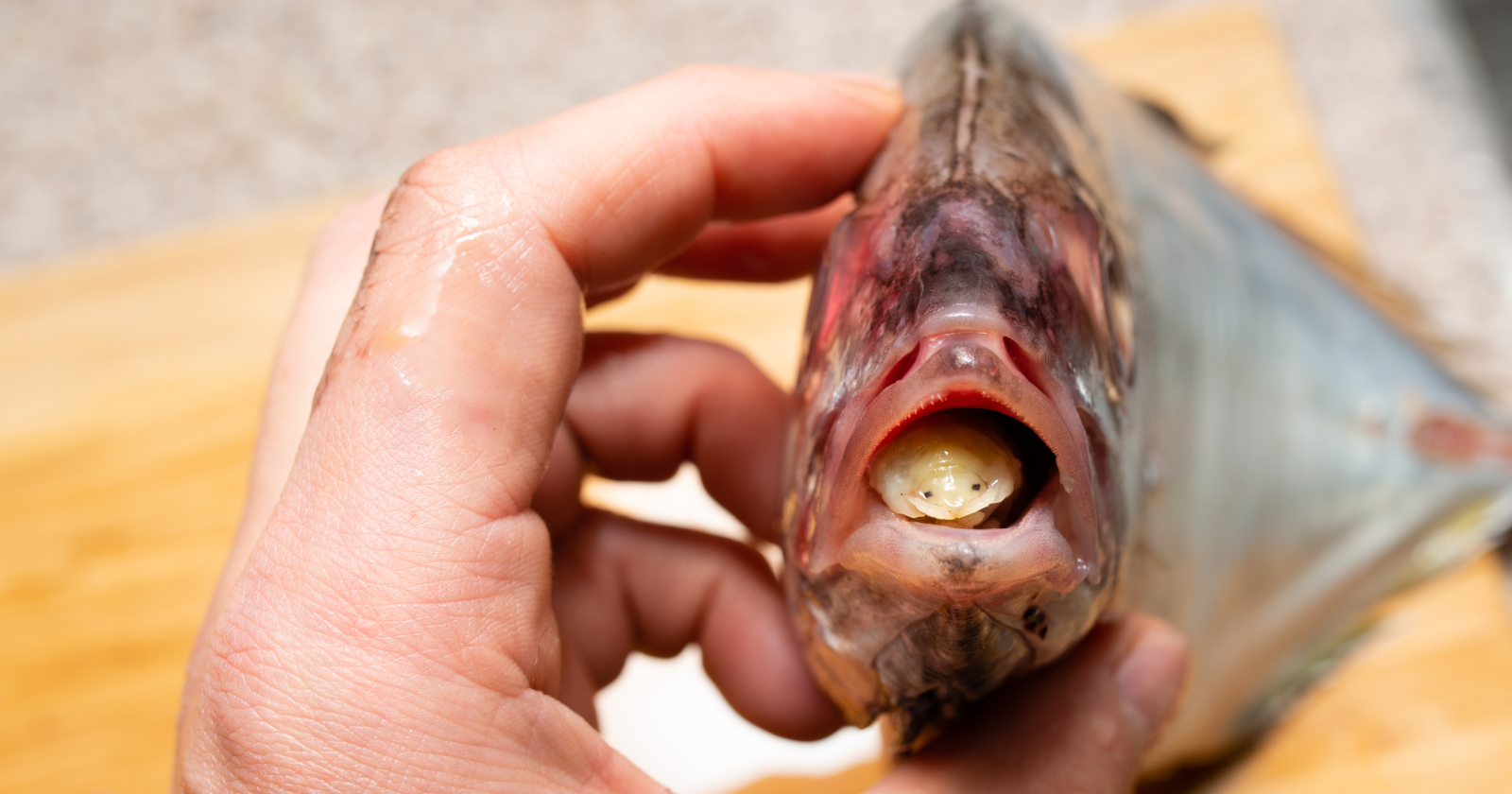
The photograph looks almost staged. A Cape seabream faces the camera with its mouth open. Inside, a pale, segmented crustacean sits where a tongue should be, its dark eyes pointed towards the lens.
Nico Smit took the image during doctoral fieldwork on the South African coast. It was not a planned scientific portrait. He had a small digital camera with him, opened the fish’s mouth, saw the parasite sitting inside, and took the picture without thinking about lighting, composition, or what would happen next.
What happened next was unusual. The photograph travelled across the internet before the parasite had a scientific name. By the time it became known as Ceratothoa famosa, its sudden fame had become part of the naming story.
The photograph came before the name
Smit is now a professor of ecology at North-West University in South Africa, where his work focuses on the biodiversity, taxonomy, and ecology of aquatic parasites.
In a 2023 interview with WBUR’s On Point, he recalled that the camera he carried during the encounter was a recent purchase. He had not been convinced that a small digital camera could produce better photographs than the equipment he normally used, but he did not want to take his larger camera down onto the coastal rocks.
When his university department later needed photographs for its website, Smit suggested the image. He also shared it on social media. The picture spread far beyond the department, appearing repeatedly in stories and posts about the disturbing group of parasites commonly called tongue biters.
By 2023, Smit described it as one of the most frequently used photographs for illustrating tongue-replacement behaviour. A casual field photograph had become the public face of an animal that had not even possessed a formal name when the picture began circulating.
Scientific images normally arrive with context already attached: a species name, collection location, host record, and published description. This photograph travelled in the opposite direction. Millions of people could recognise the scene before most knew precisely which animal they were seeing.
The parasite was Ceratothoa famosa, not Cymothoa exigua
That identification matters. A University of Duisburg-Essen page identifies the animal in Smit’s photograph as Ceratothoa famosa inside the mouth of a Cape seabream, Diplodus capensis.
It was not Cymothoa exigua, the better-known species whose name has become closely associated with tongue-replacing parasites in popular coverage. Cymothoa and Ceratothoa are different genera within the same wider family of fish-parasitic isopods.
The distinction is more than a correction of one Latin word. It changes the host, the geography, and the discovery story. Smit’s photograph came from South African fieldwork and captured a particular parasite inside a particular seabream. It was not a generic portrait of every isopod capable of living inside a fish’s mouth.
Silicon Canals has a separate explainer focused on Cymothoa exigua. The story here is about the South African photograph, the species it actually shows, and the unusual way an image can become famous faster than the scientific identity attached to it.
Why famosa became the right name
Smit said the species was named after the photograph had already spread. The epithet famosa was chosen because the parasite had become famous before it had a name.
That gives the scientific name an unusually visible backstory. It does not merely distinguish the animal from related isopods. It records how people first encountered it: not through a museum drawer or a taxonomy paper, but through a photograph of two dark eyes looking out from a fish’s mouth.
The image’s reach also created a strange reversal. Ordinarily, a scientific name allows an organism to enter public conversation. In this case, public fascination helped define the name by which the organism would later be recognised.
The parasite became famous twice: first as an anonymous animal in an unsettling photograph, and then as a named species whose epithet preserved that anonymous period.
What the photograph actually shows
Ceratothoa famosa belongs to Cymothoidae, a family of isopods permanently associated with fish. An open-access 2025 review of parasitic aquatic arthropods explains that cymothoids can occupy the mouth, gill chamber, external surface, or, in some species, the tissue of their hosts.
Their bodies are built for attachment. Hook-like legs grip fish tissue, while specialised mouthparts allow feeding. The preferred attachment site can differ between genera and species, one reason a photograph’s host and collection location are important when identifying the animal inside it.
Cymothoids also have an unusual reproductive pattern. Immature animals begin with a free-swimming stage, locate a fish, attach, and develop first as males. Under the appropriate circumstances, one later changes sex and becomes a much larger female. Adults then remain permanently attached to the individual host.
Smit’s photograph does not show that journey. It shows the endpoint: an adult parasite established inside a fish’s mouth, held in place so neatly that its body appears to complete the fish’s anatomy.
That visual fit is why the image is so difficult to forget. The isopod does not resemble a wound or an animal passing through. It appears installed—segmented back facing upwards, legs folded beneath it, eyes looking towards the open water outside the mouth.
A striking photograph is not a specimen label
Once an image separates from its original caption, the scientific details can disappear quickly. The host becomes simply “a fish.” The location becomes “the ocean.” The species becomes whichever tongue-replacing parasite happens to have the greatest name recognition.
That is how a photograph of Ceratothoa famosa can end up discussed as though it were necessarily Cymothoa exigua. The behaviour looks similar enough to a general audience, while the information scientists use to separate the animals—host species, collection location, body proportions, and fine anatomical features—is rarely preserved in a repost.
The photograph itself remains authentic. What becomes unreliable is the label added after it has travelled through multiple websites and social feeds.
Restoring the correct identity does not make the picture less extraordinary. It makes it more specific. This was one South African species inside one Cape seabream, photographed by a researcher who happened to have the right camera in his hand at the right moment.
Smit saw hidden diversity in the reaction
Smit remembered that many people initially responded to the photograph with disgust. Yet the comments also revealed genuine surprise that an animal like this existed at all.
That response changed how he thought about photographing parasites. Researchers regularly encounter organisms that remain invisible to almost everyone outside their field. Without clear photographs, the public tends to meet parasites only as abstractions, medical threats, or horror-film devices.
Smit described a “hidden diversity of these actually stunning organisms” that people might find interesting if they were given the opportunity to see it.
The photograph of Ceratothoa famosa did exactly that. It did not make the parasite conventionally beautiful, and it did not conceal what the animal did to its host. It made the organism visible enough to become an individual rather than an interchangeable example of something revolting.
That approach continued into Smit’s later work. In 2025, he and University of Duisburg-Essen parasitologist Bernd Sures edited the open-access textbook Aquatic Parasitology. The university used the same image of Ceratothoa famosa and its Cape seabream host when announcing the book.
Years after the original encounter, the photograph was still performing the same task: drawing people towards a scientific field they might otherwise avoid.
The photograph kept moving
The enduring value of Smit’s image is not that it represents every tongue-replacing isopod. It does not. Its value lies in the opposite: it preserves one precise encounter between a fish, a parasite, a scientist, and a camera.
The internet initially stripped away much of that precision. It turned the animal into “the tongue-eating parasite,” a creature defined by a shocking behaviour rather than by its species, host, or place of discovery.
But the story eventually caught up with the photograph. The parasite gained a name, and the name preserved what had already happened to the image. Famosa became a record of the period when the animal was famous but still unidentified to the public seeing it.
A Cape seabream opened its mouth during a day of fieldwork. Smit raised a small digital camera and pressed the shutter. The mouth closed. The photograph kept moving.
