

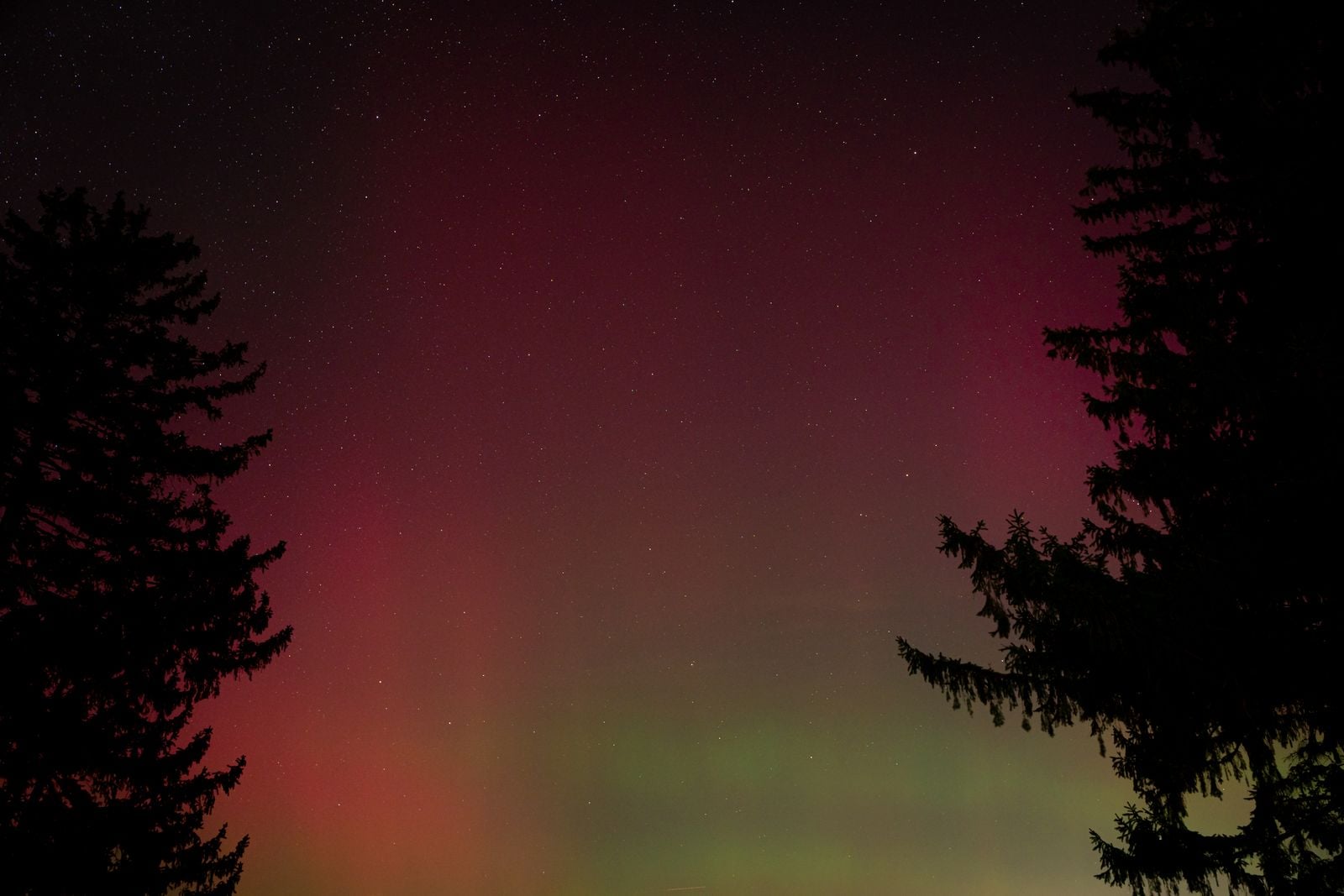
On the night of September 1, 1859, telegraph operators from Boston to Bombay watched their equipment come alive without a battery attached. Sparks jumped from keys. Paper tape caught fire on the desks. Two operators in Portland, Maine and Boston, Massachusetts disconnected their power supplies entirely and kept relaying messages for two hours using only the current the sky was pushing into their wires.
The aurora that lit up that week had already been seen from Havana, from Panama, from Queensland, from Santiago. Miners in the Rocky Mountains woke up and started cooking breakfast, convinced dawn had come. Ships’ logs in the equatorial Pacific recorded skies the color of blood.
The storm is now called the Carrington Event, after the English amateur astronomer Richard Carrington, who happened to be sketching sunspots at his private observatory in Redhill, Surrey on the morning of September 1 when he saw two brilliant patches of white light flash across the sunspot group he was drawing. The flash lasted about five minutes. Seventeen hours and forty minutes later, the Earth’s magnetic field rang like a bell.

What Carrington actually saw
Carrington’s projection apparatus was throwing an image of the Sun onto a screen about eleven inches across. The sunspot cluster he was mapping that morning had already been visible for days and was large enough to see with the naked eye through smoked glass. At 11:18 a.m. GMT, two crescent-shaped patches of intensely bright light appeared inside the group, moved across the spots for about five minutes, and faded.
He ran to fetch someone else to confirm what he was seeing. By the time he returned, the flash had shrunk to two dim pinpricks. A second astronomer, Richard Hodgson, was observing independently from his own home in Highgate and saw the same event. Their side-by-side reports, published together in the Monthly Notices of the Royal Astronomical Society, were the first recorded observation of a solar flare.
Neither man had any way of knowing what they had just witnessed. Nobody in 1859 had a working theory of how the Sun could reach out and touch a compass needle in London. That connection would take another century of physics to nail down.
The night the wires talked back
The geomagnetic storm arrived in two waves. The first, on August 28, pushed auroras as far south as Havana and Panama City. The second, triggered by Carrington’s flare, hit on the evening of September 1 and continued through September 2. This was the bigger one. Auroras were reported from Colombia, from the Caribbean, from Hawaii, from central Mexico — latitudes where the northern lights are, in any ordinary century, physically impossible to see.
The telegraph network, then about fifteen years old and the closest thing the nineteenth century had to global infrastructure, went haywire. Operators across North America and Europe reported the same sequence: sparks arcing from the keys, insulation smoldering, batteries so overwhelmed by induced current that they were producing the wrong polarity. An operator in Washington, D.C. received a shock strong enough to stun him after he leaned toward a grounded wire while working the line to Richmond.
Then came the strangest part. On the morning of September 2, an operator in Boston and a colleague in Portland reportedly held a roughly two-hour exchange with their local batteries physically disconnected, using nothing but the current the storm was feeding directly into the copper. The widely reprinted transcript, first carried by the Boston Traveler and later collected in the American Journal of Science, opens with the Boston operator asking his counterpart to “cut off your battery entirely from the line for fifteen minutes”; the Portland operator reported that reception was actually steadier without it. They then worked the wire normally for about two hours, powered by the aurora alone.
Why the sky can push a current through a wire
The mechanism was worked out slowly over the following century, and it is the same mechanism that keeps power-grid engineers awake at night today. A coronal mass ejection — a cloud of magnetised plasma weighing billions of tonnes — slams into Earth’s magnetosphere and compresses it. The magnetic field around the planet begins to twitch, sometimes violently, over the course of minutes.
A rapidly changing magnetic field induces an electric field in whatever conducts electricity nearby. In 1859 that meant iron rails and single-wire telegraph lines strung across continents. In 2026 it means high-voltage transmission networks, pipelines, undersea cables, and railway signalling circuits. The physics is described in the Nature Portfolio summary of geomagnetically induced currents, which notes that these quasi-direct currents flow through transformer neutrals and earthing systems, riding alongside the alternating current the grid was designed to carry.
When the induced DC gets large enough, transformers go into what engineers call half-cycle saturation. The core stops behaving linearly, harmonics spike, reactive power losses climb, and in the worst cases the transformer itself overheats and fails. A big transformer is a custom-built object the size of a small house. Replacements can take a year to a year and a half to manufacture.
The 1989 rehearsal
The clearest modern preview of what a Carrington-scale event does to industrialised infrastructure came on March 13, 1989. A geomagnetic storm — smaller than 1859, but severe — collapsed the Hydro-Québec transmission grid in ninety seconds. Six million people lost power for nine hours in the middle of a Canadian March. Transformers at a New Jersey nuclear plant were permanently damaged. The same storm week disrupted power in Malmö, Sweden, and the reference to it appears in recent Lancaster University research on how solar storms could affect UK rail signalling.
The Lancaster team, led by PhD researcher Cameron Patterson and Professor Jim Wild, modelled the Preston-to-Lancaster stretch of the West Coast Main Line and the Glasgow-to-Edinburgh route. They found that geomagnetically induced currents can flip railway signals in either direction. The dangerous case — the one they call “wrong side” failure — turns a red signal green. According to Patterson, space weather can cause railway signals to switch in either direction, potentially creating dangerous situations where red signals turn green. Patterson noted that this poses significant safety concerns.
Their modelling suggests wrong-side failures could be triggered by geomagnetic storms of the kind expected every one or two decades. A Carrington-scale storm, they estimate, would cause widespread signalling malfunctions across both routes studied.
How big was Carrington, actually
Geomagnetic storms are graded by their disturbance-storm-time index, or Dst, which measures how much the horizontal component of Earth’s magnetic field is suppressed by the ring current around the planet. The March 1989 Quebec storm hit a Dst of about -589 nanoteslas. Reconstructions of the Carrington Event, based on ice-core nitrate deposits and preserved magnetogram traces from the Colaba Observatory in Bombay, put its Dst somewhere between -850 and -1,760 nT.
The 17-hour, 40-minute travel time from the flare to Earth also matters. A typical coronal mass ejection takes two to four days to cross the 93 million miles between Sun and Earth. Carrington’s ejecta made the trip in under a day, which means it was moving at close to 2,000 kilometres per second. It plowed through a solar wind that had already been cleared out by the earlier August 28 event, so nothing slowed it down.
Recent samples of Greenland and Antarctic ice show a spike in beryllium-10 and nitrate isotopes deposited in 1859, consistent with a burst of high-energy protons hitting the upper atmosphere. Similar spikes appear in tree-ring records for the year 774 AD and 993 AD, which appear to represent solar events even larger than Carrington. Those are called Miyake events, after the Japanese researcher who identified the carbon-14 signature.
What happens if it hits us now
A 2013 report from Lloyd’s of London and the US Atmospheric and Environmental Research team estimated that a Carrington-class storm striking the modern North American grid could leave 20 to 40 million people without power for anywhere from sixteen days to two years, with economic damages between $600 billion and $2.6 trillion. The wide range reflects how much depends on which transformers fail and how quickly replacements can be built.
The mitigation toolkit has grown. Grid operators now have series capacitors, neutral blocking devices, and real-time monitoring platforms that couple space-weather forecasts to grid analytics. NOAA’s Space Weather Prediction Center in Boulder issues alerts. The European Space Agency’s Vigil mission, scheduled to launch later this decade, will park a spacecraft at the L5 Lagrange point to give roughly four to five days of advance warning on incoming coronal mass ejections.
Even solar power itself is not immune to weather from the star it depends on, though the current risks are more terrestrial. The 2026 Solar Risk Assessment from kWh Analytics again flags hail, fire, and stowing methods as leading operational hazards for US solar projects; its previous edition found that hail alone accounted for 73% of financial losses despite representing only 6% of loss incidents.
Speculative engineering proposals for protecting the grid have started to appear as well. One recent write-up in Hackaday describes an “orbital stormwall” concept — a shielding constellation designed to blunt an incoming coronal mass ejection before it reaches the magnetosphere. Whether such a system is physically or economically feasible is another matter.
The odds nobody agrees on
Estimates of how often a Carrington-scale storm hits Earth vary by an order of magnitude depending on which paper you read. A 2012 analysis by physicist Pete Riley in the journal Space Weather put the probability of a Carrington-class event striking Earth in the next decade at about 12%. Later reanalyses have argued that figure is too high; others say it is too low. The honest answer is that with only one confirmed event of this magnitude in the era of electrical infrastructure, the statistics are thin.
One data point is suggestive. In July 2012, a coronal mass ejection at least as powerful as the 1859 event blasted off the far side of the Sun and swept across Earth’s orbital path. Earth was on the other side of the Sun at the time and missed it by about nine days of orbital motion. NASA’s STEREO-A spacecraft, which the ejecta did hit, measured a solar wind speed of over 2,000 kilometres per second and magnetic field intensities consistent with reconstructed Carrington values.
If Earth had been in the wrong place that week, roughly the year after Fukushima and the year of the London Olympics, the modern grid would have had its first real test. Estimates published afterward suggested it might have taken four to ten years to fully recover.
The last honest witnesses
The people who watched the September 1859 storm did so without knowing what a magnetosphere was, without understanding that the Sun could throw plasma, without any concept of an ionosphere or a Van Allen belt. Diaries from Colorado gold miners describe skies so bright they read newspapers by aurora light at one in the morning. A ship’s log from off the coast of Chile records “the whole heavens” appearing to be on fire. In Cuba, an observer in Havana wrote that the sky glowed a deep crimson from horizon to zenith.
The telegraph operators in Portland and Boston, sitting at desks that had briefly become the receiving ends of a planetary-scale antenna, kept working. They kept tapping. Somewhere in the archives of a nineteenth-century American Journal of Science volume, there is a short account of two men holding a conversation in Morse code through a copper wire that was, for those two hours, plugged directly into the Sun.
