The first clue was a ring of dead trees. Then another, and another. From the air, the canopy of the Malheur National Forest in eastern Oregon showed circular openings where Douglas-fir and grand fir had browned and toppled, the kind of pattern foresters had long catalogued as Armillaria root disease. The assumption was that each ring marked its own outbreak. A team from the US Department of Agriculture Forest Service, working the Blue Mountains of northeastern Oregon, decided to test that assumption.
What they found was not a scattering of separate infections. It was the visible bruising of one enormous body underneath.
The organism is a honey fungus, Armillaria ostoyae. It covers roughly 9.65 square kilometres, about 2,385 acres, or 1,600 football fields. At its widest point it stretches 3,810 metres from edge to edge. Most of it lives underground as a webbing of black, shoelace-like cords called rhizomorphs, threaded through soil and tree roots. It is one organism. It started from a single microscopic spore. And depending on which growth rate scientists use to calculate it, it has been alive somewhere between 2,400 and 8,650 years.
How a fungus this big stays hidden
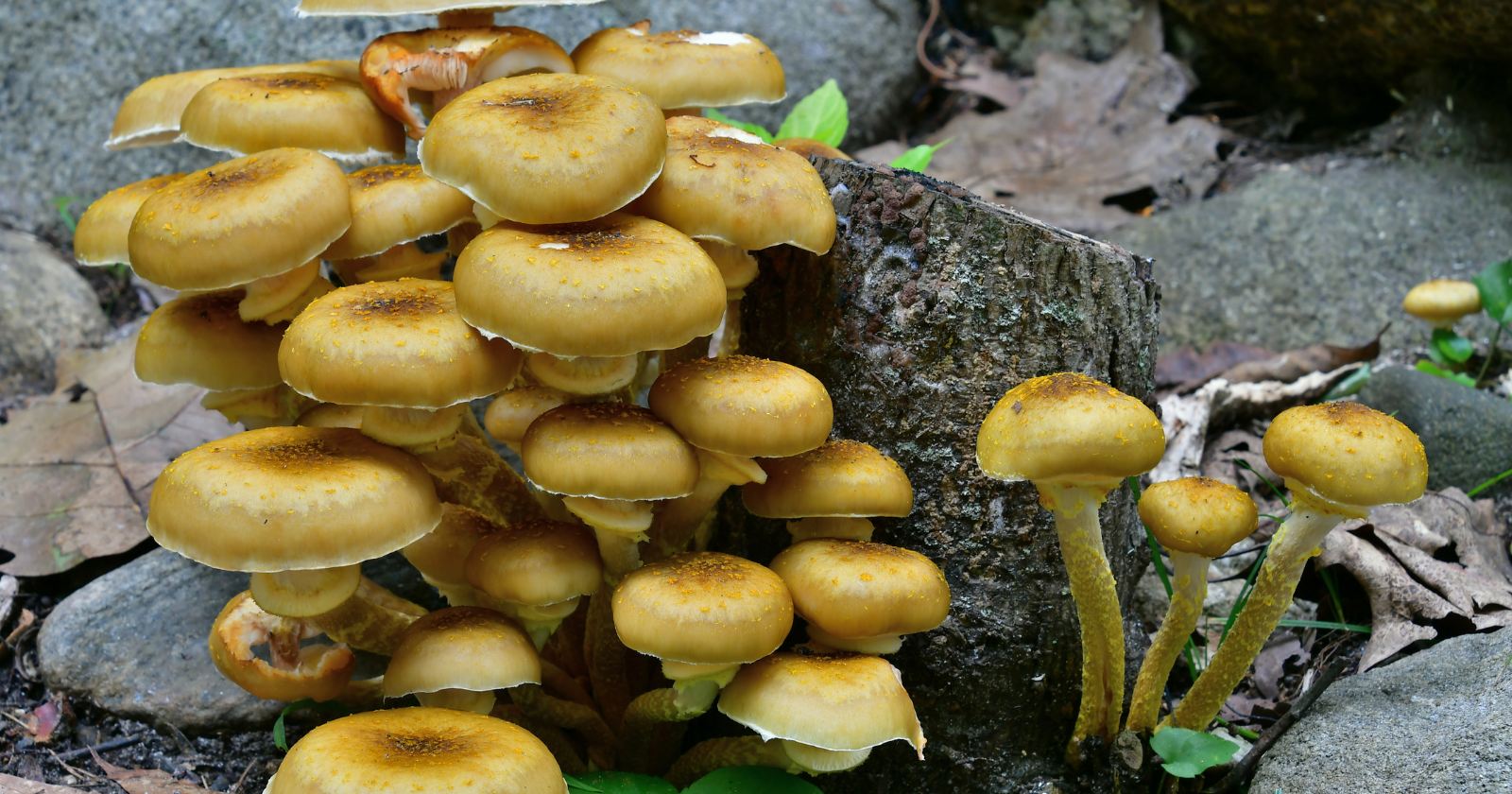
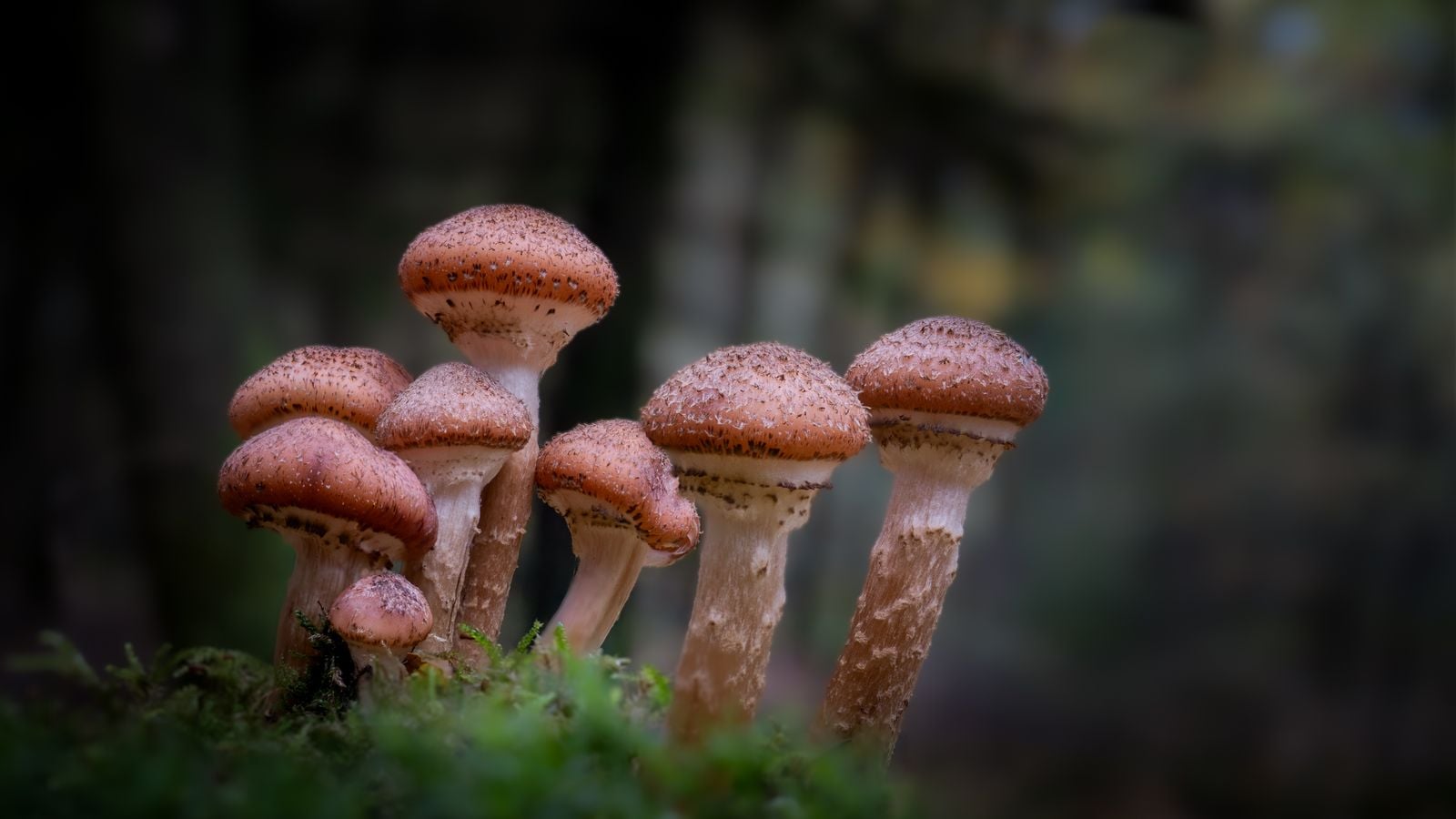
A honey fungus does not look like much from above. In autumn it sends up small, caramel-coloured mushrooms with pale gills, and most hikers walk past them without a second glance. The mushrooms are only the fruiting bodies, the part that releases spores. The actual organism is the mycelium, a fine, branching mat of filaments, plus the tougher rhizomorphs that creep through the soil like dark twine searching for new roots. When a rhizomorph touches a susceptible conifer, it slips under the bark at the root collar, kills the cambium, and starts feeding on the wood. The tree weakens, browns, and dies, often in clusters. From above you see a ring of dead Douglas-fir or grand fir. Below, the fungus has simply extended its territory by a few more metres.
The Oregon giant lives in the Strawberry Mountain area of the Malheur, in mixed-conifer forest shaped by fire, logging, insects, and disease. The fungus has likely been growing there for at least 1,900 years, and possibly as long as 8,650, depending on assumed rates of radial expansion.
Proving it was one organism
The harder problem was proving the patches belonged to a single individual. The method was elegant and old-fashioned. Researchers collected fungal material from infected trees across the landscape and grew the isolates together in Petri dishes. When two samples came from the same genetic individual, they fused. When they came from different individuals, they recognised each other as foreign and formed a dark boundary line. The technique exploits the fungus’ own ability to tell self from non-self. Molecular identification confirmed what the pairings suggested.
Six fungal genets, meaning genetic individuals, turned up in the study area. Five were Armillaria ostoyae. One of them, called genet C, dwarfed the rest at roughly 965 hectares. Genet A covered about 2.60 square kilometres. Genet E covered about 1.95. Genet B, about 0.95. Even the runners-up were enormous by any biological standard.
If you could take away the soil and look at it, it’s just one big heap of fungus with all of these filaments that go out under the surface.
What 35,000 tons of fungus actually weighs
The 35,000-ton estimate comes from extrapolating the density of mycelium and rhizomorphs across the mapped area and depth. For comparison, a fully fuelled Boeing 747-400 weighs about 400 tons at take-off. The Oregon fungus weighs roughly the same as 87 of them. It is heavier than the Eiffel Tower, which comes in at around 10,100 tons of iron. And unlike the tower, it is still growing.
It grows slowly. Rhizomorphs extend at perhaps a metre per year in good conditions, less in dry soil. That is why the age estimate is so wide. If the Blue Mountains soil supports fast growth, the fungus is roughly 2,400 years old, alive when the Parthenon was being built. If it grew slowly, it has been there for 8,650 years, which would mean it predates the invention of writing, the wheel, and almost every domesticated crop.
Why so few fungal neighbours
Honey fungi in wetter forests tend to form many small genets, packed close together. The Blue Mountains showed the opposite pattern. Population density was very low, but the individuals that established themselves spread across vast territories. The team suggested that dry conifer forests allow fewer founding spores to take hold, but those that do face less competition and can expand for centuries without bumping into a rival.
That has a strange consequence. A single genet can produce several distinct mortality centres, with apparently healthy forest between them. Trees that look fine on the surface may carry latent infections in their roots, waiting for stress, whether drought, beetle attack, or a logging operation, to give the fungus an opening.
The ancient pathogen problem
Armillaria root disease causes significant annual growth loss and mortality across western North America and southern Canada. The fungus is a major economic pest of conifers. The Oregon discovery complicated the way foresters had been thinking about it.
For years, the prevailing view was that modern fire suppression had let Armillaria spread by disrupting a natural cycle that once kept it in check. The Oregon fungus is older than modern fire policy. It is older than any human influence on regional fire regimes. Because this fungus is thousands of years old, and grew long before fire systems were influenced by man, the timeline does not fit. It also means that fire does not naturally control this disease.
Human management did make the damage more visible, though. Selective harvesting, fire suppression, and grazing shifted eastern Oregon forests away from western larch and ponderosa pine, which resist the fungus, toward Douglas-fir and grand fir, which do not. The fungus had been there the whole time. The forest just started giving it more vulnerable hosts.
What counts as an individual
The Oregon find forced a small revision in biology textbooks. It is one organism that began as a microscopic spore and then grew vegetatively, like a plant. From a broad scientific view, it challenges what we think of as an individual organism.
The study offered new insights into how forests work, and caused scientists to rethink fundamental ideas like, what is an individual, and what is a species.
By area, the Oregon Armillaria is the largest known individual organism on Earth. By mass, the title is contested by Pando, a quaking aspen clone in Utah where every tree shares one root system. Pando weighs roughly 6,000 tons and covers 43 hectares. Smaller in footprint than the Oregon fungus, lighter by a factor of nearly six, but visible above ground in a way the fungus will never be.
Fungi as quiet engineers
Fungi reshape the world more than most people realise. They break down lignin in dead wood. They form mycorrhizal partnerships with the vast majority of plant species. They invented antibiotics. And a few of them have started doing things nobody expected. Marine microbiologists at the Royal Netherlands Institute for Sea Research recently identified a sea fungus, Parengyodontium album, that can break down polyethylene floating in the North Pacific, provided the plastic has first been weathered by sunlight.
The team measured the breakdown rate at about 0.05 per cent per day. The work was described as scientifically outstanding because the team could quantify the process for the first time. The fungus joins only four marine species known to digest plastic. As researchers told reporters, they expect many more such species are hiding in deeper water, doing the same work unobserved. The discovery matters because humans now produce more than 400 billion kilograms of plastic a year, and some 80 million kilograms already sit trapped in the North Pacific Subtropical Gyre.
Fungi are not always benevolent. Silicon Canals has covered other organisms that quietly hijack their hosts, and the honey fungus belongs to the same broad category of slow, methodical biological takeover, only at a scale that swallows entire ridgelines.
Living next to it
The land above genet C is open to the public. It is part of the Malheur National Forest, and hikers walk over it without knowing. In autumn, after rain, the small honey-coloured mushrooms come up in clusters at the base of dying firs. The mushrooms are edible after thorough cooking, though foragers are advised to be cautious because they cause stomach upset in some people. Pull one up and you can sometimes see a black rhizomorph trailing from the base, the actual organism announcing itself for a moment before disappearing back into the duff.
There is no easy way to kill it. Management should aim to reduce impact rather than eliminate the fungus, which would be like trying to remove granite. Cutting an infected tree often makes things worse. After you cut an infected tree, the entire root system can be colonized by the fungus, which then increases the disease potential around that area. The recommendation is to plant resistant species, such as western larch, western white pine, and ponderosa pine, and accept that the fungus will keep doing what it has done since before the pyramids.
An organism with no clear ending
So what does the Oregon fungus actually prove? It has survived ice ages, indigenous fire regimes, the arrival of European settlers, two centuries of logging, and a century of fire suppression. By any measure of persistence, it is a success. By the measure most biologists reach for first, reproductive output and genetic diversity, it is less obvious. One spore, one genome, thousands of years of slow vegetative expansion in a forest type that may itself be a recent accident of human management.
Is that evolutionary triumph, or an evolutionary deadlock that simply has not been challenged yet? Does size mean the organism has solved something, or only that nothing has come along to stop it? The honey fungus does not answer. It keeps extending another metre a year under the Strawberry range, touching another healthy root, beginning the next century of work. The question is left to whoever stands above it.