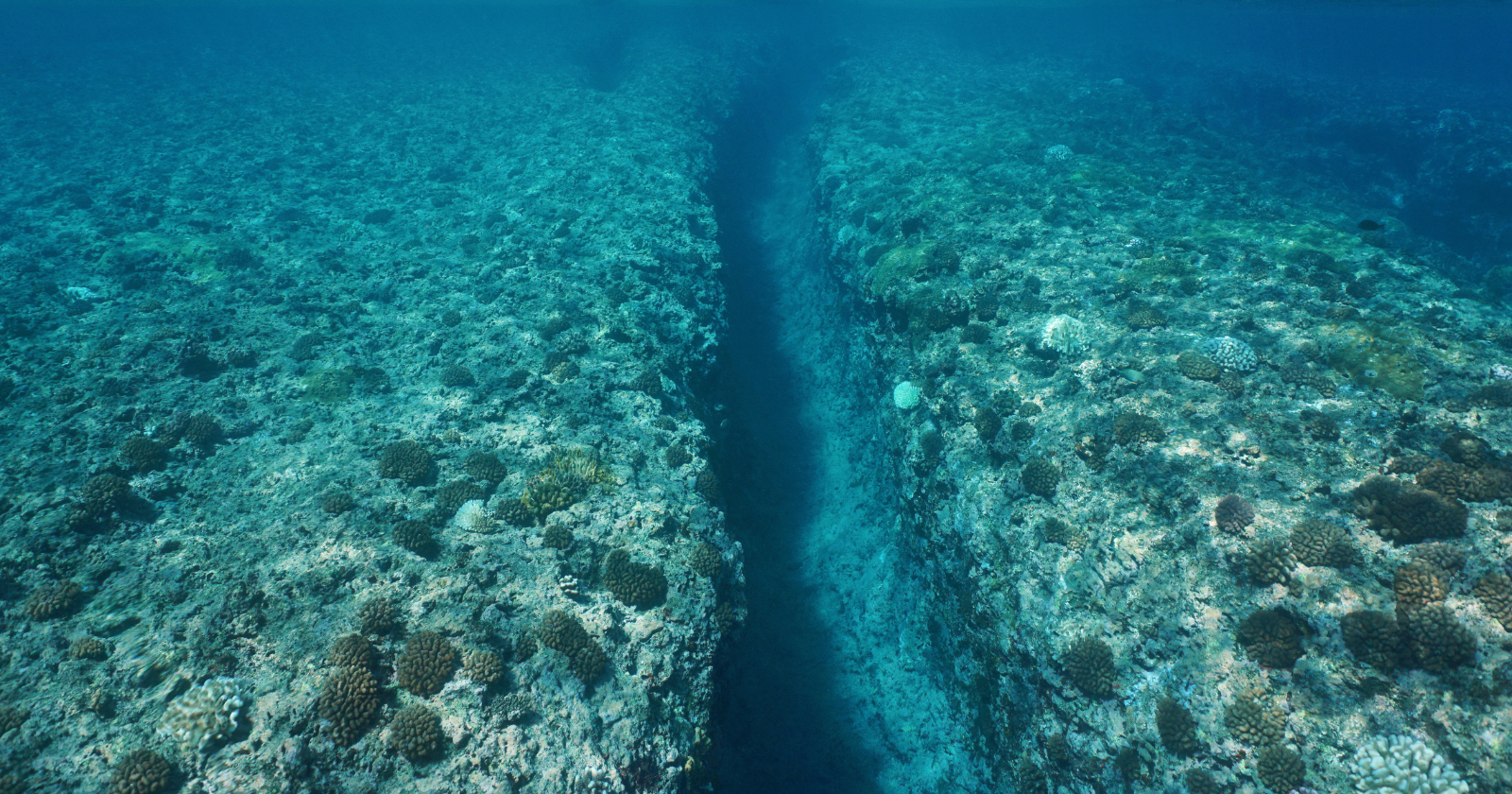
The Mariana snailfish, Pseudoliparis swirei, lives in a part of the Pacific where pressure stops being an abstraction. At nearly 8,000 metres down in the Mariana Trench, the water above it presses with hundreds of times the atmospheric pressure felt at sea level. A submarine built around an air-filled human compartment would fail catastrophically without extraordinary engineering. The snailfish, by contrast, moves through that pressure as its normal world.
That is partly because the fish is not fighting the ocean with a rigid shell. It is a soft, pale, translucent animal with no gas-filled swim bladder to collapse. Its body is mostly water, and the pressure inside its tissues balances the pressure outside them. The more difficult problem is not keeping its outline intact. It is keeping its cells working.
The species was formally described in 2017 from 37 individuals collected in the Mariana Trench at depths of 6,898 to 7,966 metres, in what the authors described as the deepest benthic capture of a vertebrate with corroborated depth data. The fish was named Pseudoliparis swirei, and it quickly became one of the clearest examples of how far a vertebrate body can be pushed without ceasing to function.
The pressure problem
Pressure at 8,000 metres is roughly 800 times atmospheric pressure at sea level. Put another way, every square centimetre of the fish experiences a force comparable to hundreds of kilograms pressing on it. That would be lethal to an animal with trapped air spaces or rigid cavities that could not equalise with the surrounding water. The physics is unforgiving: gases compress, liquids barely move, and any sealed cavity becomes a structural weakness the moment the surrounding water decides to press inward. For a human diver, the lungs would collapse long before this depth. For a rigid submersible, the hull has to be engineered with materials and geometries that resist crushing forces measured in tonnes per square metre. Even small design flaws become catastrophic. The snailfish sidesteps all of this by refusing to play the same game.
The Mariana snailfish avoids that problem by being built more like a pressure-balanced organism than a pressure-resistant machine. It carries no air-filled swim bladder. Its tissues are watery. Its skeleton is light and incomplete. Instead of trying to keep the deep ocean out, its body lets pressure pass through it.
That solves the gross structural problem. It does not solve the molecular one. Hydrostatic pressure can interfere with protein folding, enzyme function, and the behaviour of cell membranes. A vertebrate at hadal depth has to keep its biological machinery stable in conditions that push molecules out of their normal shapes.
A skeleton that never fully hardens
One of the clearest adaptations is visible in the bones. A 2019 paper in Nature Ecology & Evolution described the Mariana snailfish as having transparent skin, thin and incompletely ossified bones, an inflated stomach, and a non-closed skull. In the deep sea, those are not defects. They are part of the design.
A closed, heavily mineralised skull is useful near the surface, where rigid bone protects the brain and supports powerful movement. In the hadal zone, rigidity can become a liability. The Nature paper reported that the skull of the Mariana snailfish is not completely closed, allowing internal and external pressure to equalise, and that much of its skeleton remains cartilaginous rather than fully ossified.
The same study linked that reduced bone hardness to a frameshift mutation in bglap, the gene for bone Gla protein, which is involved in tissue mineralisation and skeletal development. In plain English, one reason the fish survives the trench is that its skeleton never finishes hardening in the way a shallow-water fish skeleton usually does.
The trade-off is obvious. The Mariana snailfish is not a fast, armoured predator. It is a soft-bodied animal built for a world where speed matters less than pressure tolerance, energy conservation, and the ability to feed on small crustaceans in darkness.
TMAO: the molecule that helps proteins hold their shape
The title molecule in this story is trimethylamine N-oxide, or TMAO.
It is a small organic compound found in marine animals, and in deep-sea fishes it becomes especially important because it helps stabilise proteins under pressure. The Nature paper explains that TMAO accumulation is one physiological mechanism deep-sea organisms use to preserve protein function at elevated hydrostatic pressure. It also notes that TMAO abundance in teleost fishes increases with depth, with deep-caught species having significantly higher levels across tissues than shallow species.
That matters because proteins are shape-dependent machines. If pressure distorts them, they can stop binding, folding, signalling, or catalysing reactions properly. TMAO helps counter that effect by favouring the folded, functional state of proteins in a high-pressure environment.
The Mariana snailfish appears to have genetic support for that chemistry. The 2019 genome analysis found changes involving the TMAO-generating enzyme flavin monooxygenase 3, or fmo3, and suggested those changes may help the species increase intracellular TMAO levels to enhance protein stability.
Membranes that stay fluid under pressure
Pressure does not only threaten proteins. It also affects membranes, the fatty barriers that separate the inside of a cell from the outside and control what passes through. At high pressure, membranes can become less fluid, making transport and signalling harder.
The Mariana snailfish genome points to a solution here as well. The Nature study found expansions in gene families associated with fatty acid metabolism. It also noted that membranes of deep-sea-adapted organisms tend to contain higher proportions of unsaturated fatty acids than comparable membranes in shallow-sea species.
Unsaturated fats have bends in their molecular chains. Those bends keep lipids from packing too tightly together. For a fish living under enormous pressure, that looseness helps preserve the membrane flexibility needed for transport proteins, ion channels, and basic cell housekeeping.
The same genome analysis also found signals of adaptation in genes linked to ion transport, transmembrane transport, calcium ion transport, ATP binding, and other functions tied to keeping cells stable under pressure. The picture is not one magic trait. It is a suite of small changes working together.
A fish built for darkness
The Mariana snailfish also lives without sunlight. At these depths, there is no day, no season of light, and no visual horizon. The fish is pale and nearly translucent, and the genome study found losses in genes involved in pigmentation and vision.
That does not mean the animal is inert or helpless. The 2019 paper reported that collected specimens had enlarged stomachs and livers, thin muscles, and incompletely ossified skeletons. It also described one specimen whose stomach contained 98 crustaceans, most of them the hadal amphipod Hirondellea gigas.
The Mariana snailfish is therefore not merely surviving at the edge of vertebrate possibility. In parts of the trench, it is feeding successfully. It appears to occupy a high position in a food web that would seem, from the surface, almost impossible for a fish to enter.
What newer snailfish discoveries add
The story of the Mariana snailfish is part of a larger pattern. Snailfishes belong to the family Liparidae, a remarkably flexible group whose members range from shallow habitats to hadal trenches. In 2025, researchers at MBARI, SUNY Geneseo, the University of Montana, and the University of Hawaiʻi at Mānoa described three new species of deep-sea snailfish from offshore California.
One of them, the bumpy snailfish, was observed by MBARI’s remotely operated vehicle at 3,268 metres in Monterey Canyon. The work was led by SUNY Geneseo researcher Mackenzie Gerringer and collaborators, and it reinforced how little of deep-sea fish diversity has actually been catalogued.
Those California species do not live as deep as Pseudoliparis swirei. But they show the same broader family tendency: soft bodies, loose skin, unusual forms, and adaptations to cold, dark, high-pressure habitats. The Mariana snailfish is the extreme end of a much larger evolutionary experiment.
Where the genes point
Deep-sea biology is increasingly becoming a genetics story. A 2026 report on a global deep-sea genetic survey described more than 500 million unique genes and 2.4 million predicted protein structures from more than 2,100 deep-sea samples. The sites included hadal trenches, hydrothermal vents, methane seeps, and other extreme environments.
That does not mean those genes all belong to snailfish. Many come from microbes and other organisms. But it does place the Mariana snailfish in the right context: the deep ocean is not simply a dark empty place with a few strange animals. It is a vast archive of biochemical solutions to pressure, cold, darkness, and scarcity.
Some of those solutions may eventually matter beyond marine biology. Proteins that function under high pressure or near-freezing temperatures are of obvious interest to biotechnology. The deep sea has spent millions of years testing molecular designs that laboratories are only beginning to notice.
The edge of vertebrate life
There may be a depth limit for fish. Researchers have argued that as depth increases, the amount of TMAO required to stabilise proteins eventually creates an osmotic ceiling: intracellular TMAO concentrations climb with depth, and modelling suggests fish tissues would reach isosmotic conditions with seawater somewhere around 8,200 metres. Beyond that point, no further TMAO can be added without breaking the fish’s internal salt balance.
The numbers line up with what has been observed. Pseudoliparis swirei was captured between 6,898 and 7,966 metres. The deepest snailfish ever filmed, an unidentified Pseudoliparis recorded in the Izu-Ogasawara Trench off Japan, was seen at 8,336 metres — within a few hundred metres of the predicted biochemical ceiling. One specimen’s stomach held 98 crustaceans. The genome shows a frameshift in bglap, changes in fmo3, expansions in fatty acid metabolism genes, and losses across pigmentation and vision pathways.
Taken together, the figures sketch a narrow operating window: roughly 800 atmospheres of pressure, near-freezing water, no light, and a TMAO budget that runs out somewhere just past eight kilometres down. The Mariana snailfish lives inside that window, and so far, nothing with a backbone has been confirmed living below it.