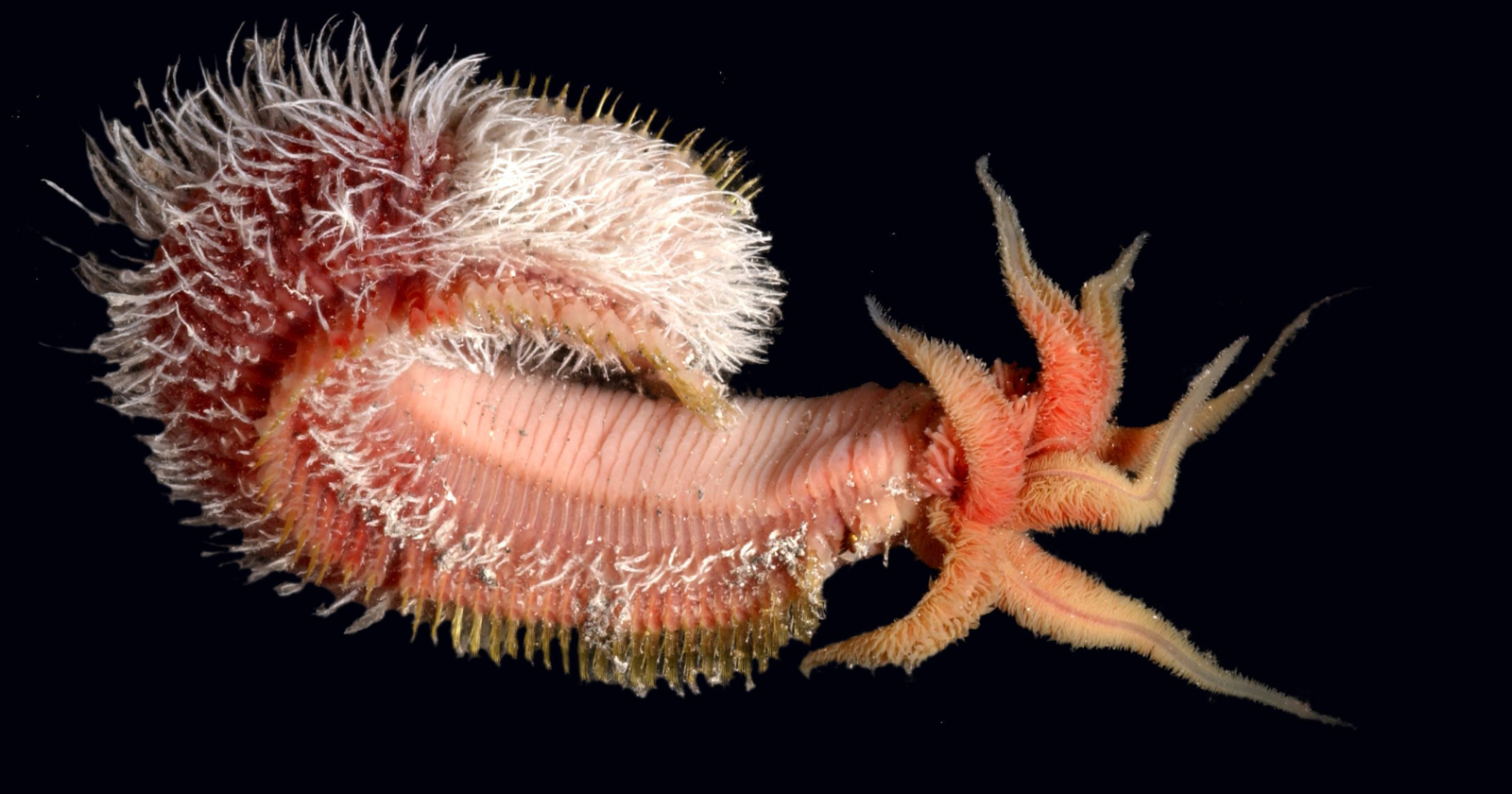
The Pompeii worm, Alvinella pompejana, builds papery tubes on the black mineral chimneys of deep-sea hydrothermal vents in the eastern Pacific and lives with its rear end pressed against rock heated to high temperatures while its feathery red gills wave in much cooler seawater. The distance between the two ends of the animal is only about ten centimetres. Few if any other animals known to science tolerate such a steep thermal gradient across their bodies.
The worm grows to about thirteen centimetres long. It is covered, from the neck down, in a thick grey fleece of filamentous bacteria that resembles felted wool. Biologists have long debated what that fleece is for. The leading hypothesis is the strangest: the bacteria may be insulating the worm from the chimney it sits on.

The chimneys it calls home
Hydrothermal vents form where seawater seeps through cracks in the volcanic seafloor at mid-ocean ridges, meets magma a few kilometres down, and shoots back up loaded with dissolved sulphide, iron, and other reduced chemicals. When that scalding fluid hits cold seawater, the minerals precipitate into porous spires that grow several metres tall. Alvinella pompejana colonises the outer walls of these spires along the East Pacific Rise, the same volcanically active ridge running parallel to South America’s west coast where researchers from the Royal Netherlands Institute for Sea Research recently chiselled through lava plates to find tubeworms living inside the crust itself.
The chimneys are not stable. They grow, crack, and topple. Fluid temperatures inside them can exceed 300°C. The worm builds its tube on the outer skin of the chimney, where the wall material is still warm but not glowing, and orients its body so that the tail end sits deepest in the heat.
That tail end is what makes the species famous.
80°C at the back, 22°C at the front
The temperature differential has been measured directly in occupied tubes on the East Pacific Rise. The back of the tube can register 60 to 80°C, with brief spikes higher. The opening, where the worm’s gills extend into ambient seawater, sits at much cooler temperatures around 20 to 22°C. That is a gradient of roughly 60 degrees across ten centimetres of animal. Steeper than anything else in the animal kingdom can survive.
For comparison, a human stops functioning at a core temperature above about 42°C. Most marine invertebrates die above 40°C. The thermophilic record holders among bacteria thrive at 80°C and above, but they are single cells. Alvinella pompejana is a complex metazoan with a circulatory system, a nervous system, and reproductive organs, and it spends its entire adult life with one half of its body sitting at a temperature that would denature most animal proteins in minutes.
How it does this is still not fully understood. The worm appears to have biochemical adaptations including unusually stable structural proteins and enzymes that function across wider temperature ranges than those in cold-water relatives. None of these explanations alone accounts for the gradient, and the answer probably involves something the worm wears rather than something it is made of.
The bacterial fleece
Run a gloved finger down the back of a Pompeii worm and it feels like wet felt. The covering is a dense mat of filamentous epsilonproteobacteria, each filament a few micrometres thick, anchored to the worm’s dorsal surface by tiny outgrowths of the cuticle. The mat can be a centimetre thick on a large adult. The bacteria are chemolithoautotrophs, drawing energy from the sulphide and other reduced compounds in vent fluid and building biomass from dissolved carbon dioxide.
This is similar in principle to the symbiosis that sustains giant tubeworms like Riftia pachyptila, which house their gammaproteobacterial symbiont Candidatus Endoriftia persephone inside a specialised internal organ called the trophosome and have lost their mouths and guts entirely. Alvinella pompejana still eats. It grazes the bacteria off its own back and supplements the diet with detritus, but the symbionts cover it externally rather than living inside it.
The functional question is why the fleece sits on the dorsal surface, exactly where the worm’s body is most exposed to the heat of the chimney wall. One answer is that the bacteria need the heat: they are thermophiles, and the chimney delivers their preferred temperature. Another answer is the one biologists have been trying to test. The fleece may be a living insulating blanket.

A blanket of microbes
Wet bacterial mat is a poor conductor of heat compared with worm tissue. A centimetre-thick layer of it across the back of the animal would substantially reduce the rate at which heat flows from the chimney into the body. Thermal modeling suggests the mat could keep the worm’s internal tissues several degrees cooler than the rock surface it rests against. The mat may also pull heat-stable metabolites and sulphide-detoxifying compounds into the close skin layer, doing chemical work as well as thermal.
The arrangement is mutualistic. The worm gives the bacteria a substrate, a steady supply of vent fluid pulled past their filaments by its ventilation movements, and protection from grazers. The bacteria give the worm a thermal buffer, possibly detoxify sulphide before it reaches the worm’s skin, and serve as a renewable food source. The system works only because the chimney keeps producing the reduced chemicals the bacteria require, which means the worm cannot leave.
Tied to a vent that can vanish overnight
Vents are temporary. The East Pacific Rise has experienced volcanic eruptions that paved over existing vent fields with fresh lava, forcing the entire animal community to recolonise from somewhere else. Alvinella pompejana is among the first large animals to appear on new chimneys, often within months of an eruption, which is part of why biologists have long puzzled over how its larvae find the next vent.
That puzzle deepened recently. A team led by marine biologist Sabine Gollner of the Royal Netherlands Institute for Sea Research used the remotely operated vehicle SuBastian to chisel through the basalt crust at a site called Fava Flow Suburbs on the East Pacific Rise at 2,515 metres depth and lift entire lava shelves to reveal fluid-filled cavities underneath. Inside those cavities, ten centimetres or so beneath the visible seafloor, were live adult tubeworms, including Riftia pachyptila up to 50 centimetres long, with mature gonads, growing in the dark. Gollner said the discovery showed that the unique hydrothermal vent ecosystem extends into the ocean’s crust, suggesting larvae may travel between vents through the porous rock rather than the open water column.
Pompeii worms have not yet been described from those subsurface cavities, but the discovery rewrites the geography in which their life cycle plays out. The chimneys they sit on are connected, by cracks and channels, to a much larger plumbing system.
What heat tolerance buys the worm
The thermal gradient is not an inconvenience the worm endures. It is the niche. By tolerating temperatures lethal to its competitors, Alvinella pompejana claims the hottest, most chemically rich real estate on the chimney, the part closest to where vent fluid emerges. Nothing else can sit there. The worm gets first access to the sulphide its bacteria need, and it gets it without having to fight anyone for the spot.
This pattern, where the extreme environment is the prize rather than the obstacle, is the basic logic of extremophile life everywhere from Antarctic dry valleys to acid hot springs. Lists of organisms that defy the odds in extreme conditions tend to focus on microbes. The bacteria that grow at 122°C in deep-sea sediments, the archaea in the boiling pools of Yellowstone, the lichens that survive vacuum exposure on the outside of the International Space Station. The Pompeii worm is unusual because it is a fully developed animal playing the same game.
The fragility of the address
Vent ecosystems take decades to assemble and can be erased in a season. A 2024 study of hydrothermal vent communities buried by volcanic ash from the 2022 Hunga eruption documented how thick ash deposits collapsed populations of the foundation chemosymbiotic molluscs at vent fields hundreds of kilometres from the volcano. Eruptions are not the only threat. Researchers studying a newly described hybrid vent–seep system off Papua New Guinea, where hot hydrothermal fluid and cool methane-rich gas bubble up from the seabed centimetres apart, have warned that the site sits within active mining exploration zones and risks being destroyed before its fauna are even catalogued.
The chimneys of the East Pacific Rise are similarly vulnerable. They have been mapped, named, and revisited by submersibles for forty years, and many of the Pompeii worm tubes filmed in the 1980s are now buried under fresh basalt or collapsed into rubble. The animals carry on. They find the next chimney, build new tubes on its outer wall, grow a new fleece of bacteria, and settle in with one end at 22°C and the other end at 80°C.
What the worm looks like, working
Footage from submersibles shows the gills first. A dozen or so red feathery plumes extend from the tube opening into cooler water, sweeping back and forth, picking up dissolved oxygen. Behind them the head is barely visible. The body inside the tube is hidden, packed in with its bacterial coat against the chimney wall, slowly grazing filaments from its own back, slowly producing eggs or sperm. The tube wall is built from proteins the worm secretes, and it acts as a second insulator between the animal and the rock.
The animal does not move much. It does not need to. The chimney delivers everything it requires: the heat that powers the bacterial chemistry, the sulphide that feeds the bacteria, the oxygen at the cooler end of its body that lets it breathe. The hottest known animal address on Earth, and the worm has set up house exactly there, wearing a coat of microbes that may be the only thing keeping it from cooking.
What the worm is teaching researchers reaches well beyond the chimney it sits on. Its heat-stable proteins are already being sequenced for clues to industrial enzymes that hold their shape at temperatures where ordinary biochemistry falls apart, and its fleece is a working model of a symbiosis that lets a complex animal occupy ground no animal should be able to occupy. That matters for astrobiology too. The icy moons of the outer solar system, Europa and Enceladus among them, are thought to harbour seafloor vents of their own beneath kilometres of ice, and the Pompeii worm is the closest thing we have to a proof of concept that animal-scale life can hold together at the edge of a magma-driven plumbing system.
The next generation of remotely operated vehicles is already being designed to sample those subsurface cavities Gollner’s team opened up, and to map the porous rock networks that link one vent field to the next. Each chimney that collapses takes a community with it, but it also leaves a richer picture of how the animal got there in the first place, and where it might be living that nobody has thought to look.