

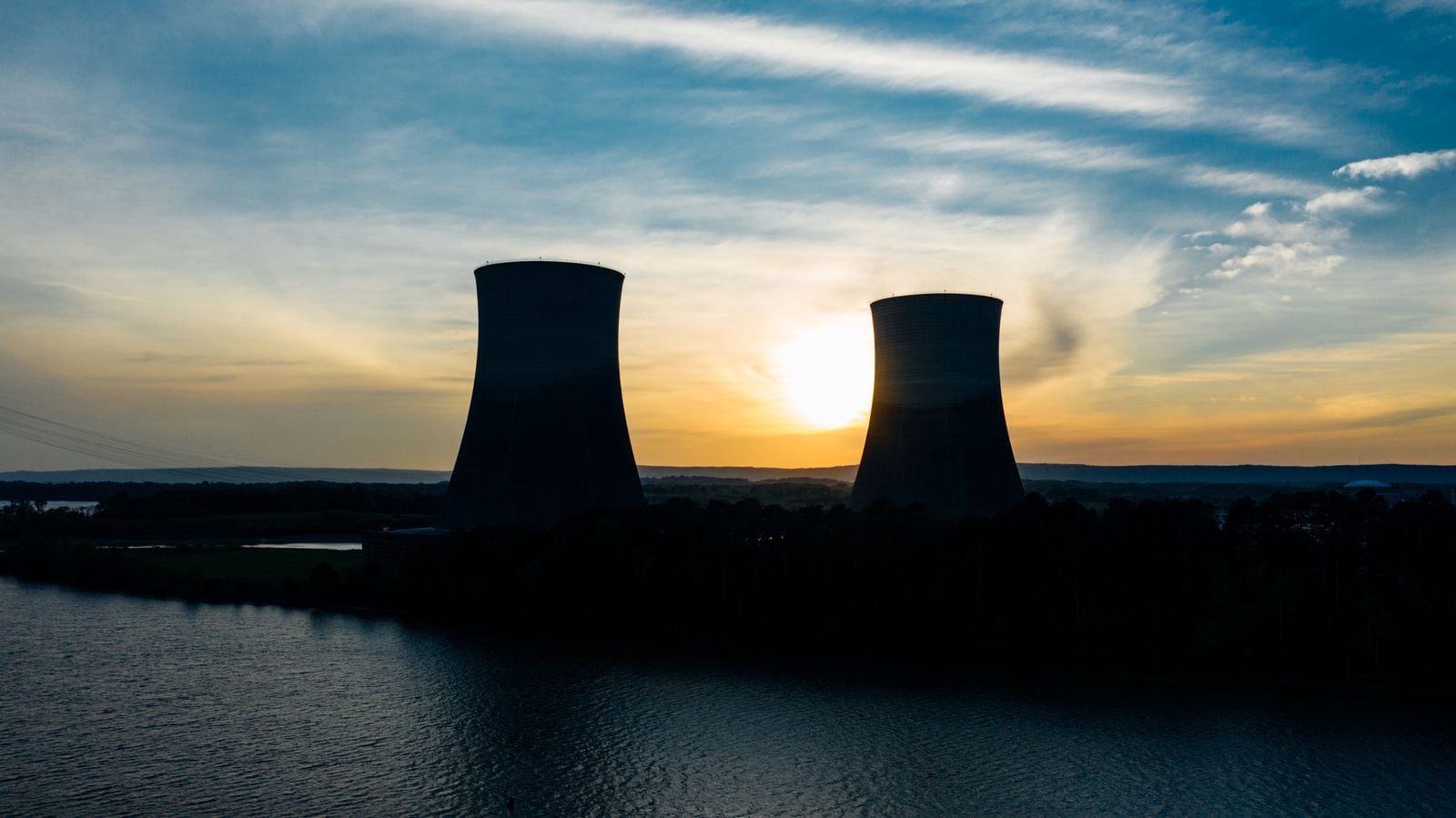
Across France, Spain, Germany and Poland this week, control room operators are watching two graphs at once: the air temperature outside, and the temperature of the river water flowing past their nuclear plants. When one climbs, the other follows, and when the river climbs too high, the reactor has to throttle back or shut down entirely. That is what happened at Golfech in southern France this week, and it is happening more often than utilities prepared for.
The conventional story about climate change and electricity is that demand will rise as people run more air conditioning. That part is true. What gets less attention is the other side of the equation: the supply side is breaking down in the same heat that drives the demand.
Heat does not just stress the grid by making people switch on cooling. It physically degrades the machines that produce the electricity.
The Golfech shutdown and what it signals
On 23 June, France recorded temperatures above 44°C. Just before midnight the previous day, unit two at the Golfech nuclear plant in the southwest was taken offline. The Garonne River, which the plant uses for cooling, had reached temperatures above the regulatory ceiling for the temperature of water the plant is allowed to return to the river.
The regulation exists to protect aquatic ecosystems downstream. Fish and invertebrates cannot survive sustained warm-water discharge. But the rule has a perverse second-order effect during heatwaves: the hotter the weather, the less margin the plant has, and the more likely it is to be cut back exactly when the grid needs it most.
Golfech was not an isolated case. It was a preview.
The 2025 precedent that nobody filed away
Last summer’s heatwave gave Europe a working dress rehearsal for what 2026 is now repeating. Nuclear facilities across France experienced various forms of capacity reduction during that period.
Several gigawatts of French nuclear capacity were forced offline during the peak of the July 2025 heatwave by the transmission system operator. That is more generation than Ireland’s entire grid runs on. When the planned reductions tied directly to the heatwave are included, the impact represented a significant portion of France’s nuclear fleet, sidelined at the moment cooling demand was setting records.
The plants along the Garonne, Loire and Rhône rivers were hit hardest. These are not coastal stations with the open sea to draw from. They depend on inland water that warms quickly and runs low in drought, and 2026 is shaping up the same way.
Three forms of generation, three different failure modes
Nuclear gets most of the headlines because the shutdowns are dramatic and the numbers are large. But the heat is squeezing every form of thermal and hydraulic generation Europe runs on.
Hydropower depends on water that is not there. In the first five months of 2025, European hydropower output fell compared with the prior year, driven by low reservoir levels and reduced river flow. Reservoirs that should be feeding turbines through summer are sitting below operating levels by April.
Gas plants lose efficiency as ambient air temperature rises. Combined-cycle turbines are rated at specific intake conditions, and every degree above that rating means less power out the back end. UK gas plants reported reduced output during the recent heat, taking capacity off the system at the moment demand was climbing.
Coal plants face the same cooling-water constraints as nuclear, though with smaller absolute volumes. Poland, which still leans heavily on coal, spent the last several years installing remedial measures specifically because cooling failures during summer heat have become a recurring problem.
The demand side is doubling on a faster clock than anyone modelled
The demand response to heat is changing too, and not in a way that matches old assumptions about European energy use. The continent has historically had low air-conditioning penetration compared to the United States or Asia. That is no longer true.
The number of UK households running air conditioning has increased substantially in recent years. UK summers were until recently mild enough that cooling was a luxury. Now it is becoming infrastructure.
The International Energy Agency expects global energy use for cooling to double by 2050 relative to 2023 levels. That curve is not a smooth doubling. It is concentrated in summer afternoons and evenings, and concentrated geographically in the regions getting hit by the worst heat. During the 2025 heatwave, peak electricity demand jumped substantially in France and Spain compared with baseline levels a week earlier. These are not marginal shifts a grid can absorb with spinning reserve.
What the price signals revealed
Electricity prices are the cleanest indicator of where a grid is stressed, and the prices during last year’s peak were extraordinary. Compared with normal days before the heatwave, average daily prices climbed sharply across Spain, Poland, France, and Germany.
During the evening peak on 1 July 2025, prices in Germany and Poland exceeded levels rarely seen outside of crisis conditions. Reporting from The Guardian shows similar patterns repeating this week.
The shape of the price spike matters as much as the height. Prices are crashing low in the middle of the day, when solar floods the grid, and spiking in the evening, when the sun goes down but the apartments still need cooling. The daily price spread in some markets was extreme. That is a market screaming for storage.
Where the solar story complicates the picture
Heatwaves come with sunshine, and Europe has a lot more solar than it did even three years ago. June 2025 saw record-breaking EU solar generation, up substantially from June 2024.
During the peak of last year’s heatwave, German solar was delivering large amounts of power at midday, supplying a substantial percentage of the country’s electricity. That output partially offset the thermal generation forced offline. The problem is timing. Solar peaks at noon. Cooling demand peaks in the late afternoon and evening, when offices are still warm and apartments are heating up after the sun has loaded thermal mass into walls and ceilings.
Germany has substantial battery storage and pumped hydro capacity to bridge that gap. It is not enough. The arbitrage opportunity created by midday solar abundance and evening scarcity is exactly what storage developers have been pricing into business models. Belgium-based LIFEPOWR recently raised €5.6M to expand virtual power plant technology that aggregates distributed batteries and flexible loads, precisely the kind of asset utility planners are now urgently shopping for.
What utilities are being asked to spend
EDF has indicated that upgrades to its plants and cooling systems will require substantial investment over the next 15 years.
That is just one company in one country, addressing only the cooling-side problem.
The wider economic damage is already larger. Extreme weather cost the European economy tens of billions of euros in 2023 alone. Power-system-specific damages over the next decade are expected to reach billions of euros annually, though specific projections vary.
Senior analysts at European think tanks have outlined the menu of responses utilities need to pursue: planning for summer peaks, making cooling demand more flexible, reinforcing grids for high temperatures, deploying batteries and demand response, and climate-proofing power plant cooling systems. None of these are cheap. None can be deferred much longer.
The nuclear question gets harder, not easier
Europe’s electricity strategy has been quietly leaning back toward nuclear as a low-carbon firm-capacity solution. France is extending reactor lifetimes. The UK is building Hinkley Point C and approving Sizewell C. Sweden and the Netherlands are reopening conversations they closed a decade ago.
The cooling-water problem complicates this strategy in ways that planners are only starting to model honestly. A reactor that has to derate for six weeks every summer is a different financial asset than one running at 90% capacity factor year-round. The economics of new builds depend on assumed lifetime output, and that assumption is now a function of climate projections rather than equipment reliability. The river-temperature ceiling at Golfech was not written with a 44°C heat dome in mind, and the regulation has not been revisited even as the climate it was calibrated against has shifted. Every summer the discharge limits hold, a reactor sits derated. Every summer they are relaxed, the downstream ecosystem absorbs the cost. There is no version of this trade-off that is free, and the bodies responsible for setting the limits sit in different ministries from the ones responsible for keeping the lights on. That institutional gap is where the next crisis will live.
Next-generation reactor designs may help. Silicon Canals covered the US approval of TerraPower’s sodium-cooled reactor, which uses liquid sodium rather than water as primary coolant and is less sensitive to ambient water temperature for heat rejection. Whether such designs reach commercial scale in time to matter for the 2030s is the open question.
Grid topology is becoming the binding constraint
The 2025 heatwave revealed something else: interconnection between national grids matters more during weather extremes than during normal operation. The heat dome moved across Europe in a sequence, peaking in Madrid on Sunday, Paris on Tuesday, Berlin and Warsaw on Wednesday. Interconnectors moved electricity ahead of the wave, smoothing price peaks that would otherwise have been catastrophic in individual markets.
Spain and Portugal, isolated from the rest of Europe by limited cross-Pyrenees capacity, have been pushing for more interconnection since the major Iberian blackout earlier in 2025. The heatwave reinforced that case. A grid that cannot import power during a local crisis has no fallback when its own plants are derating.
Italy provides the other cautionary tale. On 1 July 2025, parts of Italy lost power in outages that operators attributed to the overheating of cables. The physical infrastructure carrying the electricity is itself temperature-rated, and underground cables in particular shed heat poorly when surrounding soil is already warm.
What the next decade of summer planning looks like
European grid operators are moving, though not as fast as the weather. The Polish transmission operator PSE published an anti-blackout package on 2 July 2025, calling for real-time visibility into distributed energy resources, wider adoption of dynamic electricity tariffs, and stronger participation of generators in balancing markets.
The UK National Energy System Operator has been running the Distributed ReStart project, exploring how wind and solar could be used to restart the grid after a blackout using grid-forming inverters that can energise a network without an external voltage reference. Belgium’s TSO Elia is testing similar grid-forming asset models.
These projects share a recognition that the old playbook, large synchronous thermal plants providing inertia, voltage support and reserve, is becoming less reliable in summer, just as the underlying weather makes that reliability matter more. The replacement playbook is distributed, software-coordinated and built around storage.
The uncomfortable arithmetic
The arithmetic for utilities is brutal. Demand is rising during the exact hours when supply is most constrained. Cooling penetration in northern Europe is doubling on a five-year clock that was supposed to be a thirty-year clock. The plants that provide firm capacity are derating during the very heatwaves that drive demand peaks.
Solar production is record-breaking, but timing-misaligned. Storage helps, but Europe does not have nearly enough of it yet. Interconnection helps, but only when neighbouring grids are not simultaneously stressed, and continental heat domes by definition stress everyone at once.
The investment required for one utility just to keep existing plants viable does not include new generation, new storage, new transmission, or new demand-response infrastructure. The total bill, spread across European utilities and ratepayers, will be far larger.
Who pays, and for what
So the question Europe has been avoiding now has to be answered out loud. When the Garonne is too warm and Golfech has to choose between breaching a discharge limit and dropping a gigawatt off the grid at peak demand, somebody bears the cost. If the regulation holds, ratepayers pay through scarcity pricing and industry pays through curtailment. If the regulation bends, the river ecosystem pays, and the political constituency that built the protection in the first place loses faith in the institutions that wrote it.
There is no third option that the current rulebook permits. Pretending otherwise is how grids fail. So which constituency is Europe prepared to disappoint first: the fish, the factories, or the households running their air conditioning through a 44°C night?
