

What the IMF did not say on Wednesday matters as much as what it did. The Fund cut its 2026 global growth forecast to 3 percent, blamed the war on Iran, and moved on. Missing from the release: any acknowledgement that the assumption underpinning the entire projection — that the Strait of Hormuz begins reopening in mid-July and returns to a pre-war state by March — is already being contradicted by the missiles landing while the report was being printed. The word “assumes” is doing an extraordinary amount of work in this document. Strip it out, and the forecast collapses.
The headline number is a 0.1 percentage point cut, from 3.1 percent to 3 percent, the second downgrade of the year. That looks small. It is not. Behind it sits an inflation forecast that jumps to 4.7 percent for 2026, up from 4.1 percent in 2025, and a shipping lane running at roughly a third of its pre-war throughput. The Fund is asking the world to believe that a chokepoint carrying a fifth of global oil and LNG trade will unclench itself on a schedule dictated by a spreadsheet in Washington. Markets, by Wednesday morning, were pricing something different.
The forecast the IMF actually published, and the one hiding underneath it
The Fund’s Wednesday release describes two forces pulling against each other: an energy shock from the Middle East on one side, and an AI-driven investment boom on the other. The IMF’s research department framed it as a global outlook being shaped by two powerful forces pulling in opposite directions, adding that the IMF’s references to recent developments illustrating the risks were not diplomatic throat-clearing but represented a hedge.
Translated: the model was already out of date by the time it was presented. The US had renewed strikes on Iran on Tuesday after attacks on commercial ships in the Strait of Hormuz. A second round of bombing hit on Wednesday. The White House indicated the ceasefire was effectively over. The Fund’s central scenario, in which shipping in the strait normalises within eight months, was built on the diplomatic ground that shifted underneath it in the hours around publication.
The technical mechanism is worth naming. IMF World Economic Outlook updates are locked several days before release. The macro model that produced the 3 percent figure was almost certainly calibrated to a scenario in which the Trump-brokered memorandum of understanding with Tehran held. It did not. Anyone reading the report on Wednesday was reading a forecast whose central assumption had already been falsified.
Hormuz at a third of capacity is the story
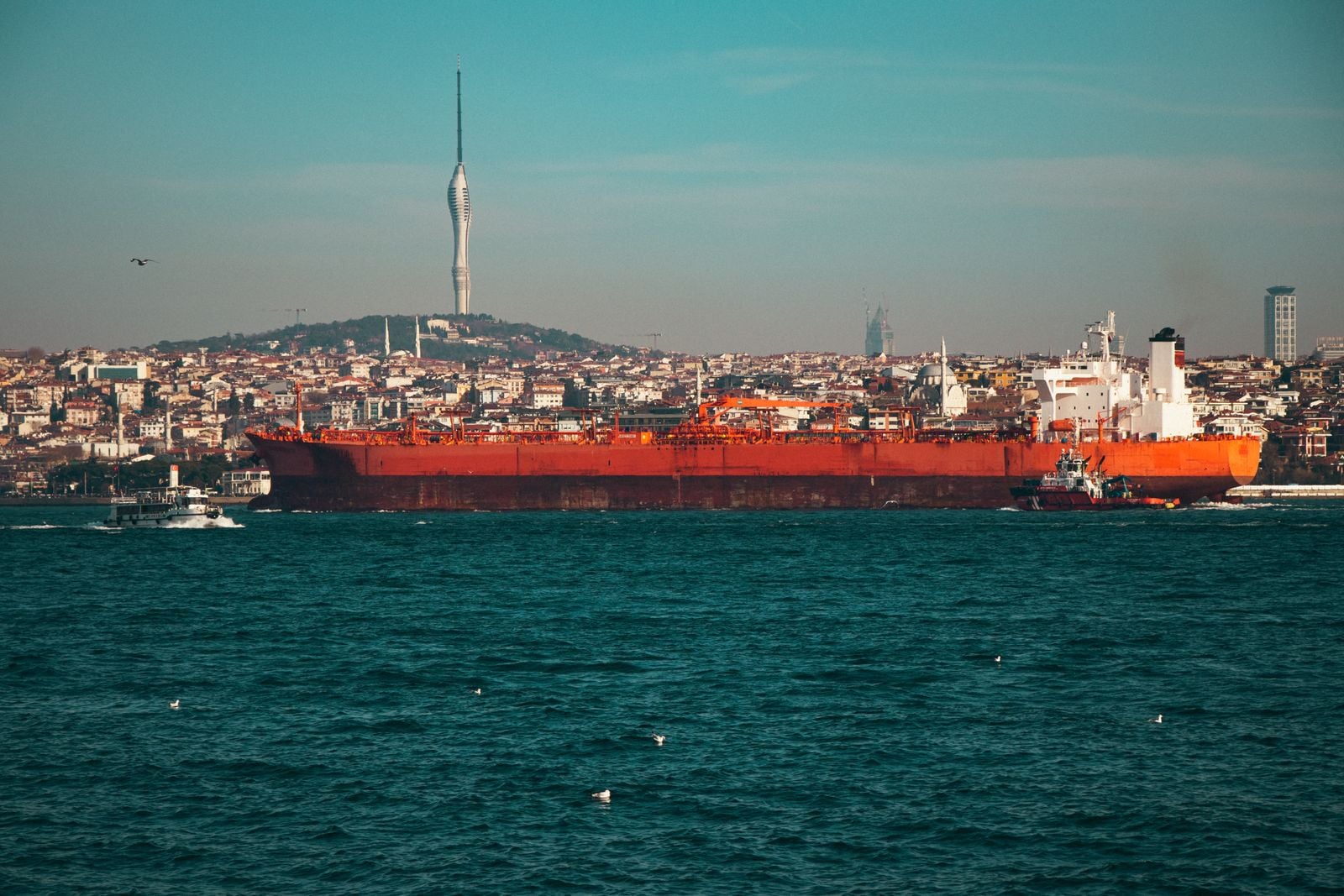
The single most important number in the entire release is not the growth cut. It is 41. That is the number of verified transits through the Strait of Hormuz on Tuesday. The pre-war baseline is roughly 130 daily crossings. The strait is running at 32 percent of capacity, and has been for weeks.
Roughly one-fifth of the global trade in oil and liquefied natural gas flows through that waterway. A 68 percent decline in throughput is not a supply disruption in the conventional sense. It is a structural rewiring of how energy moves from producers in the Gulf to buyers in Asia and Europe. Every tanker that does not sail forces a substitution: Brazilian crude to a Korean refiner, Norwegian gas to a German utility, US LNG to a Japanese trader who used to buy Qatari cargoes. Those substitutions cost money. They ripple through fertiliser plants, aluminium smelters, and container ships whose bunkers were priced against a different world.
Silicon Canals has already examined why this oil shock differs structurally from 2022: the US Strategic Petroleum Reserve has been drawn down, the Fed has less policy room, and the buffer stocks that absorbed the last shock are thinner. The IMF forecast implicitly assumes those buffers can be rebuilt on the same timeline as the strait reopens. Neither is guaranteed.
The oil price is telling a different story than the model
Brent crude jumped as much as 7 percent on Wednesday, at one point topping $79 a barrel. Brent futures for September delivery stood at $78.76 as of 02:30 GMT, up nearly $8 from the same time the previous week. Market analysts observed that oil’s earlier return to pre-war levels had shown markets leaning on a best-case outcome for the US-Iran arrangement, despite it resting on little more than a high-level MOU.
This week’s re-escalation is a reminder of how fragile that assumption was, and how quickly sentiment can turn when it’s tested. That is the sentence the IMF forecast does not contain, and cannot contain, because a multilateral institution cannot publish a projection that admits its central assumption is a coin flip.
The forward curve now embeds a risk premium that was not there a week ago. Traders are not pricing a return to $60 crude. They are pricing a range in which every headline out of the Pentagon or Tehran can move the front-month contract by three or four dollars in either direction. That volatility is its own tax. Airlines, shippers, chemical producers, and utilities all have to hedge more aggressively, and hedging costs money that eventually shows up in the price of a plane ticket or a bag of urea.
The second-order effects the growth number cannot capture
The energy shock spreads beyond the pump. US diesel prices had risen about 50 percent year-on-year, jet fuel had doubled since the start of the war, and roughly a third of global urea trade — a solid nitrogen fertiliser critical to US corn production — passes through the Middle East. About 20 percent of US imported fertiliser comes specifically from Qatar, whose Ras Laffan complex was forced to halt production after Iranian attacks.
Analysts have distinguished between first-order effects (higher pump prices) and second-order effects (crop prices, semiconductor inputs, medical devices). Eventually these increases work their way through the supply chains, and if they get large enough, they get passed through to consumers.
The IMF’s 4.7 percent inflation forecast is trying to encode all of that in a single number. It is almost certainly too low if the Hormuz assumption breaks. Helium, used in MRI machines and semiconductor fabrication, is bottlenecked by the same Qatari facility. Airlines have indicated that jet fuel prices doubling would significantly impact operating costs. Those cost passes-through have a lag. They are not fully in the CPI yet.
The AI investment boom is a real offset, and a fragile one
The other force in the IMF’s framing — the technology-driven investment boom — is doing genuine work in the forecast. Capex on data centres, chip fabs, and AI infrastructure has been the single biggest source of upside surprise in the US growth data for eighteen months. The Fund expects the US to grow 2.3 percent in 2026, the fastest among major advanced economies, compared with 0.9 percent for the Eurozone, 1 percent for the UK, 1.1 percent for Canada, and 0.6 percent for Japan. China, still classed as emerging, is forecast at 4.6 percent.
That US number is almost entirely a story about corporate investment in AI compute, and it has become the load-bearing wall of the global forecast. If hyperscaler capex slows — because rates stay higher for longer, because power constraints bite, because the returns on generative AI disappoint — the offset that keeps the global number at 3 percent disappears. And there is a specific geopolitical wire crossing here that the IMF release does not touch. Iran’s Islamic Revolutionary Guard Corps declared US hyperscaler data centres military targets earlier in the conflict, and the doctrinal implications of that declaration have not gone away just because Wall Street stopped pricing them.
The Fund is, in effect, betting that the AI capex cycle continues in the same physical facilities that a state actor has publicly named as legitimate wartime targets. That is not an incoherent bet. It is, however, a bet.
Why the UK looks better than it should
One curious detail of this week’s outlook was the treatment of the UK. The Guardian reported on Tuesday that the IMF had upgraded its UK growth forecast as fears over the impact of the Iran war diminished. That report was filed on 8 July. The Fund’s own downgrade of the global number, citing the same war, was released on 9 July. Between those two dates, the US struck Iran twice and the administration indicated the ceasefire was over.
The whiplash is instructive. It shows how thin the diplomatic assumptions embedded in these forecasts really are. A twenty-four hour swing in Washington’s posture is enough to flip the sign on a growth projection for a G7 economy. The UK upgrade may well survive the week — the country’s exposure to Hormuz is indirect and its services-heavy economy is less sensitive to diesel prices than Germany’s or Italy’s — but the fact that both stories can be true within the same 48-hour window says everything about the precision the IMF is claiming.
The inflation forecast is the pressure valve
Global inflation at 4.7 percent for 2026, easing to 3.9 percent in 2027, is the number central bankers will spend the summer arguing about. It is high enough to keep the Federal Reserve, the ECB, and the Bank of England from cutting aggressively. It is not so high that it forces hikes. It is, in other words, the number that justifies doing nothing for another quarter — the number that keeps mortgage rates elevated, keeps corporate borrowing costs sticky, and keeps the marginal capex decision harder to greenlight.
Middle East uncertainty has contributed to central banks leaving rates unchanged, which in turn has kept mortgage rates elevated. That dynamic has not gone away. Every week the strait stays constricted is another week the term premium on long-dated Treasuries stays elevated, and another week the housing market cannot find its footing.
A 4.7 percent inflation forecast also assumes wages do not chase. That assumption held in 2022 and 2023 because labour markets, though tight, did not produce a sustained wage-price spiral. It may not hold indefinitely if energy costs remain elevated for another year and food prices catch up with the fertiliser shock still working through the corn belt.
What a 3 percent global growth number actually buys you
Three percent is not a recession. It is below the 2024-25 average of 3.5 percent but well above the 2 percent threshold that development economists sometimes use to define a global downturn. The Fund’s forecast is, in one reading, a triumph of shock absorption: a shooting war involving one of the world’s major oil producers, a 68 percent reduction in the throughput of the world’s most important energy chokepoint, and the global economy still grows.
That reading is not wrong. It is incomplete. The 3 percent number is a weighted average that hides enormous divergence. The US at 2.3 percent, buoyed by AI capex, is a different economy than Japan at 0.6 percent or the Eurozone at 0.9 percent. Emerging markets that import energy — India, Turkey, much of Southeast Asia — are absorbing the shock in ways the aggregate does not surface. A 3 percent global print composed of a strong US and a stagnant Europe is a different political economy than a 3 percent print with balanced growth. The former produces the currency dislocations, capital flow reversals, and trade frictions that tend to produce the next crisis.
The forecast that matters is the one released in October
The July update is a placeholder. The full World Economic Outlook lands in October, and by then the Hormuz assumption will either have been vindicated or shredded. If shipping in the strait has genuinely returned to something near pre-war levels by autumn, the 3 percent number holds and the AI capex story dominates the narrative. If the strait is still running at a third of capacity, or worse, the October update will contain a much larger downgrade, a higher inflation path, and language that the Fund is currently choosing not to use.
The line about developments overnight illustrating the risks was not diplomatic throat-clearing. It was a hedge.
