Correction, 17 September 2026: an earlier version of this article said that Jerry Ehman died in 2025. He is alive. We apologise to Dr Ehman and to our readers for the error.
Jerry Ehman was working through a stack of green-and-white tractor-feed printouts from a radio telescope called Big Ear. He was an unpaid volunteer at the time, a former Ohio State professor helping with the university’s SETI survey. On August 15, 1977, the telescope had swept across a patch of sky in the constellation Sagittarius and recorded something the survey had been waiting years to see. Ehman saw the vertical column of numbers, 6EQUJ5, circled the sequence in red ballpoint, and wrote a single word in the margin: Wow!
The printout still exists. It is now in the Ohio History Connection archives, with the red ink slightly faded, the word still legible, the signal still unexplained.
The telescope built out of a parking lot
Big Ear was not pretty. It was a flat ground-plane reflector roughly the size of three football fields, built on land owned by Ohio Wesleyan University and assembled partly from leftover materials. Astronomer John Kraus designed it in the late 1950s as a low-cost way to do high-sensitivity radio astronomy. By the early 1970s, after completing the Ohio Sky Survey, Kraus turned the instrument toward a SETI project that would run for decades.
The telescope had no motors to track the sky. Earth’s rotation did the work. A source crossed Big Ear’s beam in about 72 seconds at the declination Ehman was scanning, and the signal would rise smoothly, peak, and fall as the sky drifted past. That shape, a clean rise and fall over roughly 72 seconds, is the fingerprint of something genuinely up there, not interference from a passing car or a satellite or a stray reflection off a microwave oven.
That is exactly what the August 15 signal did.
What 6EQUJ5 actually means
The cryptic string was not a code. It was a compressed way of printing signal strength. Big Ear’s computer measured intensity above background noise in 12-second chunks and printed a single character per chunk. Numbers 1 through 9 were the lowest tier. Once a signal got too strong for a single digit, the printer switched to letters. A was 10, B was 11, on up. U was 30.
U was off the chart. It meant the signal was roughly 30 times louder than the background hiss of empty space at that frequency. Ehman, scanning a thick fanfold of normal noise, would have been seeing 1s and 2s and the occasional 3 for hours.
Then this: a quiet 6, jumping to E (14), then Q (26), then U (30), then dropping back through J (19) to 5. A perfectly Gaussian rise and fall. The exact shape Big Ear was designed to detect from a point source in deep space.
And the frequency was the one SETI researchers had been listening for since 1959, when Cornell physicists Giuseppe Cocconi and Philip Morrison suggested in Nature that an intelligent civilization would broadcast near the 1420 MHz hydrogen line, the natural radio frequency emitted by neutral hydrogen atoms, the most abundant element in the universe. It was the obvious channel. Anyone listening for company would tune there first.
The Wow! signal sat almost exactly on that line.
Why the silence afterward was the strangest part
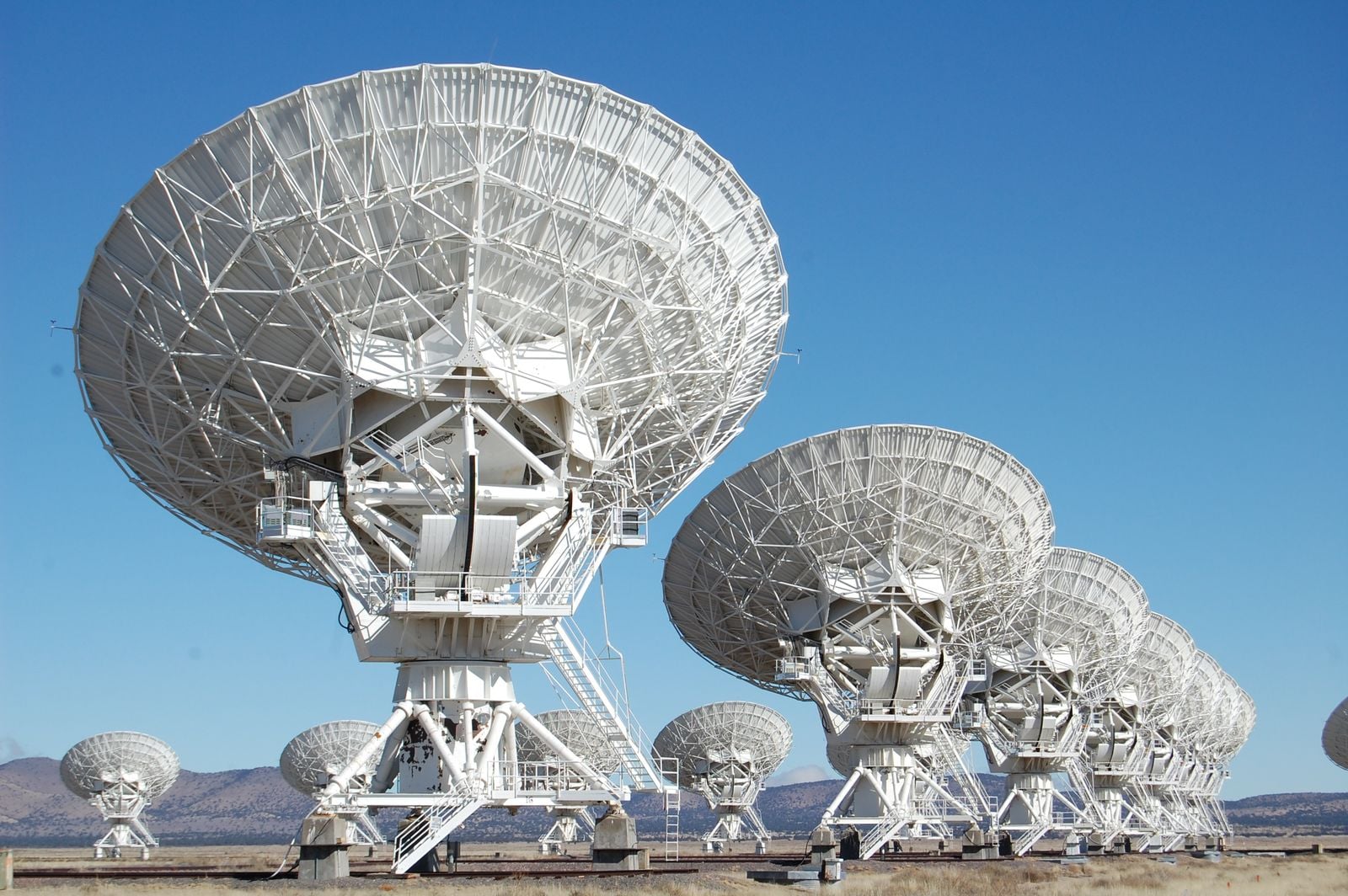
Ehman did what any astronomer would do. He kept watching. So did Big Ear’s operators for the next two decades, until the telescope was demolished in 1998 to make room for a golf course expansion. Robert Gray, an independent researcher, pointed the Very Large Array in New Mexico and other radio observatories at the same coordinates through the 1990s and into the 2000s. The Allen Telescope Array in California has looked. Nothing.
The signal appeared once, lasted 72 seconds, and never came back.
That is what makes it so hard to dismiss and so hard to confirm. A genuine cosmic source such as a pulsar, a quasar, or a flaring star tends to be repeatable. Human-made interference tends to leave fingerprints. It shows up on other instruments, or appears at predictable times, or leaks across frequencies. The Wow! signal did neither. It behaved exactly the way a deliberate, narrow-band transmission from a distant transmitter would behave if the transmitter had simply stopped, or if the beam had swept past Earth and kept going.
The candidates, in order of plausibility
Several explanations have been proposed and most have been quietly retired. The most popular for years was that a passing comet’s hydrogen cloud could have produced the signal. In 2017, astronomer Antonio Paris at St Petersburg College in Florida argued that comets 266P/Christensen and P/2008 Y2 (Gibbs) were in roughly the right area in August 1977. The astronomy community was unconvinced. Comet hydrogen clouds are diffuse and would not produce the sharp, narrow-band signal Big Ear recorded. They also would not have been silent on a second pass.
Reflected Earth signals bouncing off space debris were ruled out by Ehman himself, who pointed out that transmission at the 1420 MHz hydrogen line is internationally protected. Broadcasting on it is banned by international agreement, precisely so radio astronomers can hear what’s out there.
Stellar flares, satellite transmissions, and gravitational lensing have all been suggested. None fits cleanly. The signal remains, in the language of catalogs, unexplained.
The human pattern problem
This is where the story gets uncomfortable. The temptation to see an alien hello in 72 seconds of strong signal is enormous, and the temptation has a name. Psychologists call it apophenia, the tendency to read meaning into random data. The human brain is a pattern-recognition engine tuned to false positives. Mistaking a potential threat for nothing is far more costly than the reverse.
Faces appear in clouds, the Virgin Mary in water stains, voices in the static of an air conditioner. As one analysis of apophenia notes, the same mechanism that helps us spot real threats also makes us excellent at inventing meaning where none exists. The Wow! signal sits at exactly the spot where this becomes hard. The signal is real. The data is real. The question is what the data means.
Ehman himself was careful about this for the rest of his life. In interviews over the years, he refused to call it a confirmed extraterrestrial transmission. He called it what it was: a strong narrow-band signal from a sky direction with no known source, recorded once, by a single instrument, with no follow-up detection.
The serendipity that made it visible at all
Big Ear’s SETI program was generating thousands of pages of printouts. Ehman was reading them by hand, days after the data was recorded, as a volunteer. The signal had passed through the telescope on a Monday night. He saw it days later. If he had skipped a page, or if the noise threshold had been set slightly higher, the column would have looked unremarkable and the printout would have been filed and forgotten.
The history of science is dense with this kind of moment: the alert observer who notices the anomaly that everyone else’s eyes have slid past. These moments are not really accidents. They happen to prepared minds reading carefully, on the lookout for something they cannot quite name. As data volumes scale and pipelines automate, the kind of slow, human-eye pattern-spotting that Ehman did over a stack of fanfold paper is becoming rarer. Software flags what software is trained to flag.
It’s worth holding that against the other great accidental-attention stories in computing history. Grace Hopper’s team at Harvard pulled a moth out of a relay in 1947 and taped it into the logbook. Margaret Hamilton’s software survived the Apollo 11 landing because someone had thought about edge cases nobody had asked for. The Wow! signal is the same kind of artifact: a piece of paper that mattered because a person was paying attention.
What the coordinates point to
The signal came from a region near the star Tau Sagittarii, in the constellation Sagittarius, roughly 120 light-years away if the source was stellar. There is no known star in the exact beam position that matches the signal’s characteristics. In 2020, amateur astronomer Alberto Caballero identified a sun-like star called 2MASS 19281982-2640123 in the area, which sits about 1,800 light-years from Earth. He proposed it as a candidate target for follow-up SETI observations. So far, nothing has been heard from it.
If the signal was a transmission, and if it traveled at the speed of light, it left its source long before Big Ear was built, possibly long before radio existed on Earth. Whoever or whatever might have sent it would have no way of knowing it had ever been received. The reply, if there is one to send, would take another 1,800 years to arrive.
The printout, the golf course, the file
Big Ear is gone. The site where it stood is now part of the Methodist Theological School in Ohio’s grounds, adjacent to the golf course it was bulldozed for. Ehman, born in 1939, has spent five decades patiently telling reporters that he does not know what the signal was and does not want to guess.
So here is the harder question, the one the archived printout cannot answer. If something was transmitting at 1420 MHz in August 1977, strong enough to register at 30 times background, aimed closely enough to sweep across a single telescope in Ohio, why has nothing repeated in forty-nine years of listening? The hydrogen line is still protected. The frequency is still quiet. Dozens of instruments now scan that patch of sky with sensitivities Big Ear could not match.
Pick your conclusion. The transmitter switched off, or moved on, or never existed. A natural process we have not yet catalogued produced a once-in-a-half-century event at exactly the frequency a civilization would choose. Or the signal was real, deliberate, and meant for someone else entirely, and we caught the edge of a beam that was never aimed at us. None of these are comfortable. All of them are still on the table. That is what the silence means, and that is the part of the Wow! signal that should keep anyone honest about how thin the evidence for company in the universe actually is.